
The best shoulder cable workouts are the cable lateral raise, face pull, reverse fly, and single-arm overhead press, done for 2 to 4 sets of 8 to 20 slow reps. Cables keep tension on the deltoids through the whole rep, which is the main reason people add them to routines built on dumbbells and barbells.
This guide covers seven exercises, how to set the pulley for each one, and two full routines you can run this week. It also covers setup details most tutorials skip, like handle height, stance, and where you should feel each rep.
If your shoulders are healthy and you can press overhead without pain, everything below is fair game.
Why Cables Work So Well for Your Shoulders
A dumbbell lateral raise is hardest near the top and almost weightless at the bottom, because gravity pulls straight down and your arm lines up with it. A cable pulls along a fixed line, so the resistance changes direction with your arm. Set the pulley low, and the side delt works from the first inch of the rep.
That matters because mechanical tension is one of the main drivers of muscle growth, according to Brad Schoenfeld’s 2010 review in the Journal of Strength and Conditioning Research. Cables let you load the delts at joint angles where free weights fall short.
Cables also make small jumps easy. Many dumbbell racks climb in 5-pound steps, which is a big leap for a lateral raise, while most cable stacks let you add a plate or a half plate.
Shoulder workouts with cables are also easier to fine-tune. You can change the pulley height or your stance by a few degrees until the movement feels smooth, and the load never drops onto the joint at the bottom of a rep.
Match Each Exercise to the Right Part of the Deltoid
Your deltoid has three heads: front, side, and rear. Most lifters overwork the front through pressing and neglect the rear, so a balanced plan starts with a quick coverage check.
Side delts respond to lateral raises, upright rows, and overhead presses. Rear delts respond to face pulls and reverse flyes. Front delts get work from overhead presses and front raises, and the rotator cuff is trained by external rotations.
If your week already includes bench press and overhead press, your front delts are covered. Spend your cable sets on the side and rear heads, which is where most shoulder programs come up short.
Setup Rules for Every Cable Shoulder Exercise
Start lighter than you would with dumbbells. Cable resistance never rests at the bottom, so the same number feels heavier. Add weight only when you can finish every rep without swinging.
- Pulley height: low for lateral raises, front raises, and presses; elbow height for external rotation; upper chest to forehead for face pulls; shoulder height for reverse flys.
- Stance: feet hip-width or a split stance, ribs down, glutes lightly braced.
- Tempo: about 2 seconds up, a 1-second squeeze, and 2 to 3 seconds down.
- Range: stop when your shoulder shrugs toward your ear.
The 7 Best Shoulder Cable Workouts, Exercise by Exercise
Each move below includes setup, a rep target, and the mistake to avoid. Pick four or five for a session rather than doing all seven.
1. Cable Lateral Raise
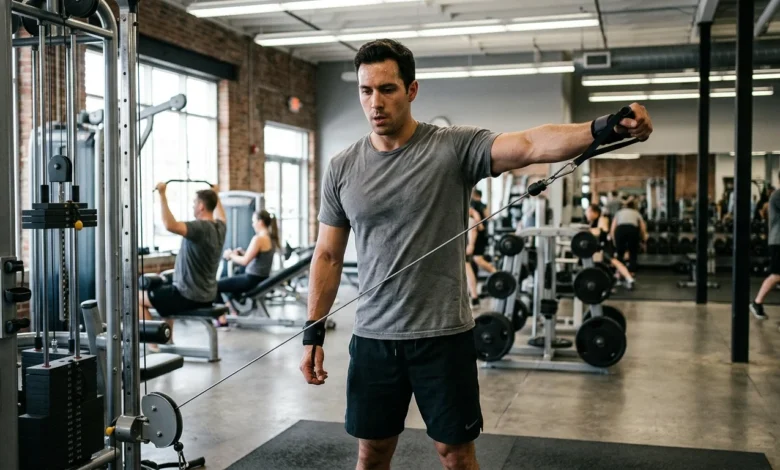
This is the go-to cable exercise for the side delts, which build shoulder width. Set the pulley at the bottom, stand sideways to the stack, and hold the handle with the hand farthest from it so the cable crosses your body.
Raise your arm out to the side until it reaches shoulder height, leading with the elbow and keeping a slight bend. Lower for two to three seconds. Do 3 to 4 sets of 12 to 20 reps per arm.
Because the cable crosses your body, the delt is loaded at the bottom of the rep, where dumbbells give almost nothing. If your traps take over, drop the weight and think about pushing the elbow out instead of lifting the hand.
2. Cable Face Pull
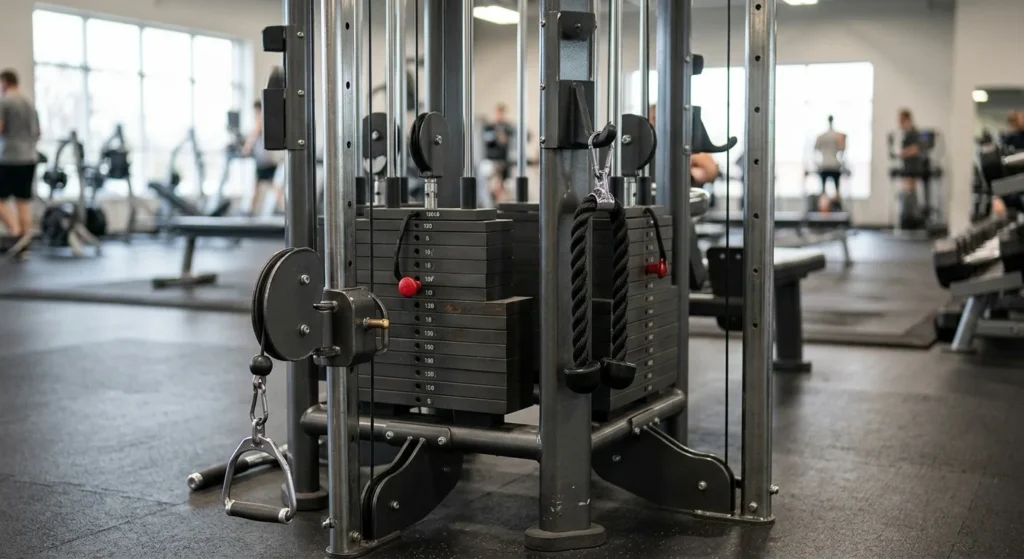
Face pulls hit the rear delts and the muscles between the shoulder blades. Set a rope attachment at upper chest to forehead height, grip it with thumbs toward you, and step back until the weight lifts.
Pull toward your face and finish with your hands beside your ears and elbows high, rotating your knuckles back. Squeeze for a second, then return slowly. Do 3 sets of 12 to 20 reps.
Most people load this one too heavy and turn it into a row. If your elbows drop below your wrists, lighten the weight.
3. Cable Reverse Fly
The reverse fly targets the rear delts, which are easy to neglect. Set two pulleys at shoulder height, grab the opposite handles so the cables cross, and step back.
With soft elbows, sweep your arms back and out until your hands line up with your shoulders. Keep your ribs down so your lower back doesn’t arch. Do 3 sets of 12 to 20 reps.
A single-arm version works too. It lets you rotate slightly toward the stack to find the angle where the rear delt feels the stretch.
4. Single-Arm Cable Overhead Press
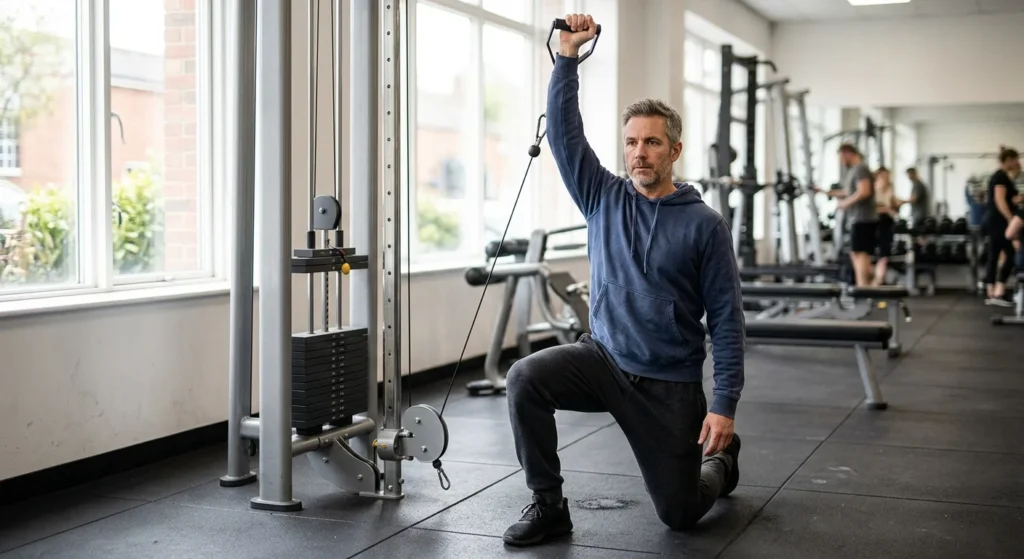
This is the one pressing move on the list, and it trains the front and side delts along with the triceps. Set the pulley low, hold the handle at shoulder height, and stand or half-kneel a step away from the stack.
Press straight up until your arm is near your ear, then lower under control. Keep your ribs stacked over your hips so you don’t lean sideways. Aim for 3 sets of 8 to 12 reps per arm.
Half-kneeling makes it harder to cheat with your lower back. The cable also pulls your arm down and forward, so your core has to keep your torso level.
5. Cable Front Raise
Front delts already work hard during any pressing, so most lifters need only a small dose of direct work. Face away from a low pulley, hold the handle or rope between your legs, and raise your arm forward to eye level.
Keep the movement slow and avoid leaning back. Two to three sets of 10 to 15 reps is enough. If you press twice a week, you may be able to skip this one.
6. Cable Upright Row
The upright row works the side delts and upper traps, but it bothers some shoulders. If it feels pinchy, use a wider grip and stop when your hands reach lower-chest height instead of pulling to the chin.
Use a straight bar or rope on a low pulley. Lead with the elbows, pause briefly, and lower under control. Do 3 sets of 10 to 12 reps, and skip it if it causes pain.
7. Cable External Rotation
External rotation trains the small rotator cuff muscles that keep the shoulder joint stable, and it shows up often in rehab and warm-ups. A 2004 study by Reinold and colleagues in the Journal of Orthopaedic & Sports Physical Therapy compared common external rotation exercises and measured activity in the rotator cuff and deltoid muscles.
Set the pulley at elbow height, tuck a folded towel between your elbow and ribs, and rotate your forearm away from the stack. Use a very light load for 2 to 3 sets of 12 to 15 reps. This is control work, not a strength test.
Two Shoulder Workouts With Cables You Can Copy
Routine A: Cable-Only Shoulder Day
This takes about 30 to 35 minutes.
- Cable lateral raise, 4 sets of 12 to 20 reps per arm
- Face pull, 3 sets of 12 to 20 reps
- Single-arm overhead press, 3 sets of 8 to 12 reps per arm
- Cable reverse fly, 3 sets of 12 to 20 reps
- Cable external rotation, 2 sets of 12 to 15 reps per arm
Rest 60 to 90 seconds between sets, and a bit longer after the press.
Routine B: Cable Finisher After Chest or Back Day
This takes about 15 minutes and adds shoulder volume without another full session.
- Cable lateral raise, 3 sets of 15 to 20 reps per arm
- Face pull, 3 sets of 15 to 20 reps
- Cable front raise, 2 sets of 12 to 15 reps (optional)
Alternate the lateral raise and face pull with about 45 seconds of rest between them.
How Many Sets and How Often to Train Shoulders
A 2017 meta-analysis by Schoenfeld, Ogborn, and Krieger in the Journal of Sports Sciences found that higher weekly set volumes were linked to greater muscle growth. Groups doing 10 or more weekly sets per muscle did better than those doing fewer.
For shoulders, a sensible starting point is 8 to 12 direct sets per week for the side and rear delts, split across two sessions. Your chest and back work already gives the front delts and rotator cuff indirect volume.
The most common mistakes are swinging the torso, using too much weight, setting the pulley at the wrong height, and skipping the rear delts. Fixing those four does more than adding another exercise.
How to Warm Up Before Shoulder Cable Workout
Spend five minutes on the stack before you go heavy. Do 1 or 2 sets of 15 external rotations at a very light weight, then a set of face pulls, then a set of lateral raises at half your working weight.
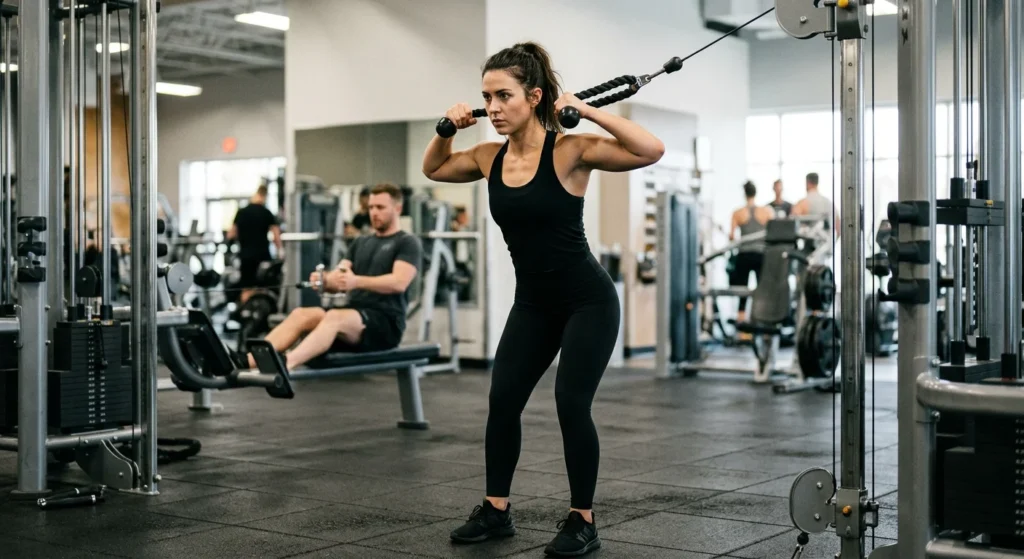
The goal is to feel the target muscle working before the load goes up, not to fatigue it. If a movement feels off, change the pulley angle before you add weight.
How to Progress Without Wrecking Your Shoulders
Use double progression. Pick a rep range, such as 12 to 20 for lateral raises, and stay at one weight until you hit the top of the range on every set. Then move up one step on the stack and start again at the bottom.
Log the weight, reps, and pulley height, since a one-hole change in height can change how an exercise feels. If your reps fall below the range twice in a row, go back one weight step.
Where Cables Fall Short
Cables are not perfect. Stack weight caps out on some machines, so heavy pressing is better with a barbell or dumbbells.
Setup also takes longer, and a busy cable station can stall your session. Use cables to finish and shape the shoulders, not to replace your main press.
When to See a Professional
Sharp pain, pain that lingers after training, numbness, or a shoulder that catches when you lift overhead is a reason to stop and get it checked by a physical therapist or doctor. This article is general fitness information, not medical advice. Once you’re cleared, shoulder cable workouts are one of the easier ways to train the delts with control and steady tension.