
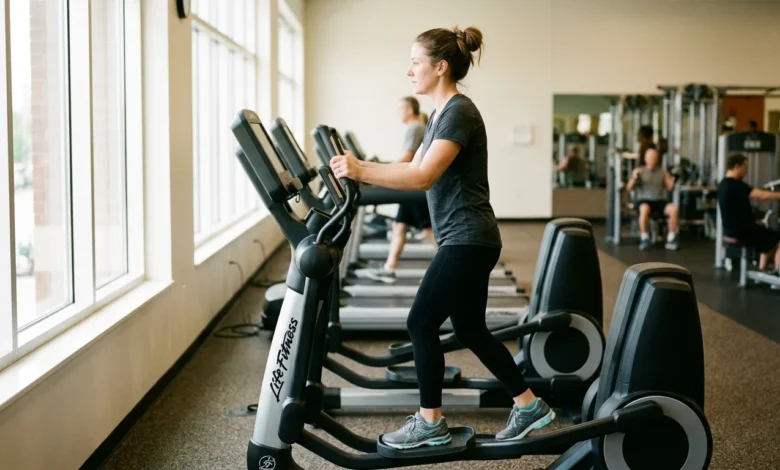
An elliptical is a stationary cardio machine with two foot pedals that move in an oval path, so you can copy a walking, striding, or running motion without your feet ever leaving the pedals. Most models add moving handles that work your arms at the same time. That is why it is a common pick for low-impact cardio at gyms and at home.
If you are wondering what is an elliptical and whether it suits you, this guide covers how the machine works, the main types, the muscles it uses, what the calorie numbers really mean, and how to use one properly.
How an Elliptical Machine Works
Your feet rest on pedals attached to arms that guide them along an oval. When you push, a crank turns a flywheel, and a resistance system, usually a magnetic brake on home models, makes each stride easier or harder. The pedals stay under your feet the whole time, so there is no heel strike as you get running on pavement.
Most ellipticals also have two moving handles linked to the pedals. Push one forward, and the opposite pedal moves back, so your arms and upper back share the work. Fixed handles near the console are for balance.
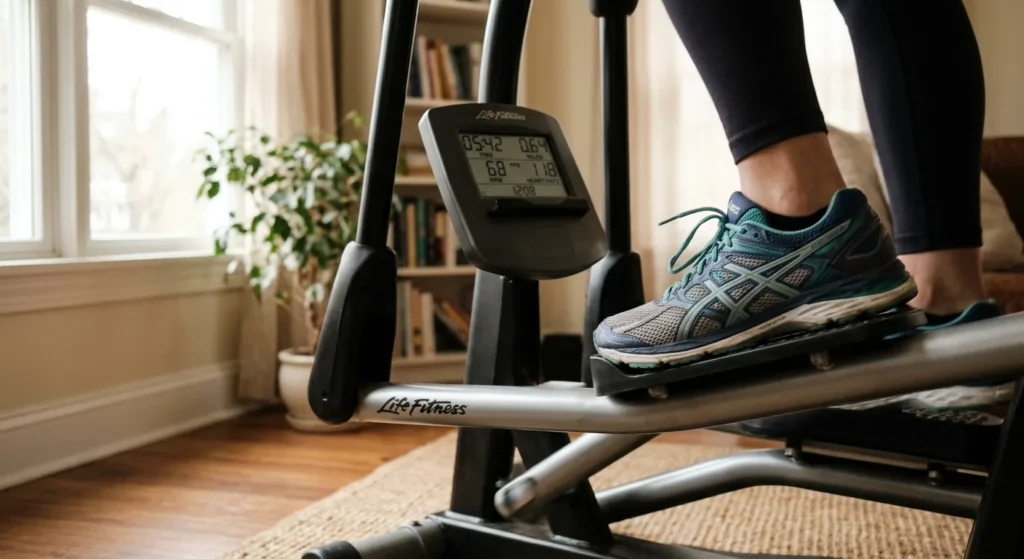
The console tracks time, speed, resistance, and an estimated calorie count. Many machines let you pedal backward, and some have a motorized ramp that raises the incline.
Where the Elliptical Came From
Precor says it introduced the first commercial elliptical, the EFX, in 1995. The idea was to let runners and walkers train with less pounding on the knees and hips. Gyms adopted it quickly, and home versions followed.
You will also see it sold as an elliptical trainer or a cross-trainer. Those names mean the same machine.
Types of Ellipticals
Ellipticals are usually sorted by where the flywheel sits, and that changes how the stride feels.
1. Front-Drive Models
The flywheel is ahead of you. These are common, tend to cost less, and take up less floor space, with a slightly upright feel similar to a stair climber.
2. Rear-Drive Models
The flywheel is behind you. The motion feels flatter and closer to walking, but the machine is usually longer.
3. Center-Drive Models
The flywheel sits between your feet, which aims for a more natural stride with the pedals set closer together. You mostly see this layout on higher-priced machines.
Stride length, the distance your foot travels front to back, matters as much as drive type. Many adult machines fall between 18 and 22 inches, and taller people often feel cramped on shorter strides. Test a few in person if you can.
What an Elliptical Does Well and Where It Falls Short
The machine is easy to learn, gentle on joints, and works your legs and arms in one steady motion. You can train indoors in any weather, and the smooth movement suits beginners.
It also has limits. It is less specific than running if you are training for a race; the upper-body work is modest, and long sessions can get dull. The calorie readout is also less exact than it looks.
Muscles an Elliptical Works
The main workers are the quadriceps, glutes, hamstrings, and calves. Your core keeps you upright, and pushing and pulling the handles brings in the chest, back, shoulders, biceps, and triceps.
Pedaling backward shifts more of the load to the hamstrings and glutes. Leaning on the handles cuts the work your legs do. Physical therapist Mari Carmen told Tom’s Guide that it lowers calorie burn and can leave muscles tight, so stand tall and keep a light grip.
Why Elliptical Workouts Feel Easier Than They Are
The flywheel carries momentum, so it is easy to spin fast with very little force. That feels like effort, but your legs are loaded lightly. Most people who plateau on the machine are coasting this way.
Raising resistance until each stride takes real effort matters more than raising speed. If you can chat comfortably while your feet fly, turn the resistance up a few notches.
How Many Calories an Elliptical Burns
Harvard Health Publishing’s chart of 30-minute activities puts an elliptical session at roughly 270 calories for a 125-pound person and about 400 for a 185-pound person. Body weight, resistance, and how hard you push all move the number.
Treat the console estimate as a rough guide. Octane Fitness, an elliptical maker, says the figures vary by manufacturer and are not lab-measured, and many machines assume a 150-pound user if you skip entering your weight.
For context, the CDC recommends that adults get at least 150 minutes of moderate aerobic activity a week. That works out to 30 minutes, five days a week, and an elliptical can cover it.
Elliptical vs. Treadmill vs. Stationary Bike
People asking what is an elliptical often want to know how it compares with running. The biggest difference is impact. A treadmill sends a jolt through your joints with every step, while an elliptical and a bike do not.
The elliptical still keeps you on your feet, and the NIH Osteoporosis and Related Bone Diseases National Resource Center lists elliptical training among low-impact weight-bearing exercises. That points to a trade-off many guides skip. Higher-impact activity such as jogging loads bones more, so someone worried about bone density may want to mix in walking or strength work. A seated bike gives your bones the least stimulus of the three.
If you are training for a 5K, running is still the most specific practice. An elliptical works well as a cross-training day, or as a way to keep fitness up while a sore knee settles down.
Who Should Be Careful With an Elliptical
Many people with sore knees or hips find the smooth motion comfortable, and beginners and older adults often like the handrails. Still, an elliptical is not right for everyone.
If you have balance problems, a recent surgery, a joint condition, or a heart condition, ask your doctor before starting. Stop and get medical advice if you feel chest pain, dizziness, or sharp joint pain. This article is general information, not medical advice.
How to Use an Elliptical Properly
1. Setup and Form
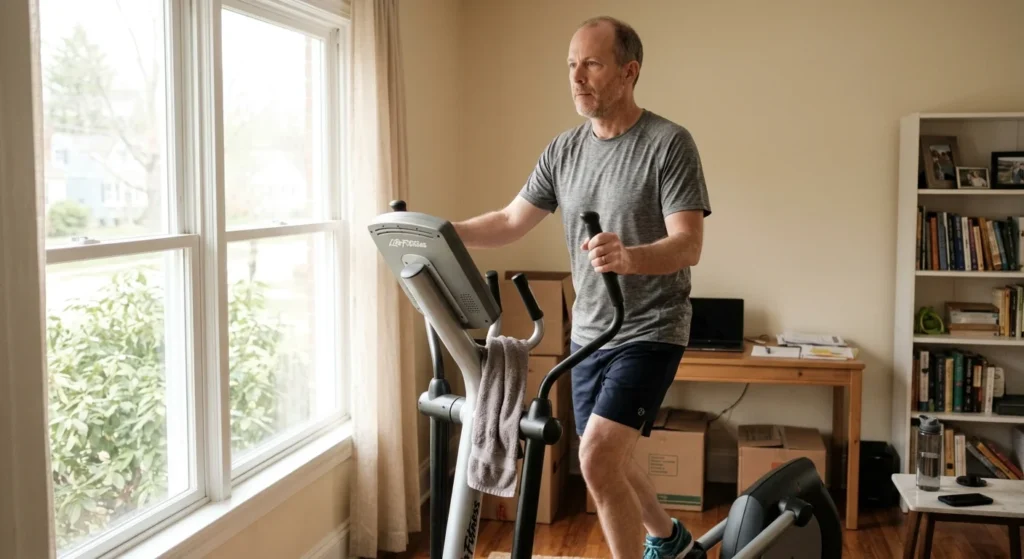
Step on while the pedals are still, holding the handles. Keep your feet flat with heels down and your eyes forward. Stay upright, keep your hips level, and hold the handles lightly.
2. A Beginner 30-Minute Session
Warm up for five minutes at low resistance. Spend 20 minutes at a steady pace where your breathing is up but controlled. Cool down for five minutes.
3. A Simple Interval Option
Once steady sessions feel easy, try 30 seconds at higher resistance followed by 90 seconds easy, repeated eight times between the warm-up and cool-down.
4. How to Tell You Are Working Hard Enough
The CDC’s talk test is simple. At moderate intensity, you can talk but not sing, and at vigorous intensity, you can say only a few words before pausing for breath.
Common Elliptical Mistakes
Most wasted workouts come from a short list of habits.
- Leaning on the handles and letting your arms carry your weight
- Keeping resistance so low that the flywheel does the work
- Taking tiny, rushed strides instead of using the full range
- Only pedaling forward every session
- Watching the calorie counter more than your effort
What to Check Before Buying an Elliptical
Start with stride length and fit, then check the footprint, weight capacity, noise, and the warranty on the frame and parts. Magnetic resistance is quiet and common. Look at pedal spacing too, since pedals set far apart can feel awkward on the hips.
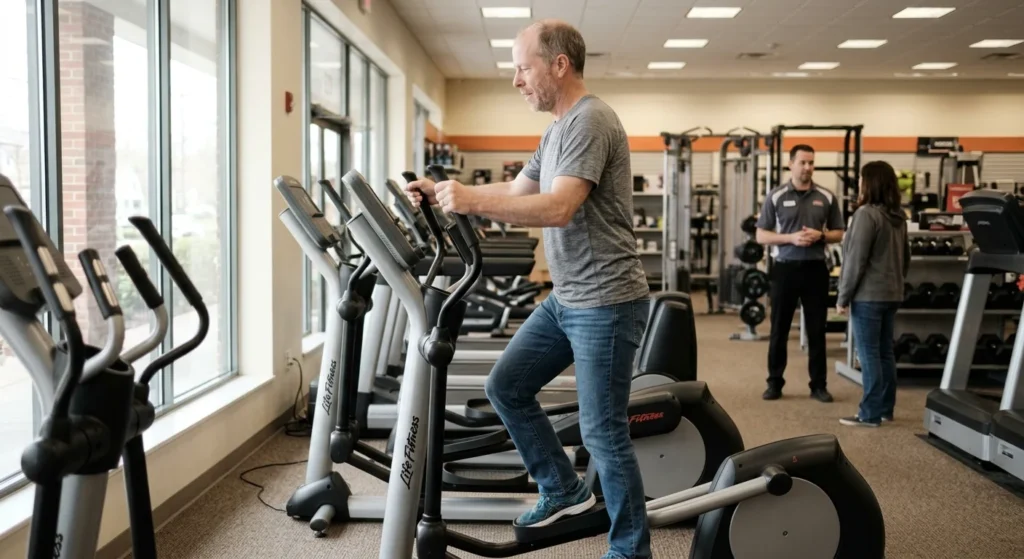
Prices vary widely, so compare current listings and consider a floor model or a used unit from a reputable seller. A few weeks of gym use first can tell you whether you will stick with one at home.