
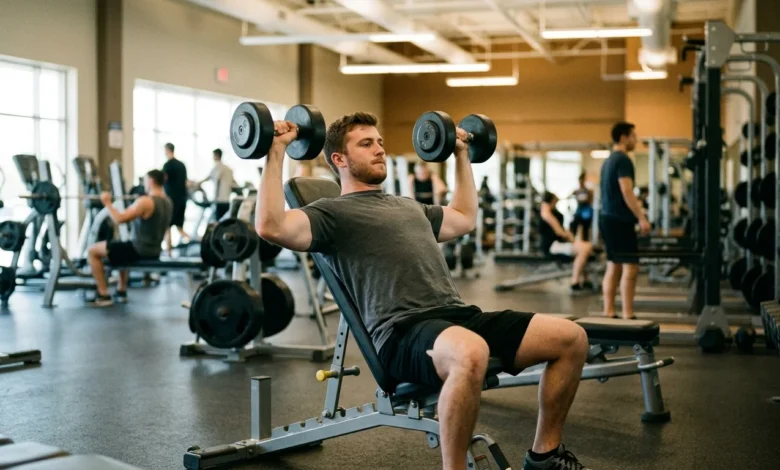
The best upper chest exercises are low incline presses, low-to-high cable flyes, and feet-elevated push-ups, done with a full stretch and a steady pace. Pick two or three of them, train them twice a week, and add weight or reps over time. That is enough to build the top of your chest.
This guide covers where the upper chest sits, what research says about bench angle, eight moves worth doing, and a simple weekly plan you can start this week. Everything works in a US commercial gym or at home with adjustable dumbbells and a bench.
What the Upper Chest Actually Is
The pectoralis major has two main sections. The clavicular head attaches to the inner half of your collarbone, and the sternocostal head attaches to the breastbone and upper ribs. When lifters say upper chest, they mean the clavicular head.
Its fibers run diagonally from the collarbone down and out toward the upper arm. Because of that angle, pressing or reaching upward and forward uses it more than a flat press does.
The front of the shoulder, the anterior deltoid, sits next to it and helps on every pressing move. That overlap matters when you choose exercises. A bench set too steep turns a chest press into a shoulder press.
Can You Train the Upper Chest Separately?
Partly, yes. Electromyography (EMG) studies measure the electrical activity of a muscle during a lift, and they show regional differences inside the pec. Lauver, Cayot, and Scheuermann reported in the European Journal of Sport Science in 2016 that the clavicular portion was more active on 30- and 45-degree inclines than on a flat bench.
A 2020 study by Rodríguez-Ridao and colleagues in the International Journal of Environmental Research and Public Health tested five bench angles. The anterior deltoid worked harder as the bench got steeper, and the chest differences between angles were smaller than many lifters assume.
Muscle activity is not the same as muscle growth, so treat these findings as a guide to exercise selection, not proof. The practical takeaway is simple. Include some incline work, keep the angle moderate, and judge results by what you see and feel over months.
Best Bench Angle for Upper Chest Training
Set the bench to about 30 degrees. Anything from 15 to 45 degrees can work, but 30 is the safest starting point because it tilts the press toward the collarbone without handing the job to the shoulders.
On most adjustable benches, that is the second or third notch. Seen from the side, it should look like a slight slope, not a steep ramp. If your front delts burn long before your chest does, drop the bench down one notch.
Many gyms have a fixed 45-degree incline bench. It is usable, but if you have the choice, a lower setting usually feels better on the shoulder joint. Some lifters also find that 15 degrees, just above flat, suits their body better than a steeper setting.
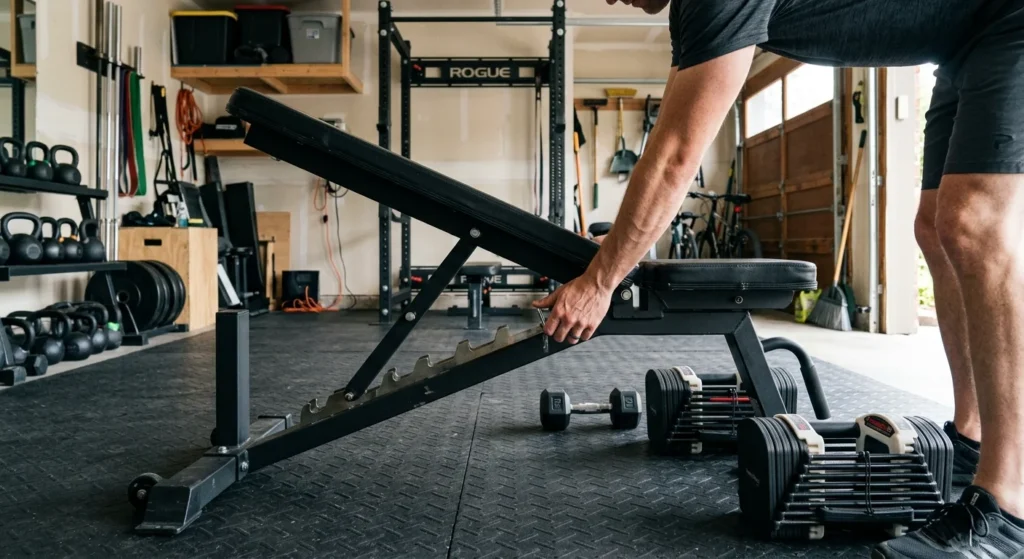
Test two angles for a few weeks each and keep the one where you feel the top of your chest working while your shoulders stay quiet. Body proportions, arm length, and shoulder mobility all change what feels right.
Eight Upper Chest Exercises Worth Doin
Each move below includes setup, cues, and a rep range. Start with one press and one fly, then add more as you recover well.
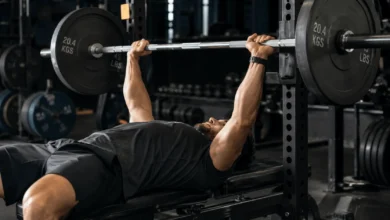
1. Low Incline Barbell Bench Press
Set the bench to about 30 degrees, lie back, and pull your shoulder blades together and down. Grip the bar slightly wider than shoulder width and lower it to your upper chest, just below the collarbone. Press back up in a slight arc over your face.
This is the heaviest option on the list, so it drives strength. Use 4 to 8 reps for strength-focused sets, or 6 to 10 if size is your main goal. Use safety arms or a spotter, since the bar travels over your face and neck.
2. Incline Dumbbell Press
Dumbbells let each arm move on its own path, which suits most shoulders better than a fixed bar. Start with the dumbbells at the sides of your upper chest, palms forward or turned slightly in. Press until they nearly touch above your collarbone.
Lower them over two to three seconds until you feel a stretch across the chest. Aim for 8 to 12 reps. If you train at home with adjustable dumbbells, this is the one worth buying a bench for.
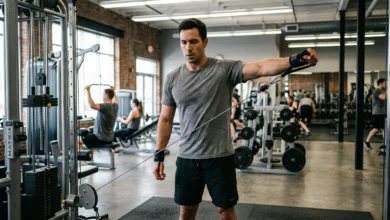
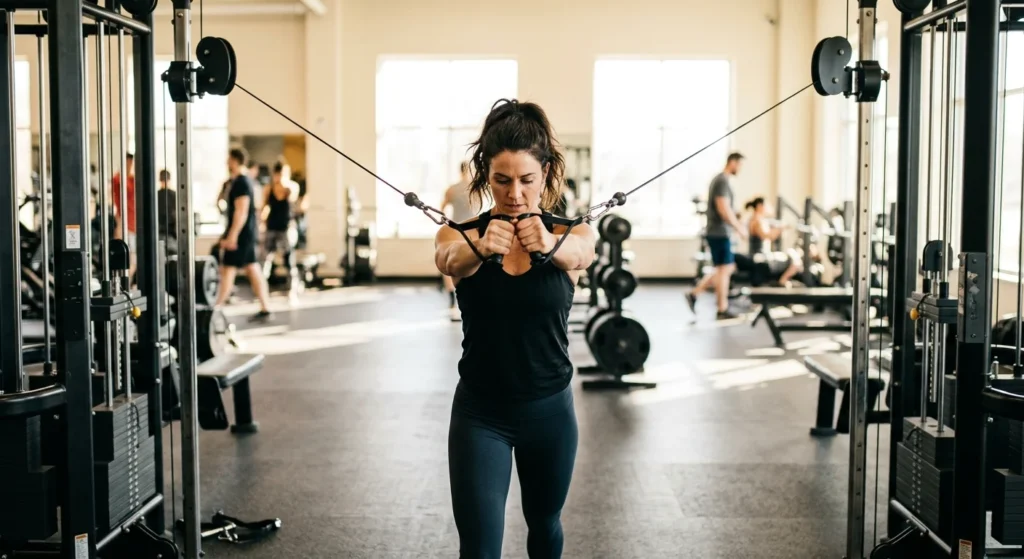
3. Low-to-High Cable Fly
Set both pulleys at the lowest setting and stand in the middle with a handle in each hand. With a slight bend in your elbows, sweep your hands up and together until they meet at about eye level. Lower them under control.
The line of pull follows the direction of the clavicular fibers, and cables keep tension on the muscle at the top, where dumbbells go slack. Use 10 to 15 reps and a weight you can move without swinging your torso.
4. Incline Dumbbell Fly
Lie on a bench set to 30 degrees with the dumbbells over your chest and a soft bend in each elbow. Open your arms in a wide arc until you feel a deep stretch, then squeeze them back together. Keep the weight light, because the stretched position loads the front of the shoulder.
Ten to 15 reps with a weight that feels easy for the first few is plenty. Stop the set if your shoulders pinch.
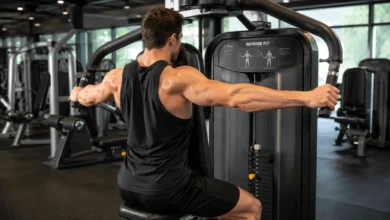
5. Incline Machine Chest Press
Many gyms have a plate-loaded or selectorized incline press. Adjust the seat so the handles line up with your upper chest, not your shoulders. A machine removes the balance demand, so you can push close to failure with less risk.
That makes it a good finisher after free-weight presses. Eight to 12 reps work well, with a slow lowering phase. Beginners also tend to find it easier to feel the target muscle.
6. Feet-Elevated Push-Up
People often call this a decline push-up. Place your feet on a bench or sturdy box about 12 to 18 inches high and keep your body in a straight line from head to heels. Lower your chest to the floor with your elbows at roughly 45 degrees from your torso.
Raising the feet shifts more body weight onto your arms and tilts the press upward, which brings in the upper chest. A hands-elevated push-up does the opposite, so skip that one for this goal. Add a backpack or weight vest once you reach 20 clean reps.
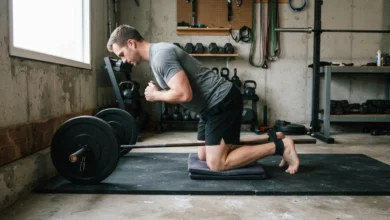
7. Landmine Press
Wedge one end of a barbell into a corner or landmine attachment and hold the other end at your shoulder. Stand or half-kneel, then press the bar up and forward in an arc. The upward-and-forward path loads the clavicular head along with the front delt.
It suits lifters who find overhead pressing or steep inclines uncomfortable. Do 8 to 12 reps per side. Keep your ribs down and avoid leaning back to finish the rep.
8. Resistance Band Low-to-High Fly
Anchor a resistance band at the bottom of a door frame or low post, or loop it under your feet. Step forward until the band has tension, then sweep your hands up and together like the cable version. Bands get harder toward the end of the movement, so the top squeeze is intense.
Use 12 to 20 reps. This is the easiest option for travel or a small apartment setup.
Where to Start If You Are New to Lifting
Begin with two exercises: the incline dumbbell press and the feet-elevated push-up. Both are easy to learn, and dumbbells let you find a comfortable path. Do three sets of 8 to 12 reps, rest about two minutes between sets, and stop each set one or two reps before failure.
After four to six weeks of steady progress, add a cable or band fly. Technique comes first. A lighter weight with a full range of motion builds more than a heavier weight with half reps.
How Many Sets and Reps to Do Each Week
The American College of Sports Medicine’s 2009 position stand recommends moderate loads of 8 to 12 reps for novice lifters, training each muscle group two to three days per week. Those numbers still make a solid baseline.
Volume matters too. A 2017 meta-analysis by Schoenfeld, Ogborn, and Krieger in the Journal of Sports Sciences found that people doing 10 or more weekly sets per muscle group gained more muscle than those doing fewer than 5. A 2016 review by Schoenfeld and colleagues in Sports Medicine found that training a muscle twice a week produced better growth than once a week.
For the upper chest, that means roughly 6 to 10 hard sets per week spread over two sessions, on top of your normal chest work. Flat presses and dips still train the clavicular head to some degree, so you do not need to double your total chest volume.
Here is a sample week for an intermediate lifter:
- Monday (push day): low incline barbell press, 4 sets of 6 to 8 reps, then low-to-high cable fly, 3 sets of 12 to 15 reps.
- Thursday (push day): incline dumbbell press, 3 sets of 8 to 12 reps, then feet-elevated push-ups, 2 sets close to failure.
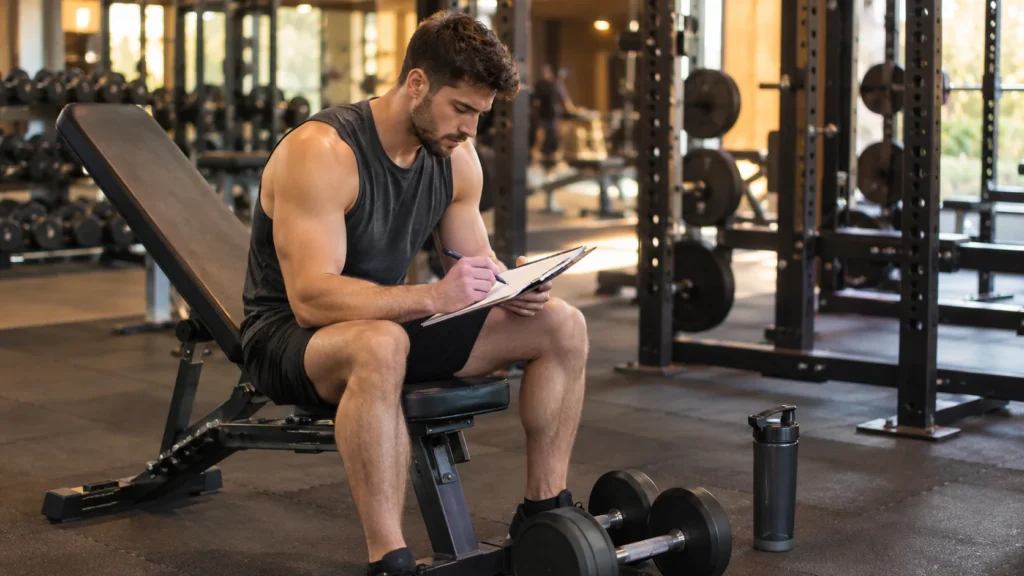
When you hit the top of the rep range on every set, add 5 pounds to the barbell or 2.5 to 5 pounds to each dumbbell next session. Log your lifts so you can see whether you are really progressing.
Common Mistakes That Waste Your Upper Chest Work
Most stalled progress comes from a short list of habits:
- Setting the bench at 60 degrees or higher. At that angle, the front delts do most of the pressing.
- Flaring the elbows out to 90 degrees. Keep them around 45 to 60 degrees from your torso to protect the shoulder joint.
- Skipping the shoulder blade setup. Pull your shoulder blades back and down before each press, and keep them there. A rounded upper back shifts load to the front of the shoulder.
- Bouncing or rushing the lowering phase. Take two to three seconds on the way down, pause briefly near the chest, then press.
- Letting ego pick the weight. If your hips lift off the bench or your elbows snap straight at the top, the weight is too heavy.
- Ignoring the back. A strong chest looks best on a balanced upper body, so pair pressing with rows and pull-ups to keep the shoulders healthy.
Warm-Up and Recovery Basics
Spend five minutes before pressing. Do a few band pull-aparts, some arm circles, and one or two light sets of your first exercise at about half the working weight. This raises shoulder temperature and rehearses the movement path.
Recovery matters as much as the sets. Leave at least 48 hours between sessions that hit the same muscle hard, and sleep seven or more hours when you can. The International Society of Sports Nutrition’s 2017 position stand suggests 1.4 to 2.0 grams of protein per kilogram of body weight daily for people who lift, which is about 0.6 to 0.9 grams per pound.
Upper chest exercises work best when they fit into a full program, not when they replace one. Choose a moderate bench angle, load the muscle through a full range, and give it two sessions a week. If a movement causes sharp or lingering shoulder pain, stop and ask a doctor or physical therapist before continuing.