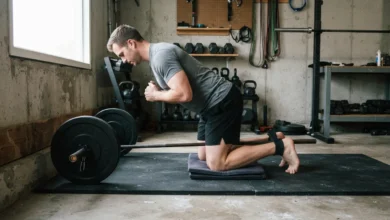


The push pull legs upper lower split, often shortened to PPLUL, is a five day training program that blends two of the most common ways to organize a lifting week: push pull legs and upper lower. Instead of forcing you to pick one system, PPLUL lets you run three focused sessions early in the week, then close things out with two broader upper and lower body days.
The result is a schedule that trains your upper body three times per week and your legs twice, which lines up well with how most intermediate and advanced lifters want to build muscle. This guide breaks down how PPLUL works, how to schedule it, a full sample program, and the exercise selection rules that keep your recovery in check.
What Is the Push Pull Legs Upper Lower Split?
PPLUL is a hybrid split. The first three training days follow the push pull legs format, where each session is built around a single movement pattern. The final two days switch to the upper lower format, where each workout trains a broader region of the body in one sitting.
Here is what each session actually covers:
- Push: chest, shoulders, and triceps, the muscles responsible for pressing movements
- Pull: back, biceps, and rear deltoids, the muscles responsible for rowing and pulling
- Legs: quadriceps, hamstrings, glutes, and calves
- Upper: a combined session touching chest, back, shoulders, biceps, and triceps in one workout
- Lower: a second full lower body session, usually built to emphasize different exercises than the earlier leg day
Because you hit push, pull, and leg muscles directly, then train most of them again during the upper and lower days, each major muscle group ends up worked roughly twice a week. That frequency is a big part of why PPLUL has become popular with lifters who have outgrown a basic three day routine but aren’t ready to commit to six days.
How to Schedule a PPLUL Week
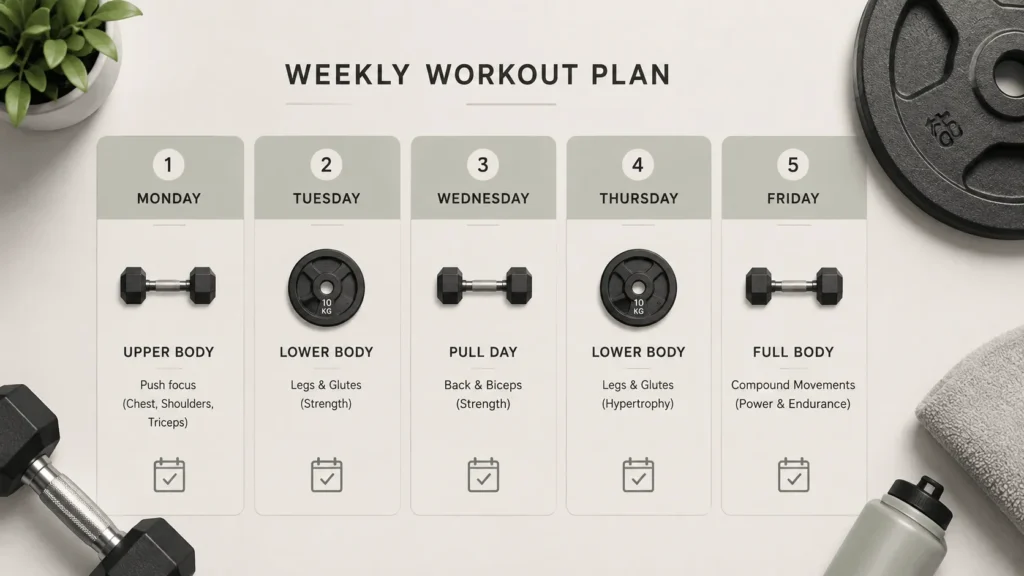
Most people run PPLUL Monday through Friday and take the weekend off:
- Tuesday: Pull
- Monday: Push
- Wednesday: Legs
- Thursday: Upper
- Sunday: Rest
- Friday: Lower
- Saturday: Rest
If five days in a row feels like too much, insert a rest day after day three:
- Monday: Push
- Tuesday: Pull
- Wednesday: Legs
- Thursday: Rest
- Friday: Upper
- Saturday: Lower
- Sunday: Rest
The tradeoff is a Saturday session, which some people find harder to protect from weekend plans than a Monday to Friday routine.
You can also flip the order and start with upper and lower before moving into push, pull, and legs. This version is usually called ULPPL:
- Monday: Upper
- Tuesday: Lower
- Wednesday: Push
- Thursday: Pull
- Friday: Legs
Both sequences train the same muscles the same number of times per week, so pick whichever order fits your energy levels and schedule better.
A Sample Push Pull Legs Upper Lower Workout Plan
Day 1: Push
- Barbell Bench Press: 4 sets, 5-8 reps
- Seated Dumbbell Shoulder Press: 3 sets, 8-10 reps
- Incline Dumbbell Press: 3 sets, 10-12 reps
- Cable Lateral Raise: 3 sets, 12-15 reps
- Triceps Rope Pushdown: 3 sets, 12-15 reps
Day 2: Pull
- Weighted Pull Up or Lat Pulldown: 4 sets, 6-10 reps
- Barbell Row: 3 sets, 8-10 reps
- Single Arm Dumbbell Row: 3 sets, 10-12 reps
- Face Pull: 3 sets, 15-20 reps
- Incline Dumbbell Curl: 3 sets, 10-12 reps
Day 3: Legs
- Back Squat: 4 sets, 5-8 reps
- Romanian Deadlift: 3 sets, 8-10 reps
- Walking Lunge: 3 sets, 10-12 reps per leg
- Leg Curl: 3 sets, 12-15 reps
- Standing Calf Raise: 4 sets, 10-15 reps
Day 4: Upper
- Incline Barbell Press: 3 sets, 6-8 reps
- Chest Supported Row: 3 sets, 8-10 reps
- Standing Overhead Press: 3 sets, 8-10 reps
- Lat Pulldown: 3 sets, 10-12 reps
- Cable Triceps Extension: 2 sets, 12-15 reps
- Dumbbell Hammer Curl: 2 sets, 12-15 reps
Day 5: Lower
- Front Squat or Leg Press: 3 sets, 8-10 reps
- Hip Thrust: 3 sets, 8-10 reps
- Leg Extension: 3 sets, 12-15 reps
- Seated Leg Curl: 3 sets, 12-15 reps
- Seated Calf Raise: 3 sets, 12-15 reps
Treat this as a template rather than a fixed prescription. Swap exercises for equipment you have access to, and adjust set counts based on the total weekly volume you’re aiming for per muscle group.

How to Build Your Own PPLUL Workouts
The biggest mistake lifters make when designing their own PPLUL program is treating each day as fully independent, which quietly stacks up overlapping fatigue. Your triceps get worked directly on push day, then again during pressing movements on upper day. Your hamstrings get worked on both leg day and lower day. None of this is a problem by itself, but it means you shouldn’t program full volume for every muscle on every day it appears.
A practical approach is to pick one day as the primary volume day for each muscle group and treat its second appearance as maintenance work. If push day already includes four sets of direct triceps work, keep triceps light on upper day, maybe one or two sets, rather than repeating a full triceps block.
The same logic applies to your two leg days. Rather than running identical leg workouts twice a week, let one session emphasize quad dominant movements like squats and lunges, and let the other emphasize hip and hamstring dominant movements like Romanian deadlifts and hip thrusts. This spreads your weekly leg volume more evenly and lowers the odds that both sessions leave the same muscles equally sore.
Always place your heaviest compound lift first in each workout, while you’re freshest, and save isolation work for the end.
Who Should Use the PPLUL Split?
PPLUL works best for intermediate and advanced lifters who already have a consistent training habit and want more weekly volume than a three or four day program allows. If you’ve trained seriously for at least six months and recover well between sessions, this split gives you enough frequency to keep progressing without the daily grind of a six day program.

Beginners are usually better served by a simpler three day full body routine or a basic push pull legs program. Five dedicated training days is a lot of new volume for a body that hasn’t adapted to consistent resistance training, and the added complexity of five different workouts can make it harder to stay consistent.
If your schedule genuinely limits you to three or four days a week, a straight push pull legs or upper lower split will give you the same core benefits without asking for a fifth session you can’t reliably deliver.
PPLUL vs ULPP: Does the Order Matter?
Swapping the order of your week doesn’t change how often each muscle group gets trained, only when. Starting with push, pull, and legs means you tackle three focused sessions before your hardest overlapping days arrive later in the week, which can feel more fatiguing by Thursday and Friday.
Starting with upper and lower instead front loads two demanding, whole body sessions while you’re fresh from the weekend, then finishes with three more targeted days. Neither order is objectively better. Choose PPLUL if you prefer building fatigue gradually, and choose ULPPL if you’d rather get your two toughest sessions done early and coast into more focused work later in the week.
How Many Weekly Sets Should You Aim For?
Weekly set counts should build up gradually rather than starting at your ceiling. Lifters newer to this split typically do well starting around 10 to 12 total weekly sets per major muscle group, spread across both training days combined. Intermediate lifters who have trained for a year or more can often handle 14 to 18 sets per muscle group before returns start to diminish.
Track your sets across an entire week rather than judging a single workout in isolation, since PPLUL spreads chest, back, and leg volume across two different sessions. If you’re still unusually sore three days after a workout, or your performance keeps dropping session to session, that’s a sign to pull volume back rather than add another exercise.