
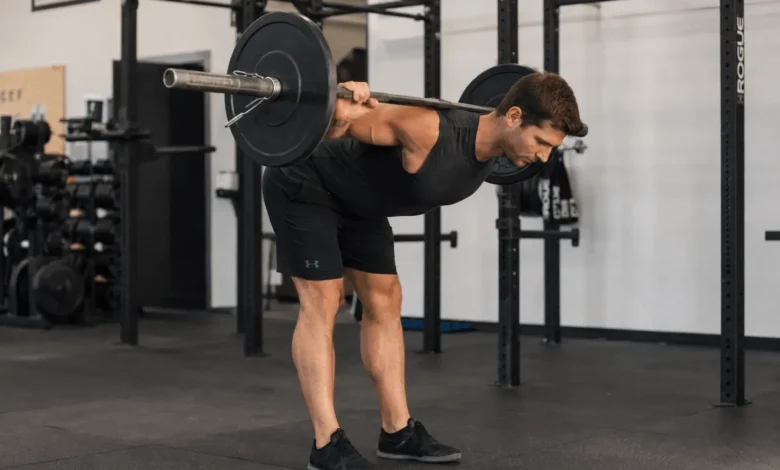
A good morning is a hip hinge exercise performed with a barbell across the upper back. You bend forward at the hips until your torso is near parallel to the floor, then drive your hips forward to stand back up, building strength in the hamstrings, glutes, and lower back.
What is the Good Mornings Exercise
The good morning gets its name from the way the movement resembles a bow, the kind of forward nod people once used to greet each other or start the school day. That’s also the explanation Wikipedia gives for the name, tying the motion to the erector spinae bracing the spine while the hips do the work.
The exercise has been around for more than a century. Strongman Hermann Goerner is thought to have used an early version of it in the 1910s, and York Barbell’s Bob Hoffman was promoting it under the name “barbell bend over” by the 1940s. It’s also had a rockier reputation: Bruce Lee reportedly injured his back performing a good morning without an adequate warm-up, an incident that still gets cited as a cautionary tale about loading the movement before your form is solid.
Despite that history, a good morning done with the right weight and technique is not inherently dangerous. It’s a legitimate strength exercise, not a mistake version of a squat
Muscles Worked in the Good Morning
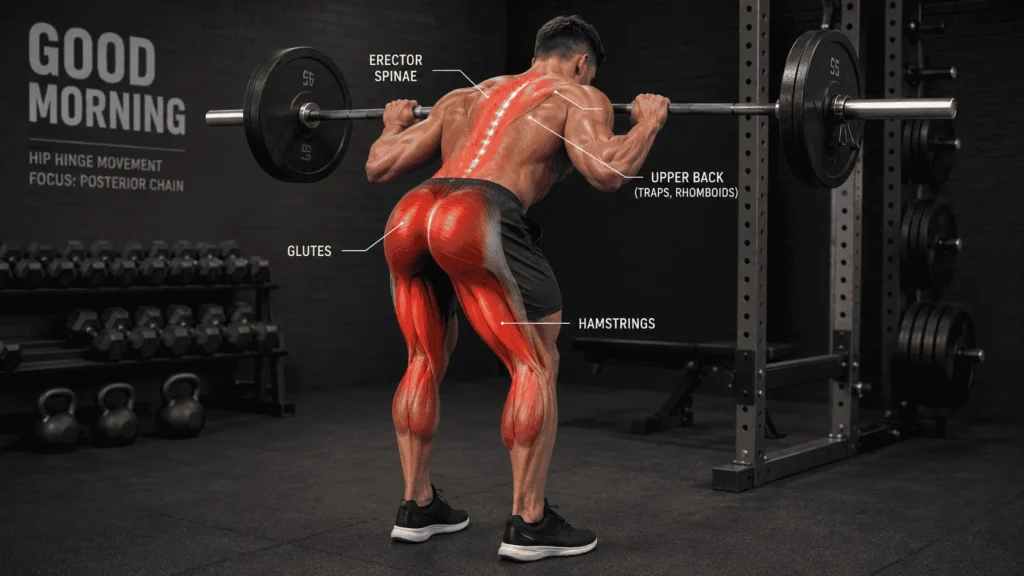
The good morning is a compound, posterior chain movement. The main muscles involved are:
The hamstrings, which control the descent and help drive hip extension on the way up. The glutes, which stabilize the hips and add power to the standing phase. The erector spinae, the muscles running along your spine, which work isometrically to keep your back in a neutral position under load. Your core also braces throughout the lift to protect your spine, and your upper back muscles help hold the bar in place
How to Do a Barbell Good Morning Step By Step
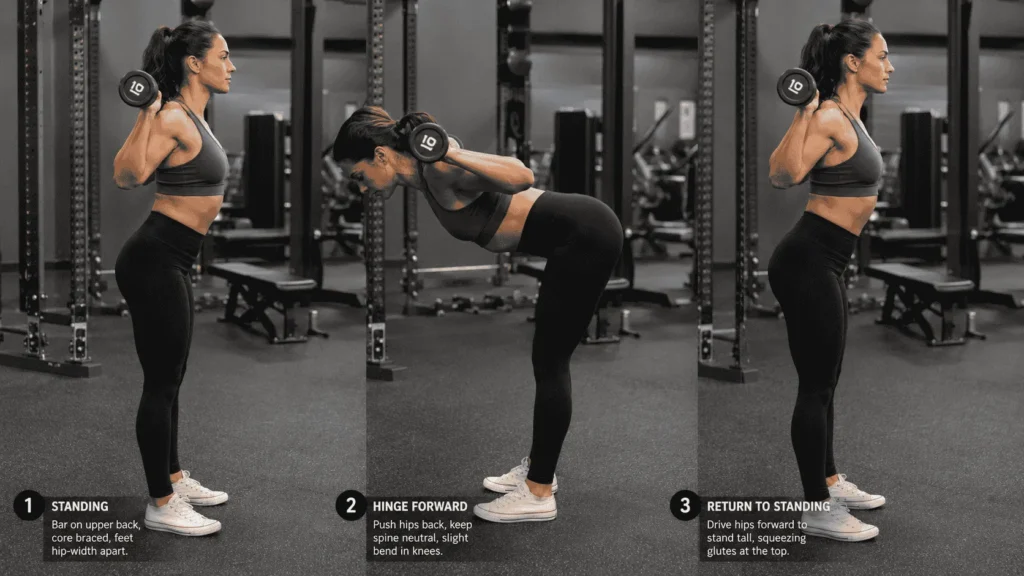
Set the bar in a squat rack at about shoulder height. Step under it and rest it across your upper back, either high on the traps or slightly lower across the rear delts, similar to where you’d position a bar for a back squat.
- Unrack the bar and step back with your feet shoulder-width apart, knees slightly bent.
- Take a breath, brace your core, and pull your shoulder blades together to keep the bar seated.
- Push your hips back, as if trying to close a door behind you with your glutes, and let your torso hinge forward.
- Keep your spine neutral, not rounded, as you lower until your torso is close to parallel with the floor or you feel a firm stretch through your hamstrings.
- Pause briefly, then squeeze your glutes and drive your hips forward to return to standing.
NASM’s training guidance for the exercise recommends 3 sets of 6 to 12 repetitions, adjusting the load based on how well you can maintain a neutral spine through the full range. If you’re new to the movement, start with just the empty bar, or even a broomstick, until the hip hinge feels natural.
Good Morning Variations
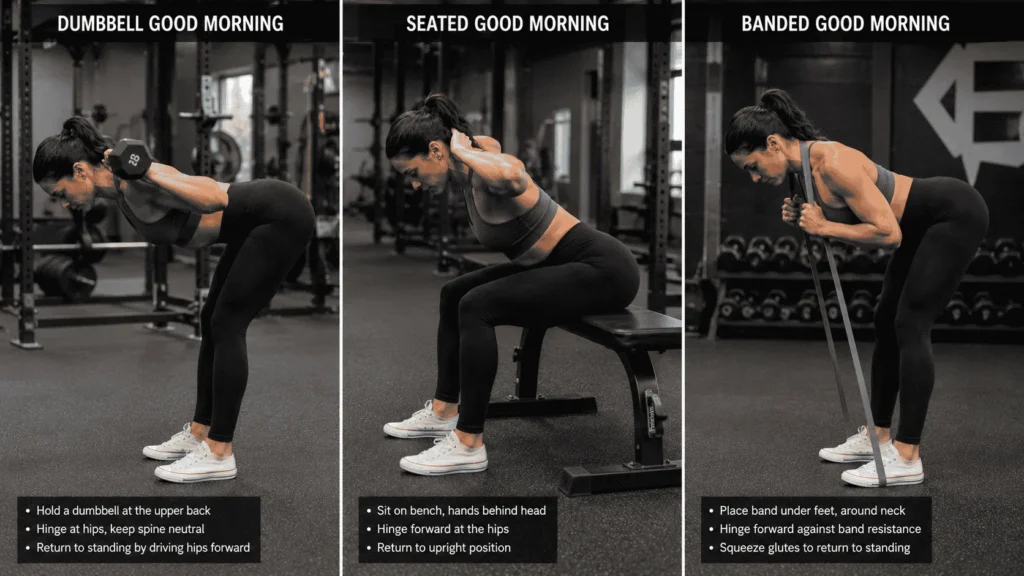
You don’t need a barbell to get the benefit of this hip hinge pattern.
Dumbbell good morning Hold a dumbbell against each shoulder instead of a barbell.
This is a useful entry point if the barbell version feels awkward, since it’s easier to load lightly and easier to feel the hamstring stretch.
Seated good morning Sit on a bench with the bar across your upper back and hinge forward from that position
Taking your legs out of the equation shifts more of the work onto your lower back and core, which makes this a good option if you have limited hip mobility or want to isolate the spinal erectors
Banded good morning Stand on a resistance band, loop it around your upper back or neck, and perform the same hinge pattern.
Bands add resistance gradually through the range of motion, which makes this version a common warm-up or activation drill before heavier lifts
Good Mornings vs Romanian Deadlifts
Good mornings and Romanian deadlifts train a similar hip hinge pattern and hit many of the same muscles, so it’s easy to assume they’re interchangeable. The real difference is where the load sits. In a Romanian deadlift, you hold the weight in your hands in front of your thighs. In a good morning, the bar rests on your upper back, above your center of mass, which makes the exercise more technically demanding and less forgiving of a rounded spine. If you’re still building confidence with the hip hinge, a Romanian deadlift is generally the easier place to start.
Common Good Morning Mistakes
Rounding the back. Losing a neutral spine under load is the main cause of good morning back injuries. If you can’t keep your chest up and spine straight through the full range, use less weight or a shorter range of motion. Bending the knees like a squat. The good morning is a hip hinge, not a knee-dominant movement. Your knees should stay only slightly bent throughout. Going too low. Dropping past parallel adds spinal load without adding much benefit. Many coaches, including Joel Seedman of Advanced Human Performance, suggest stopping around 15 degrees above parallel rather than pushing for full depth. Loading up too fast. This exercise rewards patience. Master the pattern with an empty bar before adding meaningful weight.
Are Good Mornings Bad for Your Back
Not when they’re loaded and performed correctly. A 2009 study in the Journal of Strength and Conditioning Research by McGill and colleagues looked at standing hip hinge exercises like the good morning and found that, done with proper mechanics, they can build spinal stability rather than compromise it. A separate 2015 study in PeerJ by Vigotsky and colleagues found that adding load to the good morning increases hamstring and erector spinae muscle activation, supporting its use as a genuine strength exercise rather than just a stretch. The risk comes from poor form and jumping to heavy loads too soon, not from the movement pattern itself.
How to Add Good Mornings to your Workout
Good mornings work well as an accessory lift on a lower body or posterior chain day, placed after your main compound lift like a squat or deadlift. Light-weight or banded versions also make an effective warm-up, since they wake up the hamstrings and glutes before heavier work. If you train squats or deadlifts regularly, adding good mornings once a week can help reinforce the hip hinge pattern that both of those lifts depend on.
Start light, keep your spine neutral through every rep, and let your hip mobility, not a fixed depth target, decide how far you lower the bar.
FAQ’S
1:What muscles do good mornings work?
Good mornings primarily target the hamstrings, glutes, and erector spinae, with your core bracing throughout to support your spine.
2:Are good mornings better than deadlifts?
They’re not better or worse, just different tools. Good mornings emphasize the hip hinge and lower back with the load on your upper back, while deadlifts involve more total-body loading and a vertical bar path.
3:How much weight should I use for good mornings?
Start with an empty bar or light dumbbells and focus entirely on keeping a neutral spine. Add weight gradually only once your form is consistent across every rep.
4:Can beginners do good mornings?
Yes, as long as they start with bodyweight or very light load and prioritize learning the hip hinge before adding resistance.
5:Why is it called a good morning exercise?
The name comes from the resemblance between the movement and a bow, similar to how you might nod or bend forward to greet someone in the morning.