

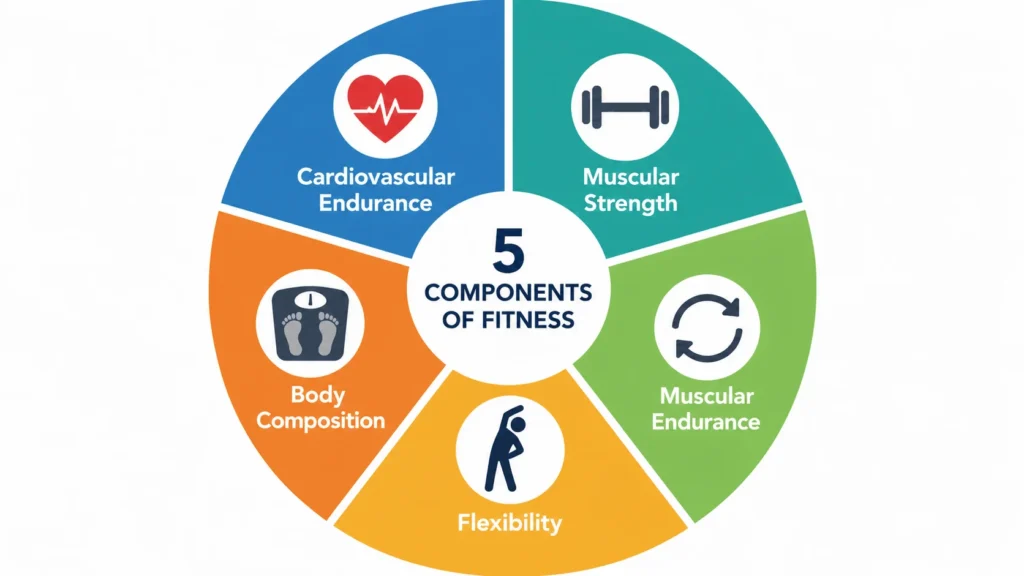
The 5 components of fitness are cardiovascular endurance, muscular strength, muscular endurance, flexibility, and body composition. Together they describe how well your body handles sustained activity, generates force, recovers, moves through a full range of motion, and carries fat versus lean tissue.
Why These Five Categories Exist
Fitness isn’t one skill. A marathoner with strong lungs can still struggle to lift a suitcase overhead, and a powerlifter with serious strength can run out of breath climbing three flights of stairs. The American College of Sports Medicine (ACSM) uses this five-part breakdown in its physical activity guidelines because it separates the qualities that predict long-term health from the ones that only matter for sport performance. Training all five, rather than defaulting to your favorite one, is what actually lowers disease risk and keeps you functional as you age.
Cardiovascular Endurance
1. What It Measures
Cardiovascular endurance, sometimes called cardiorespiratory endurance, is how long your heart, lungs, and blood vessels can keep delivering oxygen to working muscles. A runner who sprints hard for 30 seconds and then needs five minutes to recover has low cardiovascular endurance, even if their top speed is impressive.
2. How to Test It
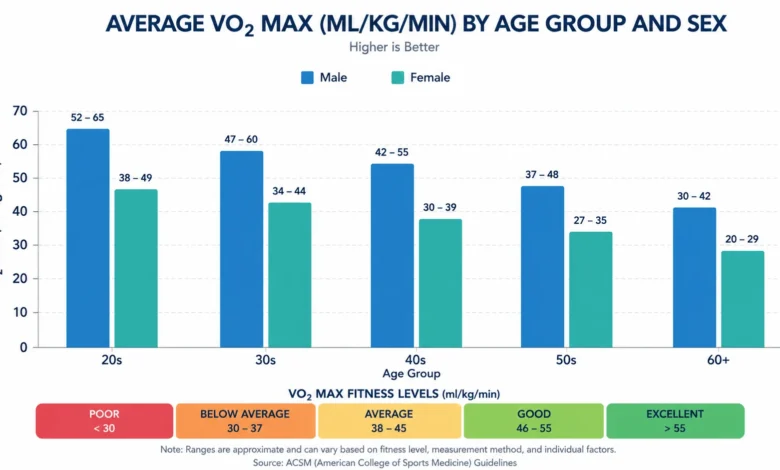
The 12-minute Cooper Run, where you cover as much distance as possible in 12 minutes, is a common field test. A 1.5-mile timed run works the same way. Many wearables also estimate VO2 max, which is a lab-grade measure of how efficiently your body uses oxygen during exercise.
3. How to Improve It
Running, cycling, swimming, and rowing all build this component. ACSM recommends 150 to 300 minutes of moderate aerobic activity per week, or 75 to 150 minutes of vigorous activity, spread across most days rather than crammed into one session.
Muscular Strength
1. What It Measures
Muscular strength is the maximum force a muscle or muscle group can produce in a single effort, like the heaviest weight you can lift once in a deadlift or bench press.
2. How to Test It
A one-rep max test, done safely with a spotter or machine, is the standard measure. A grip strength dynamometer is a quicker, lower-risk substitute that still correlates with overall strength.
3. How to Improve It
Resistance training in the 4 to 6 rep range with heavier loads builds maximum strength most efficiently. Squats, deadlifts, and overhead presses target the largest muscle groups and give you the most return per session.
Muscular Endurance
1. What It Measures
Muscular endurance is different from strength. It’s how many times a muscle can contract, or how long it can hold a position, before fatigue sets in. Someone who can do 40 push-ups but can’t bench press their own body weight has strong muscular endurance and comparatively modest strength.
2. How to Test It
A push-up test to failure, a plank hold for time, or a max rep set of bodyweight squats all work as simple benchmarks you can repeat every few weeks to track change.
3. How to Improve It
Higher-rep training, generally 12 to 20 reps per set with lighter loads, builds endurance rather than raw strength. Circuit-style workouts that move quickly between exercises train this component especially well.
Flexibility
1. What It Measures
Flexibility is how far a joint or group of joints can move through its full range of motion without pain or restriction. Tight hamstrings that keep you from touching your toes are a flexibility limitation, not a strength one.
2. How to Test It
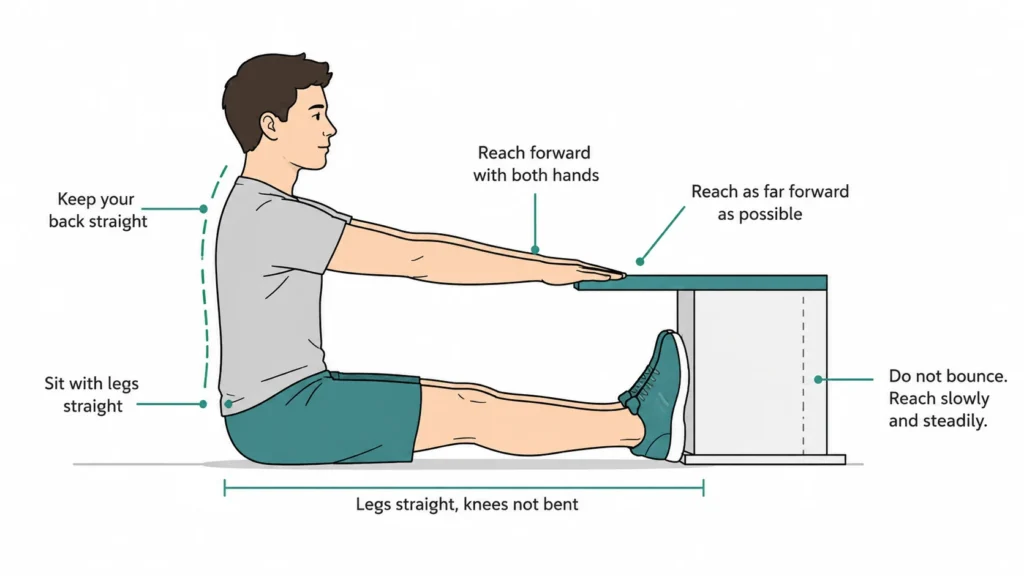
The sit-and-reach test, where you extend forward from a seated position and measure the distance reached, is the most common school and clinic screen, though it mainly reflects hamstring and lower-back flexibility rather than the whole body.
3. How to Improve It
Static stretches held for 10 to 30 seconds, repeated two to four times per muscle group, are the standard protocol. Yoga and dynamic mobility drills before a workout also help, particularly for people who sit most of the day.
Body Composition
1. What It Measures
Body composition is the ratio of fat mass to fat-free mass, meaning muscle, bone, organs, and water. Two people with the same body weight can have very different body compositions, and it’s a more useful health marker than the number on a scale alone.
2. How to Test It
Waist circumference above 40 inches in men or 35 inches in women is linked to higher chronic disease risk. More precise options include skinfold calipers, bioelectrical impedance scales, and DEXA scans, which are the most accurate but usually require a clinical or specialty setting.
3. How to Improve It
Body composition responds to the other four components combined with nutrition. Building lean muscle through resistance training while managing calorie intake shifts the ratio more reliably than cardio or diet changes alone.
The Skill-Related Components Most Guides Skip
Health-related fitness covers the five components above, but sports and movement quality draw on a second category: skill-related fitness. This includes balance, coordination, agility, speed, power, and reaction time. These matter less for baseline health but heavily affect athletic performance and fall prevention, especially later in life. A basketball player’s ability to change direction fast depends on skill-related fitness, not just the five health components. If you’re training for a sport rather than general health, this second category deserves its own attention alongside the main five.
Building a Routine That Covers All Five
A balanced week doesn’t need to be complicated. Two or three days of resistance training covering major muscle groups builds strength and muscular endurance together. Two to five days of aerobic activity, mixing steady-state cardio with occasional intervals, covers cardiovascular endurance. Ten minutes of stretching after workouts, or a weekly yoga session, maintains flexibility. Body composition improves as a byproduct of the other four, paired with consistent eating habits. Reassess with the tests above every four to eight weeks under similar conditions so the comparisons stay fair.
Bottom Line
The 5 components of fitness, cardiovascular endurance, muscular strength, muscular endurance, flexibility, and body composition, work as a set, not a menu to pick from. Test each one, train the ones you’re neglecting, and retest every few weeks to see which parts of your routine are actually moving the needle.
FAQ’S
1. What are the 5 components of fitness?
They are cardiovascular endurance, muscular strength, muscular endurance, flexibility, and body composition. Health organizations like ACSM use this breakdown to guide physical activity recommendations for general health rather than sport-specific performance.
2. What’s the difference between muscular strength and muscular endurance?
Strength is the maximum force a muscle can produce in one effort, like a heavy deadlift. Endurance is how many times that muscle can contract, or how long it can hold a position, before it fatigues.
3. Which component of fitness is most important?
None of them works well alone. Cardiovascular endurance and body composition are the two most closely tied to long-term disease risk, but training only those two while ignoring strength and flexibility increases injury risk over time.
4. Are balance and agility part of the 5 components of fitness?
No. Balance, agility, coordination, speed, power, and reaction time fall under a separate category called skill-related fitness. They matter for sports performance and fall prevention but aren’t part of the core five health-related components.
5. How often should I retest my fitness components?
Every four to eight weeks is enough to see meaningful change without the noise of day-to-day fluctuation. Repeat the same test under similar conditions, like the same time of day and similar rest beforehand, to keep comparisons accurate.