

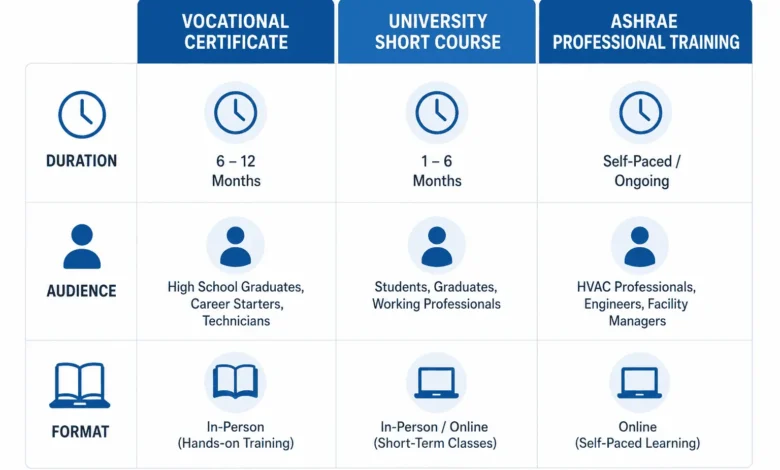
HVAC training teaches the design, installation, and maintenance of heating, ventilation, and air conditioning systems, usually through a mix of classroom theory, design software, and hands-on practice with equipment. Programs range from short vocational certificates to university-affiliated diplomas, and the right one depends on whether you’re starting a trade career or adding a technical skill to an existing engineering role.
What HVAC Training Actually Teaches
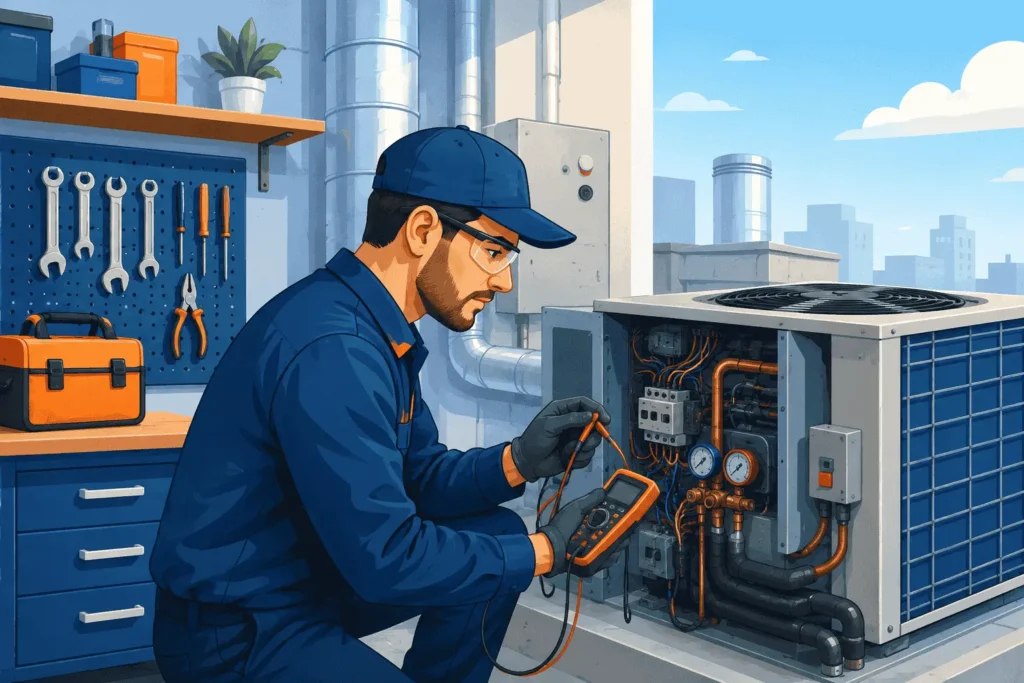
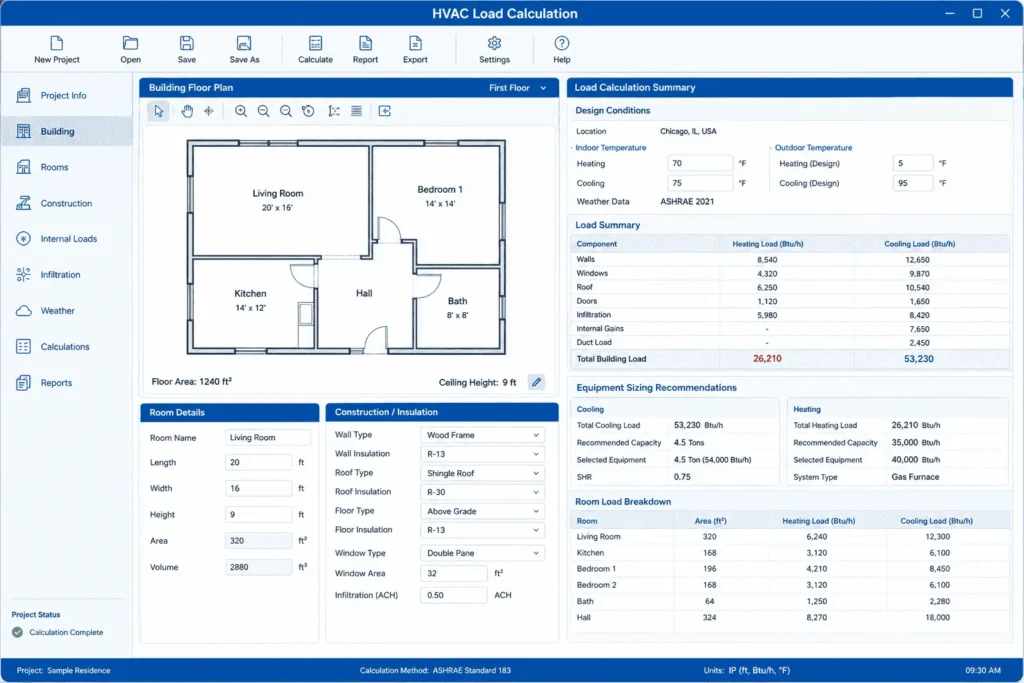
Most programs split into two halves: the science behind how a system moves heat and air, and the practical skills needed to design, install, or service one. The theory side covers psychrometrics, load calculation, refrigeration cycles, and ventilation standards such as ASHRAE 62.1, which sets acceptable ventilation rates for different building types. The applied side is where students spend time with design software, most commonly Trane’s HAP (Hourly Analysis Program), along with duct sizing, equipment selection, and troubleshooting real units. A student who only memorizes formulas without running a load calculation on actual building data usually struggles once they’re on a job site, because the software interface and the underlying math rarely match up cleanly on the first try.
Types of HAVC Training Programs
1.Vocational and Certificate Courses
Vocational HVAC courses target people entering the trade directly, often technicians, electricians, or workers already doing HVAC maintenance who want a formal credential. These run in stages, commonly labeled Level 1 through Level 3, moving from fundamentals and load calculation to full system design and energy management. 3D Educators in Karachi, for example, structures its Certified HVAC and Refrigeration program this way, with the first level covering HAP software and ASHRAE ventilation guidelines before students move into hydronic and air system design.
2.University-Affiliated Diploma and Short-Course Programs
Some universities run HVAC training through a professional development or continuing-education arm rather than a full degree program. NED University’s academy in Karachi offers short courses on air conditioning design and industrial applications, aimed at working engineers who want a specific skill, such as HVAC audits or waste heat recovery calculations, without committing to a multi-year diploma.
3.Professional Body Training and Certification
ASHRAE, the American Society of Heating, Refrigerating and Air-Conditioning Engineers, runs its own training through the ASHRAE Learning Institute. These courses target engineers and designers who already work in the field and need continuing education credits or a deeper grounding in a specific area, such as HVAC control systems or Level I and Level II design essentials. This path assumes more prior technical background than a beginner vocational course does.
What a Typical HAVC Training Course Covers
Course content varies by level, but most beginner-to-intermediate programs work through the same core sequence: building envelope and heat load factors, internal and external load calculation, humidity and temperature control, system sizing, and equipment selection. Later stages add hydronic system design, air distribution, and energy management concepts. Software training is usually built into the course rather than taught separately. Students learn to input building data into a load calculation tool, interpret the output, and use those numbers to size equipment correctly rather than guessing at capacity.
How Long does HAVC Training Take
Vocational HVAC certificate levels typically run for a few months each when taken part-time, often as weekly evening or weekend classes, since many students are already working. A full sequence through three levels can take a year or more when spread out this way. University short courses and single-topic ASHRAE seminars are much shorter, sometimes a single day or a few sessions, because they target one narrow skill rather than a full curriculum. Stat needed here: exact average completion times vary widely by country and institution, and no single verified figure covers all program types, so treat the ranges above as general guidance rather than a fixed timeline.
How much does HAVC Training Cost
Cost depends heavily on the type of program and the country offering it. University-run short courses in Pakistan, for instance, have listed individual course fees in the range of a few thousand to around twenty thousand Pakistani rupees per participant, based on NED Academy’s published course pricing. Vocational certificate programs and ASHRAE-affiliated professional courses run on different pricing structures entirely, often quoted per level or per credit hour rather than as a flat course fee, so it’s worth confirming current pricing directly with the institution before enrolling.
Do you Need a Degree to Start HAVC Training
Not for vocational or trade-focused programs. Most certificate-level HVAC courses list a minimum requirement of secondary school completion, sometimes explicitly noting that current HVAC workers, technicians, or labor staff without formal engineering backgrounds can enroll. University-run diploma and short-course programs, and especially ASHRAE-level design training, generally assume some engineering or technical background, since the material builds on concepts like heat transfer and fluid mechanics that a beginner course won’t cover in depth.
How to Choose the Right HAVC Training Program
Start with what you already do and what you want the credential to open up. Someone working as an HVAC technician who wants a formal certification should look at vocational Level 1 to Level 3 programs, since they build practical design and troubleshooting skills in sequence. An engineer who already has the fundamentals and needs a specific skill, like reading ASHRAE ventilation standards correctly or running an energy audit, is better served by a short, focused course from a university academy or ASHRAE itself. Check whether the certificate is recognized by a body you actually need it recognized by. A program that issues its own institutional certificate is not the same as one tied to an internationally recognized credentialing body, and the difference matters more in some job markets and industries than others.
The bottom line
HVAC training isn’t one fixed path. A technician building a trade career, an engineer adding a design specialty, and a facilities manager doing an energy audit all need different programs, at different depths, from different providers. Match the course level to where you’re starting from, confirm what the certificate is actually recognized for, and check current pricing and schedules directly with the institution before committing.
FAQ’S
1.What is hvac training?
HVAC training teaches the design, installation, and maintenance of heating, ventilation, and air conditioning systems. Courses combine classroom instruction on load calculation and ventilation standards with hands-on or software-based design practice.
2. Do I need a degree for hvac training?
No, not for most vocational or certificate-level courses, which are often open to secondary school graduates or current HVAC workers. University short courses and ASHRAE-level design training generally expect some existing engineering background.
3. How long does an hvac certificate take to complete?
It depends on the program. Vocational certificate levels often run a few months each when taken part-time, while single-topic university or ASHRAE seminars can take as little as a day.
4. What software do hvac students learn?
Most programs teach a load calculation tool, commonly Trane’s HAP software, alongside duct sizing and equipment selection based on the calculated loads.
5. Is ASHRAE certification the same as a vocational HVAC certificate?
Most programs teach a load calculation tool, commonly Trane’s HAP software, alongside duct sizing and equipment selection based on the calculated loads.