

Is agave good for you? Not in any special way. Agave nectar is an added sugar with a low glycemic index and a very high fructose content, so it works as an occasional sweetener but does not deserve a health halo.
Most of the confusion comes from marketing. Bottles often show a desert plant, the word “natural,” and a promise of gentle effects on blood sugar. This article covers what the research says, who should be careful, and how much is reasonable to use.
This article is general information for adults in the United States and is not medical advice. If you have diabetes, prediabetes, fatty liver disease, or a digestive condition, talk with your doctor or a registered dietitian before changing how you sweeten food.
What Agave Nectar Is and How It Is Made
Agave nectar, also sold as agave syrup, comes from the blue agave plant (Agave tequilana) and related species grown mostly in Mexico. The same plant is used to make tequila, but the syrup follows a different process.
The heart of the plant, called the piña, stores carbohydrates known as fructans, or agavins. Producers press out the juice, then heat it or treat it with enzymes, which break the fructans into simple sugars, mostly fructose with some glucose. The liquid is filtered and cooked down into a syrup.
That step changes what you are eating. The raw plant contains fibers that behave differently in the body, but the bottle on a store shelf is mostly free sugar. Light, amber, and dark versions differ in how long the syrup is processed and how strong the flavor is.
The FDA has no set definition of “raw” for agave syrup, so the word tells you little about how the product was made.
Agave Nutrition Facts Per Tablespoon
One tablespoon of agave nectar, about 21 grams, has close to 60 calories and roughly 15 to 16 grams of sugar, based on USDA FoodData Central listings. It contains almost no protein, fat, fiber, vitamins, or minerals worth counting.
For comparison, a tablespoon of table sugar has about 49 calories, honey about 64, and pure maple syrup about 52. Agave lands in the same range, so calories alone do not separate these sweeteners.
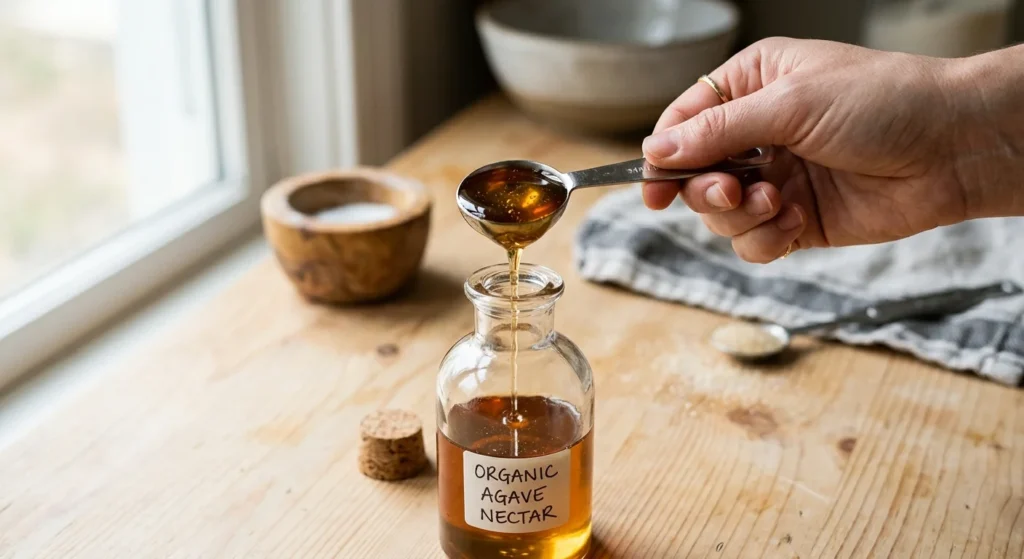
What separates them is the type of sugar. Agave is sweeter by weight than table sugar, which tempts people to use less, but the sugar it delivers is unusually heavy in fructose.
The Glycemic Index Argument
Agave’s main selling point is a low glycemic index (GI), a scale that measures how quickly a food raises blood glucose. Published values for agave nectar generally fall somewhere between the teens and about 30, compared with roughly 65 for table sugar.
The reason is chemical. Fructose barely moves blood glucose right after a meal because the liver handles most of it, and agave is mostly fructose. Glucose is the sugar that drives the quick spike.
A low GI number is not a health certificate. Fructose avoids the glucose spike by taking a different route through the body, and that route has its own costs.
Why the Fructose Content Matters
Depending on the brand, agave nectar is reported to be roughly 70 to 90 percent fructose. Table sugar is about 50 percent fructose, and the high-fructose corn syrup used in soft drinks is typically 42 or 55 percent.
Glucose can be used by cells throughout the body, but fructose is processed mostly in the liver. When intake is high, the liver turns some of it into fat. A 2010 review in Physiological Reviews by Luc Tappy and Kim-Anne Lê linked large amounts of fructose to higher blood triglycerides, fat buildup in the liver, and reduced insulin sensitivity.
Dose is the catch. Those effects show up mainly with heavy, regular intake, often from sweetened drinks, and not from a teaspoon of syrup in tea. Many of the trials behind those findings used large fructose doses.
Whole fruit is a different case. The fructose in an apple arrives with fiber, water, and a much smaller sugar load, so comparing fruit to a syrup is misleading.
Is Agave Safe for People With Diabetes?
Agave raises blood glucose more slowly than sugar, but that does not make it a recommended choice. Diabetes organizations, including the American Diabetes Association, treat agave as a sweetener that contains carbohydrates and calories, so it still has to fit into a meal plan.
Some people with type 2 diabetes use small amounts without trouble. The heavy fructose load and its effect on liver fat are the reasons agave is hard to justify as a swap for sugar, especially for people who already have a higher risk of fatty liver.
If you are managing blood sugar, check your readings after trying any new sweetener and review it with your care team. Responses vary from person to person.
How Agave Compares With Sugar, Honey, and Maple Syrup
1. Agave vs. Table Sugar
Table sugar is half glucose and half fructose. Agave leans heavily toward fructose, which explains its low GI and also its heavier demand on the liver. Because it tastes sweeter, you may use less, but it is still an added sugar.
2. Agave vs. Honey
Honey is roughly 38 percent fructose and 31 percent glucose, so its sugar mix is more balanced. It also carries small amounts of antioxidants and trace minerals, although the quantities are modest. Honey has a higher GI than agave, and the Centers for Disease Control and Prevention advises against giving it to infants under 12 months because of botulism risk.
3. Agave vs. Maple Syrup
Pure maple syrup is mostly sucrose and supplies some manganese and riboflavin. Its GI sits in the 50s, higher than agave, but its fructose load is far smaller. For a person worried about liver fat or IBS, that difference counts.
None of the four is a clear health winner. Choose by flavor and how you plan to use it, and treat all of them as added sugar.

Does Agave Offer Any Real Benefits?
A few, with limits. Agave dissolves easily in cold drinks, has a mild flavor, and is plant-based, which suits people who avoid honey. Its sweetness lets some people measure out smaller portions.
You may also see claims about inulin and agavins, which are prebiotic fibers found in the plant. Research on these compounds has focused on the raw plant and on purified fiber ingredients. The syrup itself has mostly lost them to the sugar-conversion step, so it is not a meaningful source of fiber.
Some supplement brands sell agave inulin as a separate fiber product. That is a different item from the nectar in your pantry, and the two should not be confused.
Who Should Be Careful With Agave
People with hereditary fructose intolerance, a rare genetic condition, must avoid fructose entirely and should not use agave. Anyone who has been diagnosed with it will already have dietary instructions from a physician.
People with irritable bowel syndrome or fructose malabsorption often react to foods with more fructose than glucose. Monash University, which developed the low FODMAP diet, groups excess fructose among the triggers, and agave fits that pattern. Maple syrup or table sugar in small portions is usually easier to tolerate.
Those with fatty liver disease, high triglycerides, or gout also have reason to limit it, since fructose is tied to liver fat and raises uric acid. Children need attention too, as the American Heart Association recommends no added sugar for children under 2.
What Research Exists on Agave Itself
Direct human research on agave nectar is thin. Most of what we know comes from studies on fructose in general, plus a handful of small animal and short-term human experiments that tested agave against other sweeteners.
That gap matters when reading health claims. A product page that cites agave’s low GI is pointing to a real measurement, but the same page rarely mentions long-term outcomes because few long-term trials exist. Treat confident promises with caution, and base your choices on the broader added-sugar evidence.
This is also why major health bodies group agave with other added sugars instead of giving it separate treatment.
Agave in Packaged Foods and Drinks
Agave shows up in granola bars, flavored yogurts, kombucha, protein bars, and “no refined sugar” snacks. On a label, it is still an added sugar, and the U.S. Nutrition Facts panel counts syrups like it under added sugars.
Phrases like “sweetened with agave” or “no cane sugar” are marketing choices, not nutrition claims. Compare the grams of added sugar per serving between products and ignore the front of the package.
Tequila is also made from agave, but the distilled spirit contains no meaningful sugar and is not a health food. Margarita mixes, though, often contain plenty of sugar, and alcohol carries its own risks that are unrelated to the sweetener question.
How Much Agave Is Reasonable
The American Heart Association recommends no more than 36 grams (9 teaspoons) of added sugar a day for most men and 25 grams (6 teaspoons) for most women. Children ages 2 to 18 should stay under 25 grams.
One tablespoon of agave holds about 15 to 16 grams of sugar, which is more than half of the daily limit for most women. A teaspoon holds around 5 grams.
A teaspoon in coffee or tea fits comfortably. Pouring it over pancakes, blending it into a daily smoothie, and drinking a sweetened latte in the same day will use up the allowance quickly, since added sugar from every source counts toward the same limit.
Choosing a Sweetener by Situation
The best option depends on what you are doing with it, so a single winner does not exist.
For iced tea or cold coffee, agave dissolves without clumping, and a small amount works well. For hot oatmeal or a baked dish, maple syrup or a measured spoon of sugar gives you a flavor you can predict. If you cook for someone with IBS, skip agave and test small servings of other options. If you cook for someone managing diabetes, plan the portion as carbohydrate and talk it through with their dietitian.
The most reliable step is simply using less of any sweetener, since switching between them changes the type of sugar but not the amount.
Practical Ways to Use Agave Wisely
If you like the taste, a few habits keep it in perspective.
- Measure with a teaspoon instead of pouring straight from the bottle.
- Check that the ingredient list says only agave, with no added sweeteners or flavorings.
- Pair it with protein or fiber, such as plain Greek yogurt with oats, so the sugar arrives with food that slows digestion.
- In baking, start by replacing each cup of sugar with about two-thirds to three-quarters of a cup of agave, cut other liquid slightly, and lower the oven temperature by about 25°F, because agave browns faster.
- Store it at room temperature in a sealed bottle, away from heat.
Light agave suits tea, cocktails, and delicate sauces, while amber and dark versions add caramel notes that work better in marinades, granola, and baked goods.

So, is agave good for you? In small amounts, it is a reasonable sweetener for people who enjoy the flavor, and in large amounts it behaves like any other sugar, with a heavier fructose load than most.