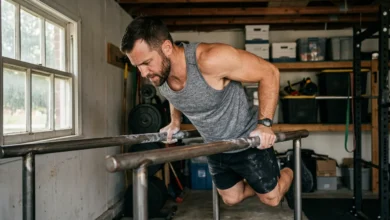


The army crawl is a floor based, full body exercise where you move forward on your forearms and toes while pulling with one arm and opposite leg at a time. It trains core stability, upper body pulling strength, hip control, and coordination, and it needs no equipment at all.
You will find it in military conditioning drills, bootcamp classes, and calisthenics programs across the US. The version most people actually train is the army crawl plank, a slower, more controlled variation that keeps the body raised in a forearm plank the entire time.
What Is an Army Crawl
An army crawl is a prone, ground based movement pattern. You start face down, propped on your forearms and toes, and pull yourself forward inch by inch using opposite arm and leg, similar to how soldiers move under low cover.
The exercise shows up in two common forms. The classic crawl travels across the floor for distance, while the army crawl plank stays in one place and moves the arms and legs without the hips or shoulders bouncing up and down.
Both versions ask your core to stay braced the entire time. Fitness platform ClassPass describes the setup as a forearm plank position with elbows on the mat and hands in loose fists, with one arm and the opposite leg moving forward together while the body stays low and steady.
Muscles the Army Crawl Works
The army crawl is a compound movement, so it recruits muscle groups from your shoulders down to your calves instead of isolating one area. Coverage from Tom’s Guide breaks the primary movers down into three regions.
Your shoulders, chest, biceps, and triceps drive the pulling and pushing action as you shift weight from arm to arm. Your core, including the rectus abdominis, obliques, and transverse abdominis, works to keep your hips from sagging or twisting. Your glutes, quads, hamstrings, and hip flexors handle the leg drag and keep your lower body from dropping to the floor.
Your grip and forearms also take on real work, since your hands or fists are bearing part of your body weight the whole time. That combination is why a short set of army crawls can leave your whole body fatigued in a way that a single isolation exercise usually does not.
How to Do an Army Crawl With Proper Form
Good form is what separates a productive army crawl from one that just wears out your lower back. Set up correctly first, then focus on control over speed.
1. Step by Step Setup
Start face down on a mat with your forearms on the ground, elbows stacked under your shoulders. Come up onto your toes so your hips lift off the floor and your body forms a straight line from your head to your heels, the same starting position as a standard forearm plank.
Brace your core before you move, the way you would before someone lightly pushes you. Keep your neck relaxed and your eyes looking a few feet ahead of you instead of straight down or straight up.
2. The Movement Pattern
Move one forearm forward a few inches while dragging the opposite leg forward at the same time. Keep your hips low and level, resisting the urge to let them rise into the air or sag toward the mat.
Repeat on the other side, alternating arm and leg in a slow, controlled rhythm. If you are doing the plank version in place, focus on quality reps rather than distance, moving each limb only far enough to feel your core and shoulders working.
Aim for short sets of 20 to 40 seconds to start, and rest fully between rounds. Two to three sessions a week is enough to build noticeable strength and endurance without overloading your shoulders.
Common Army Crawl Mistakes
Most army crawl problems come from letting the hips move instead of the limbs. Watching for these issues will save your lower back and get more out of each rep.
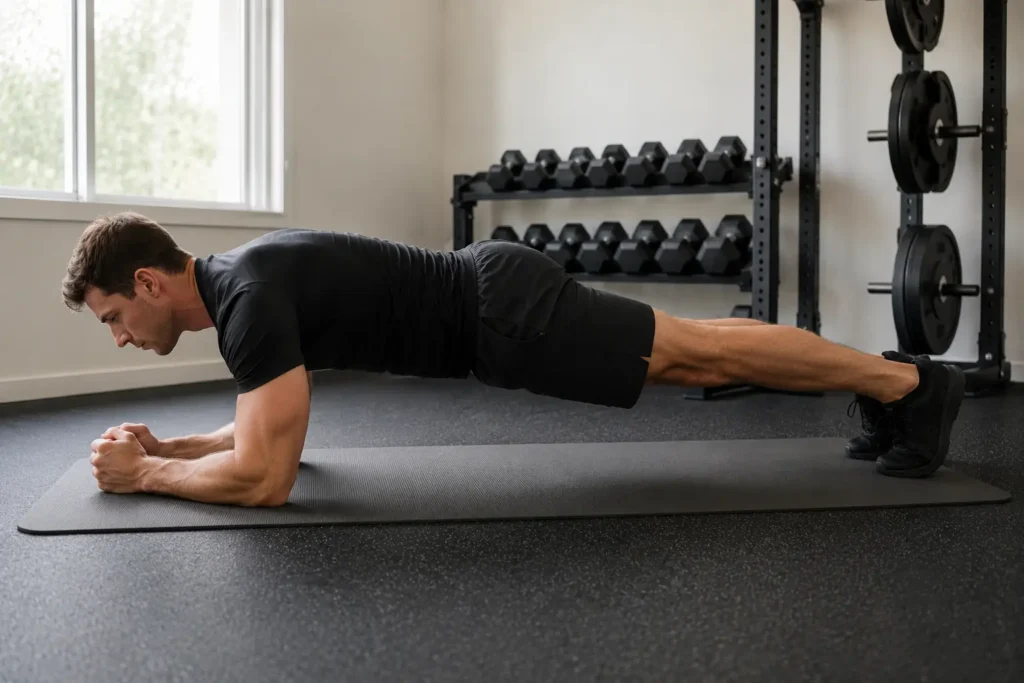
Letting the hips rise up turns the exercise into a walking motion instead of a plank, which takes tension off the core. Letting the hips sag pushes the work into the lower back instead of the abs, and it is the most common cause of soreness the next day.
Rushing the movement is another frequent issue, since fast, jerky reps rely on momentum instead of muscle control. Holding your breath is common too, so try to breathe steadily through the belly instead of locking your ribs and holding air in.
Army Crawl Variations
Once basic form feels solid, a few variations can change how much load falls on your shoulders versus your legs.
1. Army Crawl Plank
This is the stationary version most gyms actually teach. You stay in one spot and cycle your arms and legs through the full pattern without traveling across the floor, which makes it easier to control in a small space.
2. Loaded Army Crawl
Some bootcamp and military style classes add a weighted vest or have you drag a sled while crawling. This adds resistance to the pulling motion and increases the demand on your shoulders, back, and grip, so it is best saved for people who already move well through the basic pattern.
Who Should and Should Not Do Army Crawls
The army crawl suits people who already tolerate planks and light floor work comfortably, including recreational lifters, bootcamp participants, and anyone training for military fitness tests.

People with wrist pain, shoulder impingement, or recent lower back injuries should check with a physical therapist or doctor before adding it in, since the exercise loads the wrists and shoulders under body weight for an extended stretch. Pregnant individuals should also get guidance from their provider, since prone floor positions are not appropriate for every stage of pregnancy.
If any version causes sharp pain rather than normal muscle fatigue, stop and scale back to a standard forearm plank instead.
How to Add Army Crawls to a Workout
Army crawls work well as a finisher after strength training, since they hit the core and shoulders when they are already warm. They also fit into circuit style or bootcamp workouts alongside push ups, lunges, and mountain climbers.

A simple way to start is three rounds of 30 seconds of army crawl plank, resting 30 to 45 seconds between rounds, twice a week. As form and endurance improve, distance crawls or a light loaded version can be layered in.