
If you sit at a desk for most of the day, your shoulders have probably rounded forward without you noticing it. The wall angels exercise is one of the simplest tools for reversing that pattern, but most people rush through it and get almost no benefit. Done correctly, this move retrains your shoulder blades to sit in a better position, stretches a tight chest, and uses the wall itself as instant feedback on your alignment. Below is the exact technique, the small mistakes that quietly cancel out the exercise, and how to adjust it if the full range of motion feels impossible right now.
What Is the Wall Angels Exercise
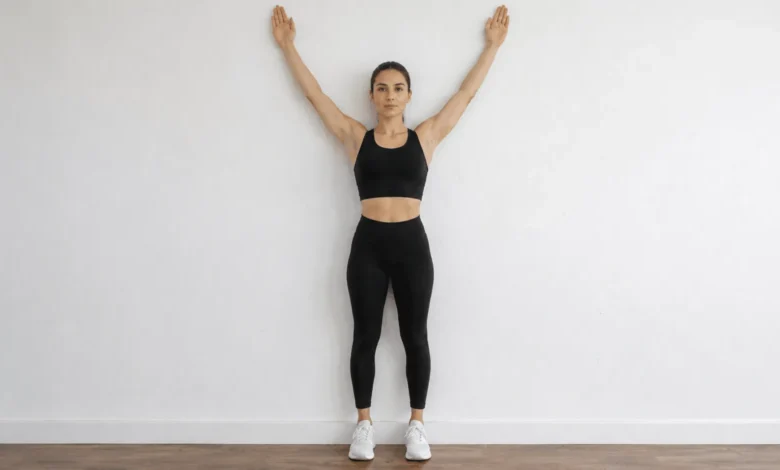
Wall angels are a standing mobility exercise performed with your back against a wall. You start with your arms bent at the elbows in a low W position, then slide them up the wall into a high V, and back down again. The name comes directly from that V to W arm path, and from the way the movement resembles a snow angel done vertically instead of on the ground. Some coaches also call it a V to W stretch, since it works as much as a chest opener as it does a strengthening drill.
What makes this exercise useful is the wall itself. Most people cannot see or feel when their shoulders round forward or their lower back arches too much during a normal shoulder stretch. Pressing your body against a flat surface removes that guesswork. If your arm, shoulder, or lower back loses contact with the wall during the movement, you know immediately where your form is breaking down, without needing a mirror or a second person watching you.
What Muscles Does the Wall Angels Exercise Work?
Wall angels train the muscles that hold your shoulder blades back and down, which is exactly the position that collapses when you slouch. The rhomboids and the middle and lower trapezius do most of the pulling, drawing your shoulder blades together and stopping them from winging forward. The serratus anterior, a muscle that wraps around your ribcage, helps rotate the shoulder blade as your arms travel overhead, and weak serratus function is a common reason people feel stuck partway through the movement.
At the same time, the exercise stretches the muscles that get tight from sitting and pressing movements. Your pectoralis major and minor, across the front of your chest, lengthen as your arms move into the V position. Your deltoids and rotator cuff muscles stay active throughout, controlling the arms as they slide up and down the wall in a slow, deliberate path rather than a loose swing.
How to Do Wall Angels Correctly (Step by Step)
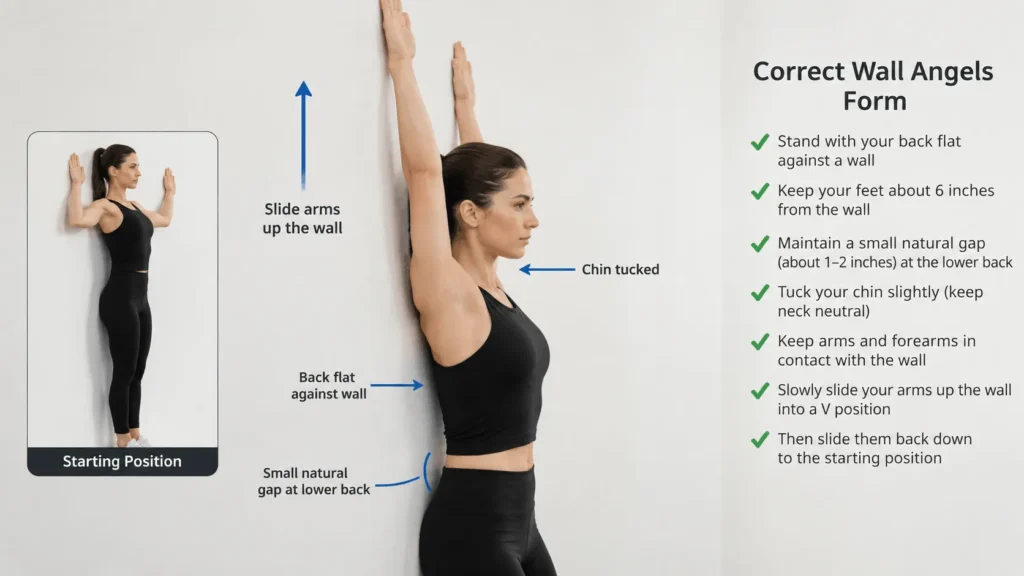
- Stand with your feet six to eight inches away from the wall, then lean back so your head, upper back, and glutes touch the wall.
- Flatten your lower back slightly by tilting your pelvis under, similar to tucking your tailbone forward, since a small gap between your lower back and the wall is normal and expected.
- Tuck your chin so the back of your head rests against the wall without tilting your head backward.
- Bring your arms up to shoulder height with your elbows bent at roughly 90 degrees, pressing your forearms and the backs of your hands into the wall. This is your starting W position.
- Slowly slide your arms upward along the wall until they straighten overhead in a V, keeping your wrists, elbows, and hands in contact with the wall for as long as you can manage.
- Pause briefly at the top, then reverse the movement back to the W position, taking three to four seconds on the way up and the way down.
- Repeat for eight to twelve slow repetitions, resetting your posture against the wall if your lower back arches or your shoulders shrug upward at any point.
Common Mistakes That Cancel Out the Exercise
The most common error is arching the lower back to force the arms flat against the wall. This turns a shoulder exercise into a lower back stretch and defeats the purpose of the movement entirely. It is better to keep a small gap at your lower back and only raise your arms as high as you can without losing that position.
Shrugging the shoulders toward the ears is another frequent mistake. Wall angels should be driven by the shoulder blades gliding down and together, not by the traps hiking upward toward your neck. If you notice your shoulders creeping up, lower the height of your arms slightly and focus on pulling your shoulder blades down before you move them at all.
Moving too fast is a third issue. Wall angels are a control exercise, not a stretch you bounce through or a warm up to rush past. Rushing the repetitions makes it easy to miss the exact point where your form breaks down, which is the whole point of doing this against a wall in the first place.
A fourth mistake is forcing your hands to touch the wall at the top of the V. If your shoulders are tight, your hands may only get partway up before your lower back or ribs start to lift off the wall. Stopping short of full range with good form beats reaching full range by sacrificing your alignment.
How to Modify Wall Angels If They Feel Too Hard or Too Easy
If a full V position feels impossible, reduce the range of motion. Raise your arms only as far as you can while keeping your forearms and lower back in their correct position, even if that means stopping well below shoulder height. Range of motion improves with practice, and a shorter, well-controlled repetition is more useful than a longer one done with poor form.
A seated version works well if standing against a wall is uncomfortable, or if you want to fit the exercise into a break at your desk. Sit in a chair with your back flat against a wall or a firm chair back, then run through the same arm pattern without the added demand of holding your whole body upright.

If you want more of a challenge, add a light resistance band looped around your wrists as you perform the movement, which is useful for athletes doing a lot of overhead lifting or throwing. You can also increase the difficulty by pausing for a two count at the top of the V and the bottom of the W instead of moving straight through. For a version without a wall, lie on your back on the floor with your knees bent, press your lower back gently into the floor, and run your arms through the same V to W pattern using the floor as your feedback surface instead of a wall.
Benefits of Doing Wall Angels Regularly
The main benefit of wall angels is postural awareness. The exercise teaches your body what a neutral, upright position actually feels like, which carries over into how you sit and stand once you step away from the wall and go about your day.
Wall angels also improve shoulder mobility, which matters for overhead activities like reaching into a high cabinet, lifting objects above your head, or pressing weight overhead in the gym. Because the exercise stretches the chest while strengthening the upper back at the same time, it directly addresses the muscle imbalance created by long hours at a desk or a training program heavy on pressing movements.
Many people also use wall angels as a short warm up before upper body training, since the exercise activates the shoulder blade muscles without adding meaningful fatigue. A minute or two of wall angels before an overhead press or pull up session can improve how your shoulder moves through the rest of the workout.
Results from wall angels show up on two different timelines. Shoulder mobility, meaning how far your arms travel before your form breaks down, tends to improve within a few weeks of consistent practice. Visible posture change takes longer, since posture is shaped by everything you do during the day, not just the few minutes you spend on this exercise. Wall angels work best as one part of a broader habit of sitting upright, taking movement breaks, and strengthening the upper back, rather than as a standalone fix.
How Often Should You Do Wall Angels?
Wall angels are low intensity, so they tolerate frequent practice better than most strength exercises. Two to three sets of eight to twelve slow repetitions, done most days of the week, is a reasonable starting point for improving posture and shoulder mobility over time.
If you are using wall angels as a warm up before training, one set is usually enough to activate the shoulder blade muscles before you move into heavier work. If your goal is correcting a long standing postural habit, spreading a few short sessions across the day, such as during work breaks, tends to work better than one longer session in the evening.
When Wall Angels Are Not a Good Fit
Wall angels are generally low risk, but they are not the right exercise for everyone. Stop immediately if you feel sharp or pinching pain in your shoulder, since this can point to an impingement issue that gets worse with overhead movement rather than better.
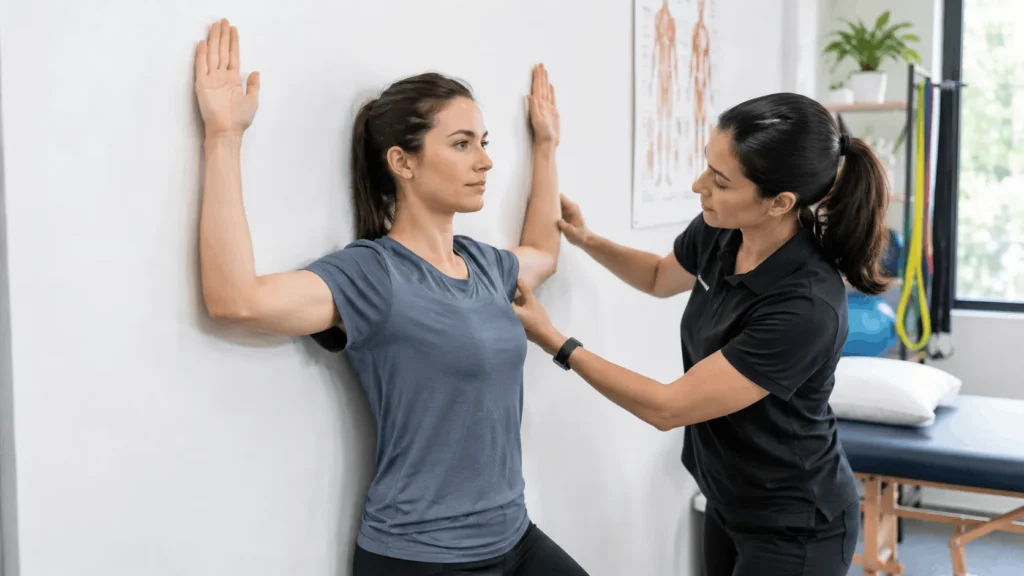
If you have a diagnosed shoulder injury, a rotator cuff tear, or a structural spine condition such as significant scoliosis, talk to a physical therapist or doctor before adding this exercise to your routine. They can tell you whether the standard version is appropriate or whether a modified range of motion is a safer place to start.
Mild discomfort from stretching a tight chest or working an unfamiliar movement pattern is normal in the first few sessions. Pain that is sharp, one sided, or that lingers after you stop the exercise is not normal, and is a signal to stop and get it checked rather than push through it.