
Building a strong upper body changes how you carry groceries, lift your kids, and hold your posture at the end of a long day. An upper body workout for women at the gym targets the chest, back, shoulders, and arms in one session, and it does not require hours on the floor to work.
Many women still avoid upper body training because they worry it will make them look bulky. That fear is misplaced. Building visible size requires a specific combination of heavy progressive loading, a calorie surplus, and often years of consistent training. A regular upper body routine two to three times a week builds strength, improves posture, and creates the toned, defined look most women are actually after.
This guide walks through a full gym-based upper body workout for women, including warm-up moves, the best exercises for each muscle group, a sample routine with sets and reps, and how to progress it over time.
Why Upper Body Strength Training Matters for Women
Upper body strength is not just about how your arms look in a tank top. It affects your ability to push open a heavy door, carry a suitcase up a flight of stairs, or catch yourself if you trip.
Resistance training in the chest, back, and shoulders also supports bone density. Women lose bone mass faster than men after menopause, and lifting weights is one of the most effective ways to slow that process. Strengthening the upper back specifically counters the forward-rounded posture that comes from sitting at a desk or looking down at a phone all day.
There is also a metabolic benefit. Muscle tissue burns more calories at rest than fat tissue does. Adding upper body muscle through consistent training raises your baseline calorie burn, which supports long-term weight management without extra cardio.
How to Warm Up Before an Upper Body Workout
Cold muscles are more prone to strain, especially around the shoulder joint, which is one of the most mobile and least stable joints in the body. Spend five to eight minutes warming up before you touch a weight.
Dynamic Warm-Up Sequence
Start with arm circles, ten forward and ten backward, to loosen the shoulder capsule. Follow with band pull-aparts for fifteen reps to activate the muscles between your shoulder blades. Finish with two sets of ten scapular push-ups, a small range-of-motion push-up that wakes up the muscles stabilizing your shoulder blades.
If your gym has a rower or an assault bike, two minutes of light cardio before your warm-up drills raises your heart rate and increases blood flow to the muscles you are about to train.
The Best Upper Body Exercises for Women at the Gym
A complete upper body workout covers four muscle groups: chest, back, shoulders, and arms. Training all four in one session, rather than isolating just one, builds balanced strength and avoids the muscle imbalances that lead to poor posture and shoulder pain.
1: Chest Exercises
The chest press machine is the most beginner-friendly chest exercise because the seat and handles guide your range of motion. Once you are comfortable with the movement pattern, the flat dumbbell bench press builds more stabilizer strength because you control the weight path yourself.
The cable chest fly isolates the chest without involving the triceps as much as a press does, which makes it useful for building definition once your strength base is established.
2: Back Exercises
The lat pulldown teaches the pulling pattern that many women have never trained, since most daily movements involve pushing. Keep your torso still and pull the bar to your upper chest rather than yanking with your lower back.
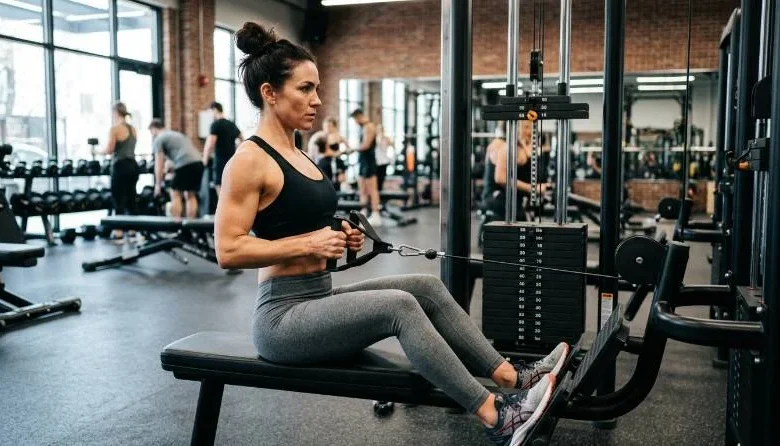
The seated cable row builds the mid-back muscles that pull your shoulders back and down, directly counteracting a hunched posture. Add single-arm dumbbell rows once you want extra core stability work.
3: Shoulder Exercises
The seated dumbbell shoulder press targets the front and middle deltoid and is safer for beginners than a standing version, since the bench removes the temptation to arch your lower back. Lateral raises with light dumbbells isolate the middle deltoid, which is the muscle most responsible for shoulder width and definition.
4: Arm Exercises
Bicep curls with a dumbbell or cable attachment build the front of the upper arm, while tricep pushdowns on a cable machine target the back of the arm, the area most women specifically want to tone.

Sample Upper Body Workout Routine for Women
This routine takes about 40 to 50 minutes and works well as a standalone gym session or paired with a lower body day later in the week.
Full Workout Plan
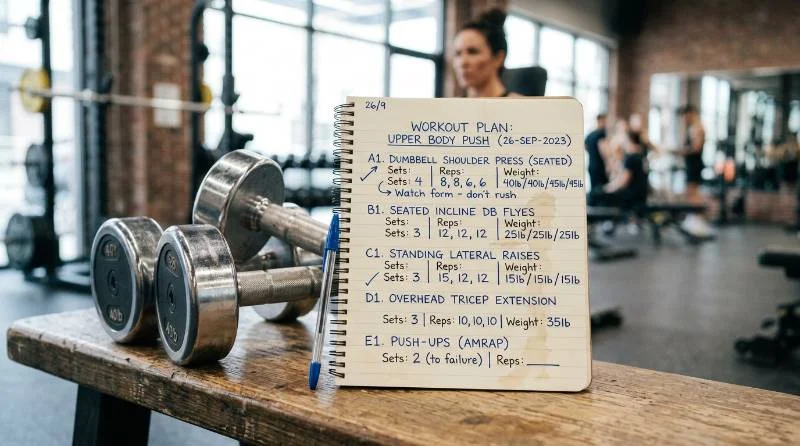
Chest press machine: 3 sets of 10 to 12 reps. Seated cable row: 3 sets of 10 to 12 reps. Seated dumbbell shoulder press: 3 sets of 10 reps. Lat pulldown: 3 sets of 10 to 12 reps. Lateral raises: 3 sets of 12 to 15 reps. Cable tricep pushdown: 2 sets of 12 reps. Dumbbell bicep curl: 2 sets of 12 reps.
Rest 45 to 60 seconds between sets for most exercises, and up to 90 seconds on the chest press and lat pulldown, since these involve larger muscle groups that need more recovery time.
How Often Should Women Train Upper Body
Two to three upper body sessions per week, with at least one rest day between them, gives your muscles enough time to recover and rebuild. Training the same muscle group on back-to-back days without recovery slows progress and raises injury risk.
If you are new to strength training, start with two sessions a week and add a third once the movements feel familiar and your recovery is consistent. More experienced lifters can split the routine into separate push days for chest and shoulders and pull days for back and arms, allowing four upper body sessions a week.
Common Mistakes That Slow Progress
Using momentum instead of muscle control is the most common error. Swinging the weight up during a curl or row shifts the work to your lower back and reduces the benefit to the target muscle. Slow down the lowering phase of each rep to keep tension on the muscle.
Skipping the back and shoulders in favor of only training the chest and arms creates a strength imbalance that pulls your posture forward over time. Treat all four muscle groups as equally important in every session.
Lifting too light for too long also stalls results. If you can easily complete more than 15 reps with good form, the weight is too light to build meaningful strength, and it is time to increase the load.
How to Progress Your Upper Body Workout Over Time
Progressive overload, gradually increasing the demand you place on your muscles, is what drives ongoing strength and definition gains. Once you can comfortably complete all sets and reps with solid form, increase the weight by the smallest available increment, usually 2.5 to 5 pounds.

Track your workouts in a notes app or workout log so you know exactly what you lifted last time. After four to six weeks on the same routine, consider changing exercise order, adding a new variation like an incline chest press, or adjusting rep ranges to keep challenging your muscles in new ways.
Consistency matters more than intensity in the early months. A woman who trains her upper body twice a week for six months will see far more change than someone who trains hard for two weeks and then stops.