


So, can you build muscle in a calorie deficit? Yes, but not for everyone and not at the pace of a bulk. People new to lifting, people coming back after time off, and people with a fair amount of body fat to lose can gain muscle while eating less than they burn. Lean, experienced lifters usually do better aiming to keep the muscle they have. This guide covers who gains, how much protein and training it takes, and how to tell whether your plan is working.
The Short Answer: It Depends on Your Training Experience
A deficit makes muscle gain harder, not impossible. A 2022 meta-analysis by Murphy and Koehler in the Scandinavian Journal of Medicine & Science in Sports found that energy deficits reduced gains in lean mass, while strength gains held up.
Picture a sliding scale. A true beginner can add visible muscle while dropping fat. An intermediate lifter may hold steady and add a little. An advanced lifter is mostly protecting what took years to build.
Why Eating Less Makes Muscle Harder to Build
Building muscle costs energy and amino acids. In a deficit, your body has to cover the energy gap first, which leaves less to spend on new tissue.
Recovery also takes a hit. Hard sessions feel heavier, sleep gets lighter for some people, and adding weight to the bar gets harder to sustain.
Stored body fat softens the problem. Someone with more fat to spare has a bigger energy reserve to draw on, which is why people with higher body fat tend to recompose more easily than lean lifters.
What the Research Actually Found
The most cited result is a 2016 trial by Longland and colleagues in The American Journal of Clinical Nutrition. Forty young men ate about 40 percent below their energy needs for four weeks while lifting and doing high-intensity intervals six days a week. The group eating 2.4 grams of protein per kilogram gained about 1.2 kg of lean mass and lost about 4.8 kg of fat. The group eating 1.2 grams per kilogram gained about 0.1 kg of lean mass and lost about 3.5 kg of fat.
That result is real, but it has limits. It lasted four weeks, used young men, and involved a training schedule most people cannot copy.
A 2020 review by Barakat and colleagues in the Strength and Conditioning Journal looked at body recomposition more broadly. It concluded that losing fat and gaining muscle at the same time is most realistic for beginners, people returning to training, and people with higher body fat. For trained lifters, it is possible only when protein, training, and energy intake are all dialed in.
Who Is Most Likely to Gain Muscle While Losing Fat
1. Beginners and People Returning to Training
A novice’s muscles respond to nearly any new stimulus, so a few months of consistent lifting can add muscle even on fewer calories. The same goes for someone who trained years ago and stopped, since regaining lost muscle is faster than building it the first time.
2. People Carrying Extra Body Fat
Extra fat acts as a fuel reserve, which cushions the energy shortfall. If you have a lot to lose, you can often eat in a deficit and still add lean tissue early on. The effect fades as you get leaner.
3. Experienced and Already Lean Lifters
For this group, the honest goal is retention. You will probably keep your muscle and may add a small amount, so strength is a better measure of success than size. If building is the priority, a stretch at maintenance calories or a small surplus will work faster.
How Much Protein You Need in a Deficit
A 2018 meta-analysis of 49 studies by Morton and colleagues in the British Journal of Sports Medicine found that muscle gains from resistance training leveled off around 1.6 grams of protein per kilogram of body weight per day. The upper end of the confidence range reached 2.2 grams. That works out to roughly 0.7 to 1.0 grams per pound.
For a 180-pound adult (about 82 kg), that is roughly 130 to 180 grams a day. The federal Recommended Dietary Allowance of 0.8 grams per kilogram is a minimum to prevent deficiency, not a muscle-building target.

In a deficit, aim for the higher half of that range and spread it over three or four meals so it is easy to hit. People with kidney disease should get medical guidance before raising protein.
How to Train So Your Body Keeps Its Muscle
Lifting is the signal that tells your body to keep, and sometimes add, muscle. The Physical Activity Guidelines for Americans, 2nd edition, set the minimum at two days a week of muscle-strengthening activity. For visible results, most lifters do better hitting each major muscle group about twice a week, which a 2016 meta-analysis by Schoenfeld and colleagues in Sports Medicine supported over once-a-week training.
Keep the load heavy and keep trying to add a rep or a small amount of weight over time. Build the plan around compound lifts like squats, presses, rows, and deadlift variations. If recovery slips, trim sets before you drop the weight on the bar.

Do cardio, but keep it moderate. Daily walking burns calories without cutting into lifting recovery the way long, hard runs can.
A Sample Week for a Beginner in a Deficit
Here is one workable setup. Lift full-body on Monday, Wednesday, and Friday, and walk on the other days.
Each session can include a squat or leg press variation, a pressing movement, a rowing or pulldown movement, and a hip hinge such as a Romanian deadlift, plus a couple of arm or core exercises. Do three sets of six to ten reps on the main lifts, stopping a rep or two before failure. When you hit ten clean reps on every set, add a little weight next session.
This is a starting template, not a prescription. Adjust it to your schedule, your joints, and your equipment.
How Big Should the Deficit Be?
Smaller is better here. Coaching sources that summarize the research commonly suggest roughly 250 to 500 calories a day below maintenance, which for most adults means losing about 0.5 to 1 percent of body weight per week.
A 2011 study by Garthe and colleagues in the International Journal of Sport Nutrition and Exercise Metabolism compared athletes losing about 0.7 percent of body weight weekly with athletes losing about 1.4 percent. The slower group gained lean mass, while the faster group did not meaningfully change.
A 180-pound person at 0.5 to 1 percent is about 0.9 to 1.8 pounds a week. If you are losing faster than that, the extra loss may be costing you muscle and training quality.
How to Tell Whether Your Plan Is Working
The scale alone will mislead you. Muscle gain and fat loss can cancel each other out, so your weight can stall while your body changes.
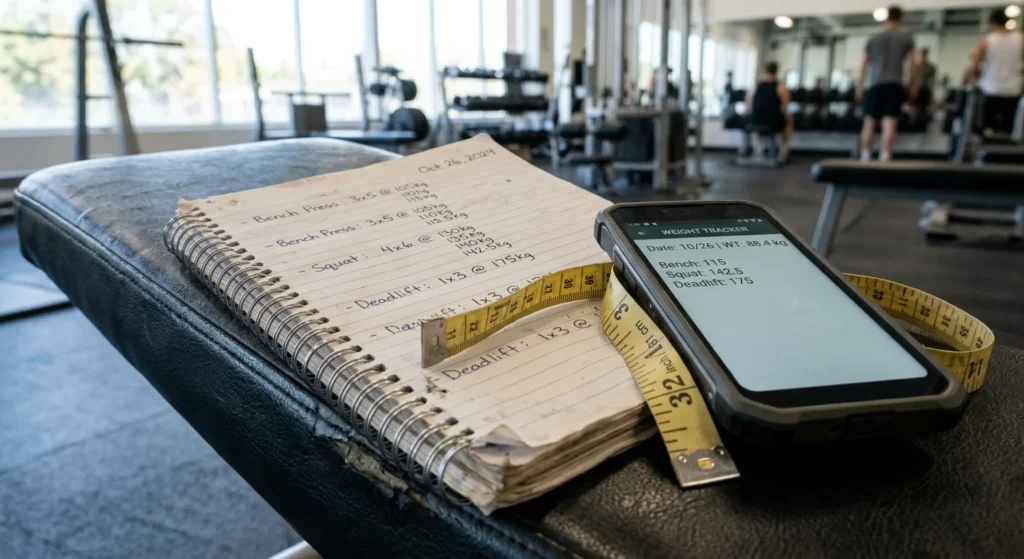
Track four things: your main lifts, your waist measurement, a weekly average of your body weight, and a photo every two to four weeks. If strength is holding or rising and your waist is shrinking, the plan is working.
Here is a simple rule from practical coaching, not a research finding. If your main lifts drop for two to three weeks in a row and you are losing more than 1 percent of body weight weekly, raise calories by 100 to 200 a day and reassess.
Sleep matters here too. The CDC recommends that adults get at least seven hours a night, and short sleep makes both hard training and a deficit feel worse.
Common Mistakes That Stall Progress
Four mistakes show up again and again. First, cutting calories too hard because faster feels better, which costs you training quality. Second, swapping lifting for cardio because cardio burns more calories per session. Third, eating protein at the old maintenance level of 0.8 grams per kilogram. Fourth, judging everything by the scale.
A fifth is changing programs every two weeks. Progressive overload needs a stable plan so you can see whether your numbers are climbing.
When to Stop Cutting and Eat at Maintenance
A deficit is not meant to run forever. When you reach a leaner weight, or when strength has stalled despite good sleep and protein, a few weeks at maintenance calories gives training quality a chance to recover.
Keep protein high and keep lifting. You can still improve body composition at maintenance, just more slowly than in a dedicated surplus.
Who Should Check With a Professional First
This article is general education, not medical advice. If you have diabetes or kidney disease, have a history of disordered eating, are pregnant, or take medication that affects appetite or weight, talk to your doctor before starting a deficit. A registered dietitian can set calorie and protein targets that fit your body and health history.