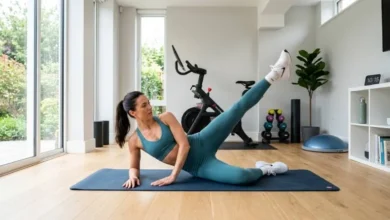

A 30 minute full body workout hits your legs, chest, back, shoulders, arms, and core in one session, using only your body weight. You do not need a gym, a rack of dumbbells, or an hour you don’t have. This routine is built around short circuits, so your heart rate stays up while your muscles do the work.
The appeal of a session like this is not just the time savings. Training your whole body in one sitting means you are not stuck picking between a leg day and an arm day when your schedule only allows for one workout that day. It also means the muscles you trained get a full week to recover before you load them again, which matters more than people expect when they are just getting into a routine.
Why 30 Minutes Is Enough
Thirty minutes is not a compromise. The Centers for Disease Control and Prevention recommends adults get 150 minutes of moderate aerobic activity a week plus muscle-strengthening work on two or more days, and notes that this can be broken into 30 minutes a day, five days a week. A full-body circuit checks both boxes in a single session because it mixes strength moves with almost no rest, which keeps your heart rate elevated the whole time.
The catch is intensity, not duration. A slow, chatty 30 minutes on the couch-to-kitchen circuit will not do much. A focused 30 minutes with short rest periods will. That is the difference this workout is built around.
What You Need (Nothing)
This is a 30 minute full body workout, no equipment required. Every move uses your own body weight, so a yoga mat or towel and a bit of floor space are the only extras, and even those are optional. That makes it a fit for a hotel room, a small apartment, or a break room at lunch.
Which Muscles This Workout Actually Trains
A true full body session does not just mean doing a few random moves and calling it complete. It means covering the major pushing, pulling, hinging, squatting, and core patterns your body relies on for daily movement.
The lower body work in this routine, squats and lunges, targets your quads, hamstrings, and glutes, plus the smaller stabilizer muscles around your knees and ankles that keep you steady on uneven ground. The push-ups cover your chest, front shoulders, and triceps. The glute bridges bring your lower back and hamstrings into the mix, which is a pairing a lot of leg-only routines skip. The plank shoulder taps and mountain climbers hit your core from a few different angles instead of just one. A strong core resists rotation and extension in addition to handling the forward crunching motion most people train it for.
What is missing, by design, is a dedicated pulling movement like a row, since that typically needs a band or a bar. If you have a sturdy table edge or a set of resistance bands on hand, adding 40 seconds of inverted rows or band pulls to the circuit rounds this out further.
The Workout Structure
The session runs in three parts: a warm-up, three rounds of a six-move circuit, and a cooldown. Each circuit move gets 40 seconds of work and 20 seconds of rest, which is a standard tempo used in circuit and interval training. Move through the six exercises once, rest 60 seconds, then repeat for a total of three rounds.
1. Warm-Up (5 Minutes)
- Marching in place, 1 minute
- Arm circles, 30 seconds each direction
- Bodyweight squats, slow tempo, 1 minute
- Hip circles, 30 seconds each direction
- Walking lunges, 1 minute
- Jumping jacks, 1 minute
The goal here is to raise your body temperature and open up your hips and shoulders before you load them, not to tire yourself out.
2. The Circuit: Three Rounds
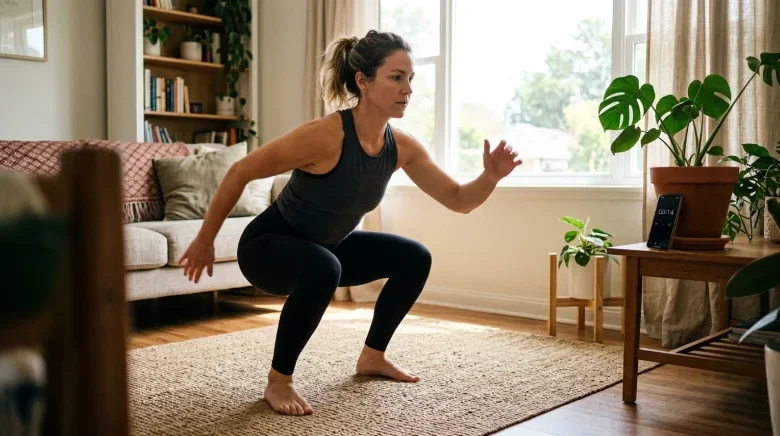
- Squats. Feet shoulder-width apart, chest up, sit back like you are lowering into a chair, then drive through your heels. Targets quads, glutes, and hamstrings.
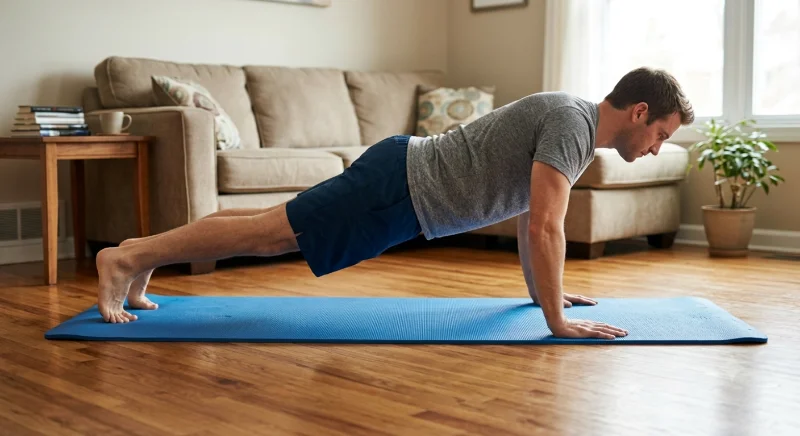
- Push-ups. Hands under shoulders, body in a straight line. Drop to your knees if a full push-up is not available to you yet. Targets chest, shoulders, and triceps.
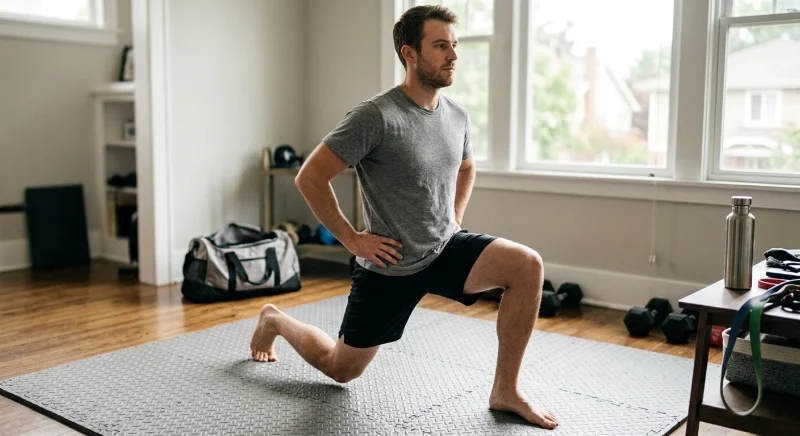
- Reverse lunges. Step back, lower until both knees hit close to 90 degrees, push back to standing. Alternate legs. Targets glutes and quads, with a balance component full squats do not give you.
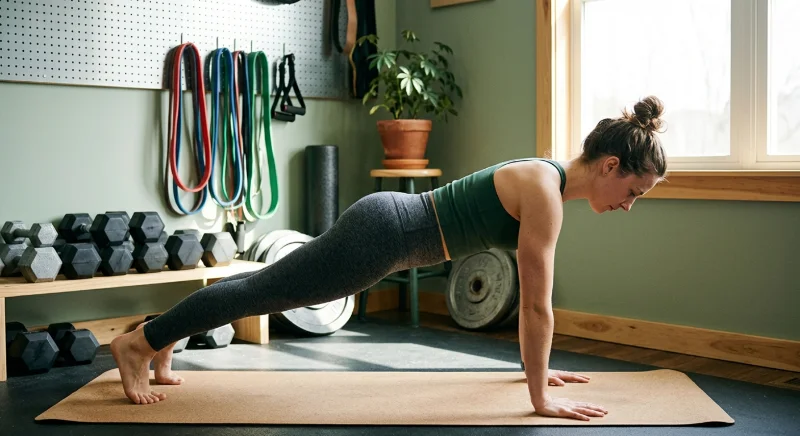
- Plank shoulder taps. Hold a high plank and tap the opposite shoulder with each hand, keeping your hips as still as possible. Targets the core and shoulders.
- Glute bridges. Lie on your back, knees bent, feet flat, drive your hips up, and squeeze at the top. Targets glutes and lower back.
- Mountain climbers. From a plank, drive knees toward your chest, alternating quickly. Targets core with a cardio spike.
Work each move for 40 seconds, rest 20, then move to the next. After all six, rest 60 seconds before starting round two. Three full rounds lands you right around 25 to 26 minutes of work.
3. Cooldown (4 to 5 Minutes)
- Standing forward fold, 30 seconds
- Quad stretch, 30 seconds each leg
- Chest and shoulder stretch against a wall or doorway, 30 seconds each side
- Child’s pose, 1 minute
- Deep breathing while seated, 1 minute
Skipping the cooldown is common, and it is also where a lot of next-day soreness gets worse than it needs to be. Give it the full five minutes.
How Many Calories Does This Burn
Harvard Medical School’s calorie chart puts general circuit training at roughly 240 calories in a half-hour for someone who weighs 125 pounds, 298 calories at 155 pounds, and 355 calories at 185 pounds. Your own number will move around depending on how little rest you take between moves and how much of each 40-second window you spend actually working versus catching your breath. Treat these figures as a reasonable range, not a fixed target.
Making It Harder or Easier
This 30 minute full body workout no equipment format, scales in both directions without changing the moves.
To make it easier: extend rest to 30 seconds, drop to two rounds instead of three, or do push-ups and planks from your knees.
To make it harder: extend work intervals to 45 or 50 seconds, add a fourth round, or add a pause at the bottom of each squat and lunge. Jump squats can replace regular squats once your knees and ankles are used to the load, and a push-up with a slow three-count lowering phase adds difficulty without adding a single extra rep.
You do not need to pick one version and stick with it forever. Most people are better off starting on the easier end for the first week or two, then adding difficulty gradually as the moves start to feel manageable instead of maxed out.
What Changes After a Few Weeks
The first week or two of a new routine like this is usually the hardest, mostly because your body has not adapted to the specific movements yet, even if you are already active in other ways. Soreness in the days after tends to fade by the third or fourth session as your muscles get used to the demand.
By week three or four, a lot of people notice the workout feels shorter than it did on day one, even though the clock says the same 30 minutes. That is a sign it is time to add a round, shorten rest periods, or move to the harder variation of each exercise, rather than a sign the workout stopped working. Progress in bodyweight training comes from adjusting these variables since you cannot add plates to a push-up the way you can to a bench press.
Common Mistakes Worth Fixing
Rushing the squat depth is the most common one. A shallow squat done fast does less for your legs than a full squat done at a controlled pace. Letting your hips sag during the plank shoulder taps is another, since it shifts the work away from your core and onto your lower back.
Skipping the warm-up because the workout is already short is understandable, but it works against you. Cold muscles limit how much force you can produce, which means your squats and lunges end up shallower and less effective anyway.
Fitting It Into a Week
The CDC’s muscle-strengthening guidance calls for activities that work all major muscle groups on two or more days a week. Running this circuit three times a week, on non-consecutive days, covers that guidance with room to spare and leaves your other days open for a walk, a run, or just rest.