
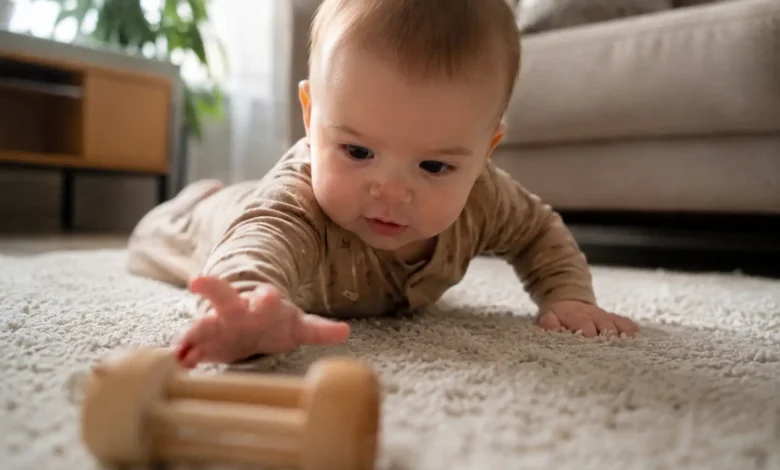
Most babies who army crawl start between 6 and 9 months old, dragging their belly across the floor while their arms do most of the work. It is not a required stage of development. Some babies skip it completely and move straight to crawling on hands and knees, while others use it for weeks before switching styles.
If your baby is scooting around the living room like they are on a mission, you are watching a normal and fairly common part of early mobility.
What Army Crawling Actually Looks Like
Army crawling, sometimes called commando crawling or belly crawling, happens when a baby keeps their stomach on the floor and pulls or pushes themselves forward using their arms. Their legs usually drag along behind, sometimes helping with a small push, sometimes just going along for the ride.
It often starts by accident. A baby lying on their tummy pushes backward before they figure out how to go forward. Once they connect the movement of their arms to actual progress across the room, the belly scoot takes off.
Some babies move in a straight line right away. Others pivot in circles for a while, or go backward under the couch before working out how to go the other direction.
When Babies Typically Start Army Crawling
Pediatric physical therapists generally place the start of army crawling somewhere between 6 and 9 months, though the range varies more than most parents expect. A few babies begin closer to 5 months, and some do not attempt any form of forward movement until closer to 10 months.
Hands and knees crawling, sometimes called creeping, tends to follow a few months later, often between 9 and 11 months. Army crawling frequently works as a bridge between those two stages, giving a baby a way to get across the room before they have the strength and balance for a full four point crawl.
Every baby’s timeline depends on muscle strength, motivation, and how much time they spend on their stomach during the day. A baby who gets regular tummy time from early infancy often builds the shoulder and core strength for crawling sooner than one who spends less time on their belly.
Why Some Babies Army Crawl Instead of Crawling on Hands and Knees
Army crawling asks less of a baby’s body than crawling on hands and knees. Keeping the belly on the ground means less weight has to be supported by the arms and core, so a baby with less upper body strength can still move independently.
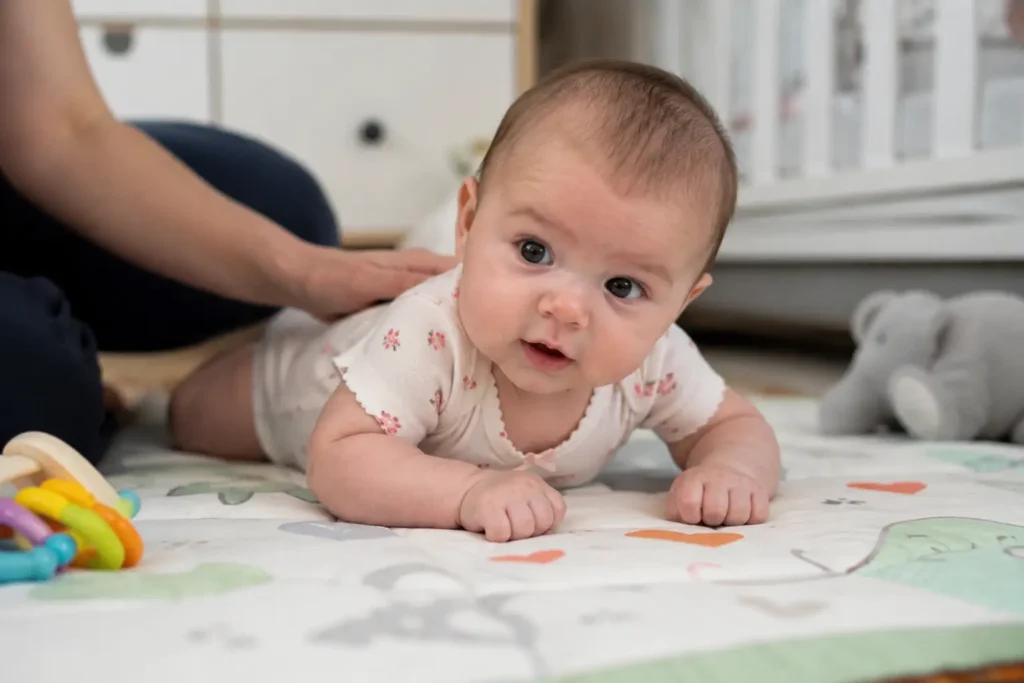
For a lot of babies, army crawling is simply the version of movement their body is ready for first. As their shoulders, arms, and core get stronger over the following weeks, many transition on their own to a hands and knees position.
A smaller number of babies stick with army crawling well past 10 or 11 months, even after they can pull themselves up to stand. This usually is not a sign of a problem on its own, especially if the baby is otherwise meeting milestones like sitting independently, babbling, and reaching for objects with both hands.
Is Army Crawling a Concern
In most cases, no. Pediatricians and pediatric physical therapists generally view army crawling as one of several normal movement patterns babies use on the way to full mobility, not a red flag by itself.
Some signs are worth mentioning to your child’s doctor at a well visit. These include a baby who only ever uses one arm to pull themselves forward, a baby who shows little interest in any form of forward movement by 10 to 12 months, or a baby who seems to favor one side of their body consistently across multiple activities.
1. When to Talk to a Pediatrician or Physical Therapist
Bring it up at your baby’s next checkup if army crawling is the only movement pattern they use for more than a few months with no attempt at hands and knees crawling, pulling to stand, or cruising along furniture. A pediatrician can watch your baby move and refer you to a pediatric physical therapist if anything needs a closer look.
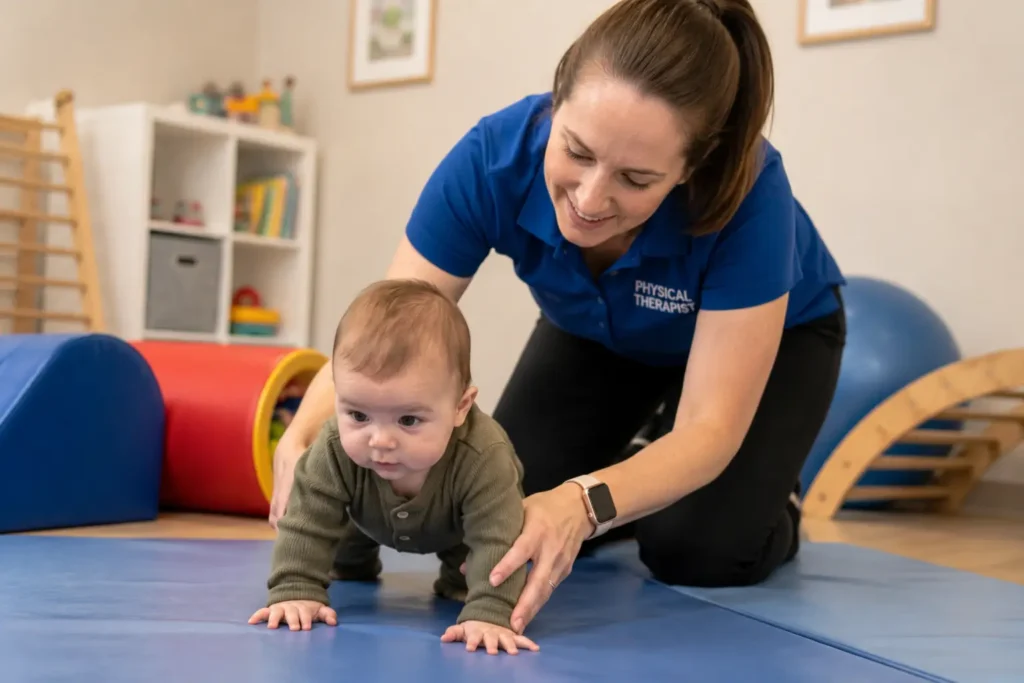
Most of the time, a short evaluation puts parents’ minds at ease. Pediatric physical therapists often work with families on simple, playful exercises that build strength for the next stage, rather than anything that feels like formal treatment.
How to Support Your Baby During This Stage
1. Give Them Reasons to Move
Babies move toward things that interest them. Setting a favorite toy just out of reach during floor time gives a baby a reason to practice pushing and pulling themselves forward. Rotating toys every few days keeps the motivation fresh.
Short bursts of floor time spread across the day tend to work better than one long session. A baby who is tired or frustrated will not get much out of forced practice.
2. Build Strength Through Play
Time spent on the belly, propped on forearms or reaching for toys, builds the same muscles used in both army crawling and the later hands and knees crawl. Playing on different textures, like a rug, a play mat, or even a clean kitchen floor, also helps babies adjust their movements to different surfaces.
Avoid too much time in bouncers, walkers, or seats that hold a baby upright. Babies need floor time on their stomach and back to build the strength and coordination crawling requires.
Army Crawling vs Other Crawling Styles
Babies use more movement styles than most parents realize. Some scoot on their bottom instead of crawling on their stomach at all. Others use an asymmetrical crawl, pushing off with one leg while dragging the other. A smaller group skips crawling entirely and moves from sitting to pulling up to walking with no floor crawling in between.

None of these paths is more correct than another. Research on infant motor development has found that babies switch between styles depending on the surface, their clothing, and even their mood on a given day. A baby who army crawls across the living room carpet might use a different style entirely on a hardwood floor.