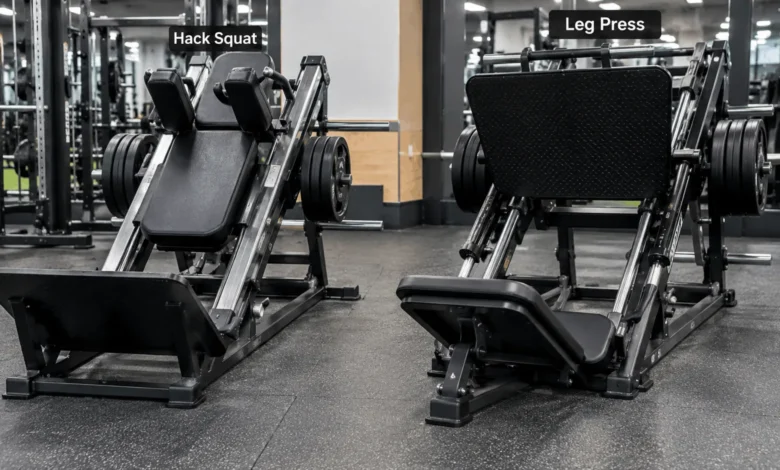
If your gym has both machines, you’ve probably stood between them wondering which one deserves your working sets. The hack squat and the leg press look like they do the same job, but they load your body in completely different ways, and that difference matters more than most gym-goers realize.
The short version: the hack squat puts you in an upright, squat-like position that drives your quads through a longer range of motion, while the leg press reclines you into a fixed sled that lets you move heavier loads with less fatigue and less spinal stress. Neither one replaces the other. Below is exactly how they differ, which one fits your goals, and how to use both without wasting training time.
The Core Difference Between the Two Machines
The leg press seats or reclines you against a pad while your legs push a weighted platform along a fixed rail. Your torso barely moves. The hack squat stands you up, braces your shoulders and upper back against a sliding pad, and has you squat down and drive back up along an angled track.
That single postural difference changes everything downstream: which muscles carry the load, how much your spine and knees absorb, and how much weight you can safely handle.
How Each Exercise Is Performed
Hack Squat Setup and Execution
Step under the shoulder pads, plant your feet shoulder-width on the platform, and unrack the safety handles. Lower yourself by bending your knees and hips until your thighs approach parallel, keeping your heels flat and your lower back pressed into the pad. Drive back up through your whole foot without locking your knees out hard at the top.
Because your torso stays fixed against the pad, the motion mimics a barbell squat closely, but the machine handles your balance for you.
Leg Press Setup and Execution
Sit or recline in the seat, place your feet on the platform at hip width, and release the safety catches. Lower the sled until your knees reach roughly 90 degrees, then press through your heels to extend your legs without locking your knees. Your lower back should stay flat against the pad the entire time.
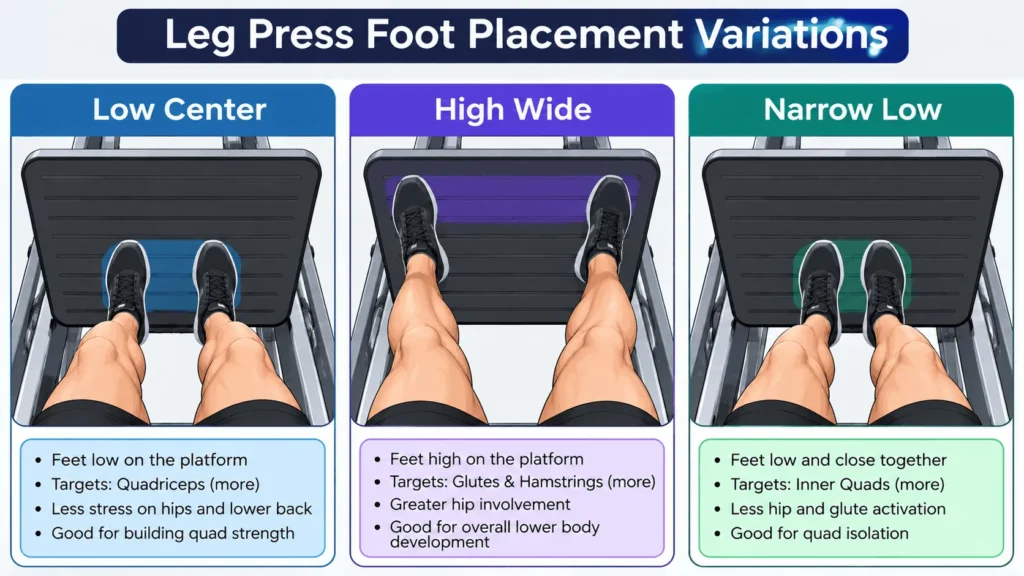
Higher foot placement shifts more work to your glutes and hamstrings, while a lower placement puts more demand on your quads.
Muscles Worked by Each Machine
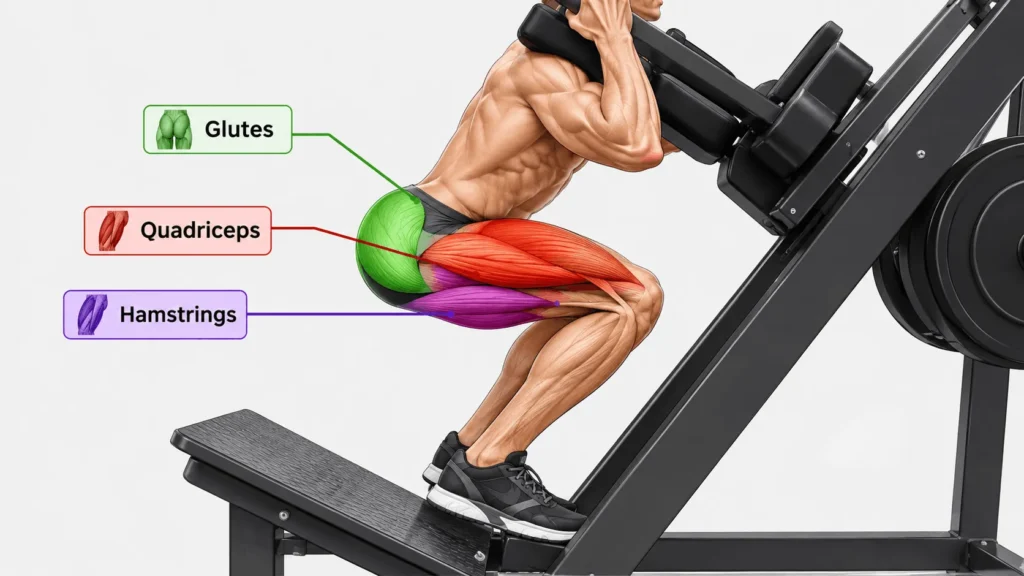
Both exercises train the quads, glutes, hamstrings, and calves, so the overlap is real. The split shows up in emphasis. The hack squat’s upright position and deep knee bend stretch the quads harder and longer, which is why lifters chasing quad size often favor it. The leg press spreads the load more evenly across the posterior chain, especially with a higher foot position, and asks less of your core for stabilization.
If your training goal is a specific muscle group rather than general leg mass, foot placement and machine choice both matter more than most lifters assume.
Which Machine Builds Bigger Quads
For pure quad development, the hack squat has the edge. The combination of an upright torso and a deep, controlled knee bend puts your quads under a longer stretch at the bottom of each rep, and that extended time under tension is a strong driver of muscle growth. The leg press can still grow your quads effectively, particularly with feet set low on the platform, but it rarely matches the stretch position the hack squat forces you into.
This doesn’t mean the leg press is inferior overall. It means the two machines answer different questions, and “bigger quads” is only one of them.
Lower Back and Knee Stress Compared
The leg press is generally gentler on your lower back because the pad supports your spine throughout the entire movement, and you never have to brace against an unsupported load the way you do in a squat pattern. This makes it a common choice for lifters managing back issues or finishing a workout when their spinal stabilizers are already fatigued.
The hack squat, while safer than a barbell squat for most people, still compresses your spine slightly through the shoulder pads and demands more control through a deep knee bend. Anyone with existing knee pain should approach both machines cautiously and limit how far they descend, since deep flexion under load is where most discomfort shows up on either exercise.
None of this makes either machine dangerous when used correctly. It simply means the leg press tends to forgive more error, while the hack squat rewards more precise technique.
Load Capacity: Why You Can Leg Press More Weight
You’ll almost always move more total weight on a leg press than on a hack squat, and that’s by design rather than a reflection of effort. The reclined position removes the balance and core demands the hack squat requires, which frees your legs to handle heavier loads without other muscle groups becoming the limiting factor.
That extra weight doesn’t automatically mean better results. Moving more load with a shorter, less demanding range of motion isn’t inherently superior to moving less weight through a deeper, more targeted range. Judge the exercises by how they make your target muscles feel, not by the number on the weight stack.
Foot Placement and How It Shifts the Emphasis
On both machines, foot position changes which muscles do the most work. Placing your feet lower and closer together emphasizes the quads. Moving your feet higher and wider shifts more load onto your glutes and hamstrings. A narrower stance also tends to bias the outer quad sweep, while a wider stance brings in more inner thigh and glute involvement.
Small adjustments here let you use the same machine for different goals across a training week, rather than needing separate equipment for each muscle emphasis
.
Which Is Better for Beginners
The leg press is the easier entry point. It requires less balance, less core bracing, and less technical coaching to perform safely, which makes it a reasonable place to start building leg strength before progressing to more demanding patterns.
The hack squat still has value early on, since the machine’s fixed path teaches a squat-like motion without the balance challenge of a barbell. Beginners just need closer attention to depth and knee tracking, since the fixed track can encourage pushing through a range that feels supported but isn’t yet appropriate for their mobility.
Common Mistakes and Injury Risk
On the hack squat, the most frequent errors are letting the heels lift, rounding the lower back off the pad, and descending past a comfortable depth just because the machine allows it. On the leg press, lifters commonly let their lower back round off the pad under heavy loads, lock their knees hard at the top, or go so deep that their hips tuck under, which places unnecessary stress on the spine.
Both machines are safer than free-weight squats for most lifters, but “machine” doesn’t mean “foolproof.” Control the weight through the full range rather than letting momentum or ego dictate depth and speed.
When to Choose the Hack Squat
Reach for the hack squat when quad growth is your priority, when you want a squat pattern without free-weight balance demands, or when you’re early enough in a workout that you can still control a deep, technical range of motion. It also works well as a primary quad movement earlier in a leg session, before fatigue makes technique harder to maintain.
When to Choose the Leg Press
Choose the leg press when you need to add volume without excessive fatigue, when your lower back needs a break from spinal loading, or when you’re training legs later in a session and want an exercise that’s more forgiving under tired muscles. It’s also a strong choice for pushing close to failure safely, since the seated position limits how much a form breakdown can compromise your spine.
Programming Both Into Your Leg Day
You don’t have to pick one permanently. Many well-built leg programs use the hack squat as a primary quad-focused movement and the leg press as a higher-volume finisher later in the same session, or rotate which one leads the workout every several weeks. Ten to twelve total sets per week across your squat pattern, hack squat, and leg press is typically enough for most lifters chasing leg growth without excessive junk volume.

If your gym only has one of the two machines, don’t stress over the missing option. Adjust foot placement and depth on whichever one you have access to, and you can still hit your quads, glutes, and hamstrings effectively.