

What is a Mountain Climber
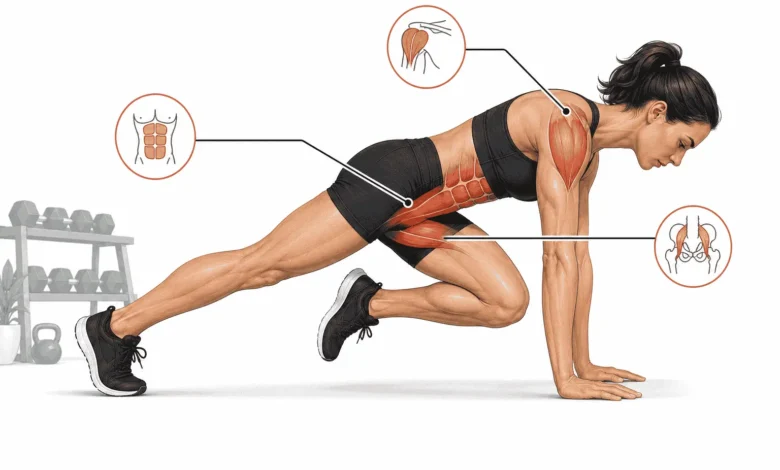
A mountain climber starts in a high plank, hands under your shoulders and body in a straight line from head to heels. From there, you bring one knee toward your chest, return it, and repeat with the other leg, alternating at a pace that ranges from slow and controlled to fast and breathless depending on your goal. Trainers often group it with burpees and high knees because it borrows from both: the plank holds your upper body under tension while your legs move like you’re running in place
Muscles the Mountain Climber Works About
Your shoulders, chest, and triceps hold you up in plank, so they’re working the entire time, not just during the leg drive. Your core, including your rectus abdominis, obliques, and the deeper transverse abdominis, resists rotation and keeps your hips from sagging. Your hip flexors, quads, hamstrings, and glutes power the knee drive itself. Because so many muscle groups fire at once, most trainers file mountain climbers under “full-body” rather than a pure ab or leg exercise.
How to do a Mountain Climber Step By Step
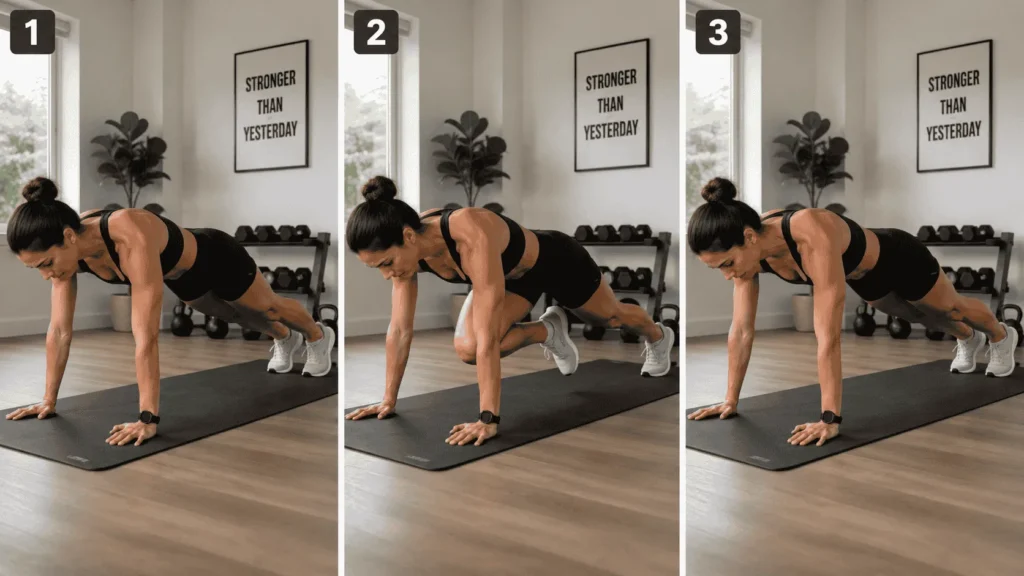
Start on the floor in a high plank. Place your hands directly under your shoulders, arms straight, and extend your legs behind you so your weight rests on your hands and the balls of your feet. Draw your ribs down toward your hips to brace your core before you move.
Keeping your left foot planted, bend your right knee and drive it toward your chest without letting it touch the floor. Extend your right leg back to the starting position. Then bend your left knee and drive it toward your chest, extending it back once you finish. That’s one full repetition. Keep alternating legs at a pace you can control while keeping your hips level and your back flat.
Beginners can start with 2 to 3 sets of 10 to 15 slow, controlled reps per leg. If you’re using mountain climbers for a cardio or HIIT block, try 20 to 30 seconds of fast alternating reps followed by 10 to 20 seconds of rest, repeated for 6 to 8 rounds.
Common Mountain Climber Mistakes
Letting your hips rise into the air is the most common error, and it usually happens when your shoulders are working harder than your core, so your body tries to find an easier angle. Keep your ribs pulled down and your glutes lightly engaged to keep your hips in line with your shoulders.
Bouncing on your toes as you drive your knees forward is another one. It feels fast, but the bounce comes from momentum instead of your core doing the work, and it puts extra load on your ankles and knees. Aim for a controlled step, almost like you’re gliding your knee forward rather than hopping it.
Rounding or hunching your upper back is a third mistake, often from placing your hands too far forward or too close together. Keep your hands roughly shoulder-width apart, directly under your shoulders, and think about keeping your spine long from your head to your hips.
Mountain Climber Variations
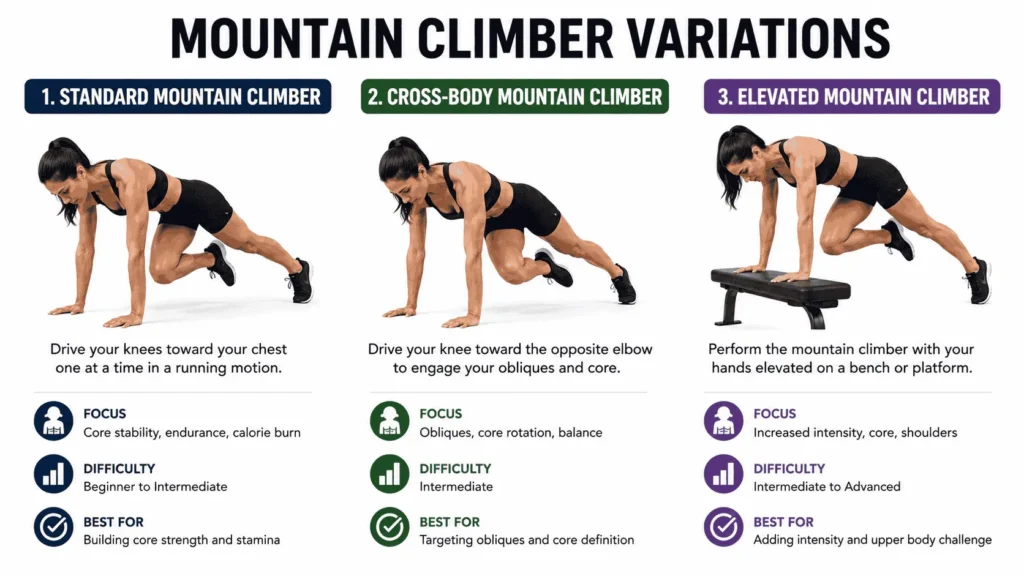
Cross-body mountain climbers send your knee toward the opposite elbow instead of straight ahead, which adds a twist that works your obliques harder. Standing mountain climbers take the movement off the floor: stand with feet shoulder-width apart, drive one knee up toward your waist while reaching the opposite arm overhead, then switch sides, which is a useful low-wrist-strain option. Elevated mountain climbers, with your hands on a bench or step instead of the floor, reduce the load on your wrists and core, making this a solid entry point if the standard version feels too intense. A resistance band looped just above your knees adds tension to each knee drive for anyone who has mastered the basic form and wants more of a strength challenge.
Benefits of Mountain Climbers
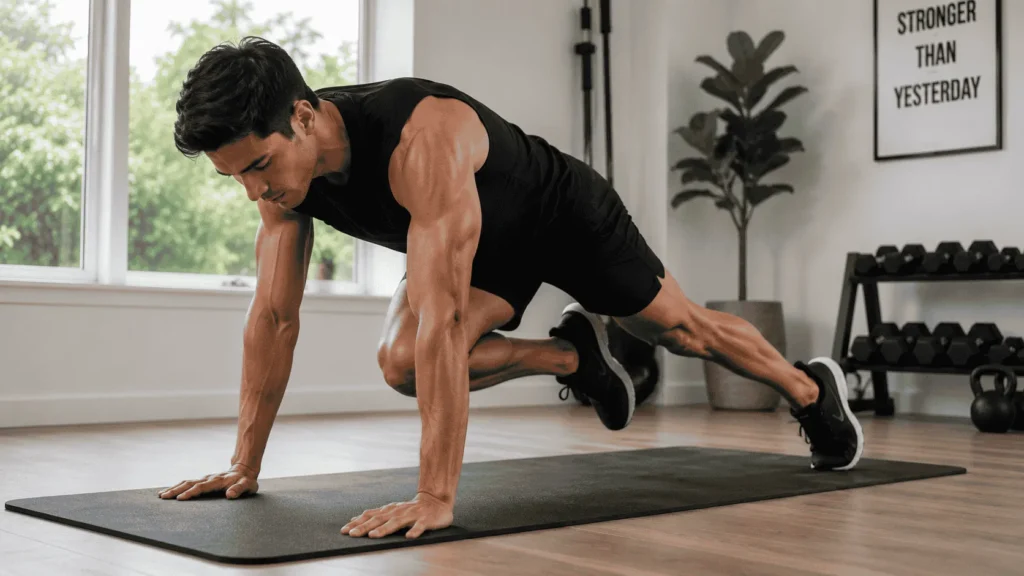
Mountain climbers combine strength and cardio in one move, which makes them time-efficient if you’re short on workout minutes. The plank position itself builds core stability and shoulder endurance, and the fast leg drive raises your heart rate quickly, which is why the exercise shows up so often in HIIT circuits and gym class warm-ups. Because it requires no equipment and very little space, it also works as a travel or home workout option when you don’t have access to a gym.
Who should be careful with mountain climbers
Mountain climbers put continuous load on your wrists, shoulders, and lower back, so anyone with wrist pain, shoulder impingement, or a lower back condition should check with a doctor or physical therapist before adding them to a routine. Pregnant exercisers are often advised to swap the plank-based version for a standing variation, since prolonged time on hands and knees becomes uncomfortable as pregnancy progresses. If you’re new to exercise altogether, master a static plank hold first. Being able to hold a plank with a flat back for 20 to 30 seconds is a good sign you’re ready to add the leg movement.
FAQ’S
1:How many mountain climbers should I do a day?
There’s no fixed daily number that works for everyone. Beginners can start with 2 to 3 sets of 10 to 15 reps per leg a few times a week, then build up pace and volume as core strength improves
2:Do mountain climbers burn belly fat?
Mountain climbers strengthen and tone your core, but spot reduction, losing fat from one area through targeted exercise, isn’t how fat loss works. Losing fat around your midsection depends on overall calorie balance, not which muscle you’re working.
3:Are mountain climbers good for beginners?
Yes, with modifications. Elevating your hands on a bench or slowing the pace makes the move accessible, and standing mountain climbers remove the plank position entirely if wrist or shoulder strain is a concern.
4:What’s the difference between mountain climbers and running?
Both raise your heart rate, but mountain climbers add upper body and core loading that running doesn’t, since you’re supporting your bodyweight on your hands the entire time.
5:Can mountain climbers replace cardio?
Short bursts of fast mountain climbers can work as a HIIT-style cardio stimulus, but they’re not a full substitute for longer steady-state cardio if your goal is building aerobic endurance over time.