


The close grip lat pulldown muscles worked list starts with the latissimus dorsi. But that single fact hides most of what makes this exercise useful. Grip width does not just change how the bar feels in your hand. It changes the angle your arms pull from, and that shifts the workload across your back, biceps, and shoulders. The close grip version is not a smaller copy of the wide grip pulldown. It trains the lower lats harder, pulls the biceps in more directly, and allows a longer range of motion. This guide breaks down which muscles do the work, why the mechanics change with a narrower grip, and how to perform the exercise correctly.
What Muscles Does the Close Grip Lat Pulldown Work
The close grip lat pulldown is a compound pull, so several muscle groups share the load on every rep. The split between them depends on your grip, your pulling angle, and how far you let the bar travel.
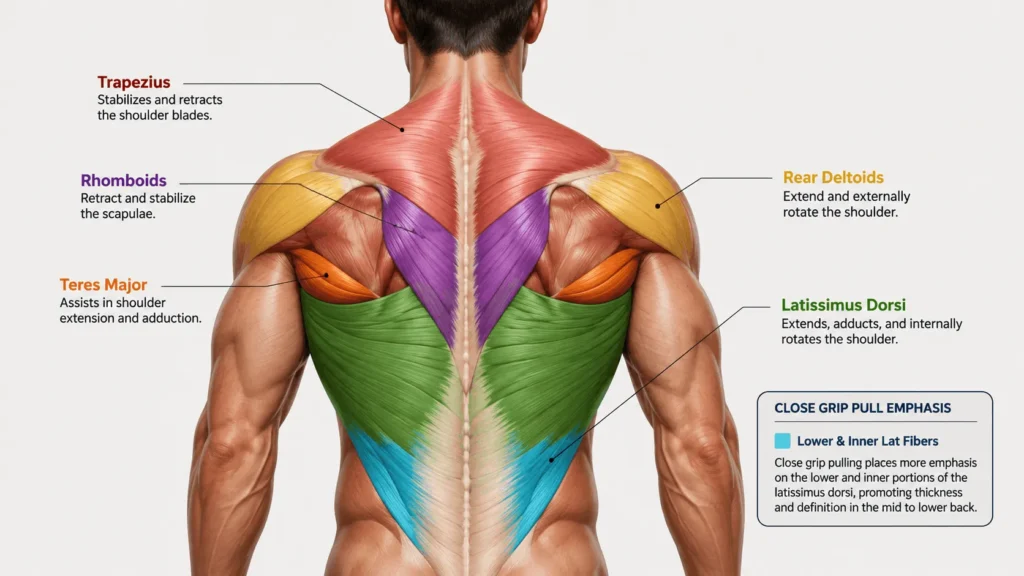
1: Latissimus Dorsi (Lower and Inner Fibers)
The latissimus dorsi is the main mover in every pulldown variation, and the close grip version is no exception. What changes is which part of the lat does the most work. Because your hands sit close together, your elbows travel down and slightly in toward your hips rather than out to the sides. That path shortens the lower and inner fibers of the lat more completely at the bottom of the rep. Lifters who struggle to feel their lats on a wide bar often feel this variation immediately, simply because the muscle gets to contract through a fuller range.
2: Secondary Movers: Biceps, Rhomboids, and Trapezius
Because the elbows bend more sharply in a close grip pulldown, the biceps brachii and brachialis take on more of the pulling work than they do with a wide grip. This is not a flaw in the exercise. It is simply a trade-off that comes with the mechanics of a narrow hand position. At the same time, your rhomboids and middle trapezius contract hard as you retract your shoulder blades before the bar reaches your chest. These muscles sit between your shoulder blades and add thickness to the middle of your back when trained consistently.
3: Stabilizers: Rear Delts, Teres Major, and Core
A few muscles do not drive the movement but keep it stable and controlled. The rear deltoids and teres major assist as your shoulder extends and help control the arm as it moves overhead and back down. Your core braces to keep your torso upright instead of swinging with the weight. Your forearms and grip muscles work isometrically the entire set, since you are holding the bar under load from the first rep to the last.
Why a Narrower Grip Changes Which Muscles Do the Work
The latissimus dorsi is a large, fan shaped muscle that runs from the upper arm down to the lower back and pelvis. Because the fibers run in different directions across that fan, the angle you pull from decides which section shortens the hardest. A wide grip forces your elbows out to the sides early in the pull. That angle favors the upper, outer fibers of the lat along with the rear delts and upper traps, which is why a wide grip is often linked to back width. A close grip keeps your elbows tracking close to your torso for a longer part of the movement. That path favors the lower and inner lat fibers and lets your elbows finish closer to your hips, which is also why the biceps get pulled into the movement more directly. Neither angle is more correct than the other. They simply train different parts of the same muscle, which is why many lifters rotate grips across a training block instead of picking one and ignoring the rest.
How to Do the Close Grip Lat Pulldown With Proper Form
Good form determines whether your back or your arms end up doing most of the work. Follow these steps for each rep.
- Attach a V-bar or a narrow neutral grip handle to the cable pulldown machine.
- Set the thigh pad so it locks your legs in place once you sit down.
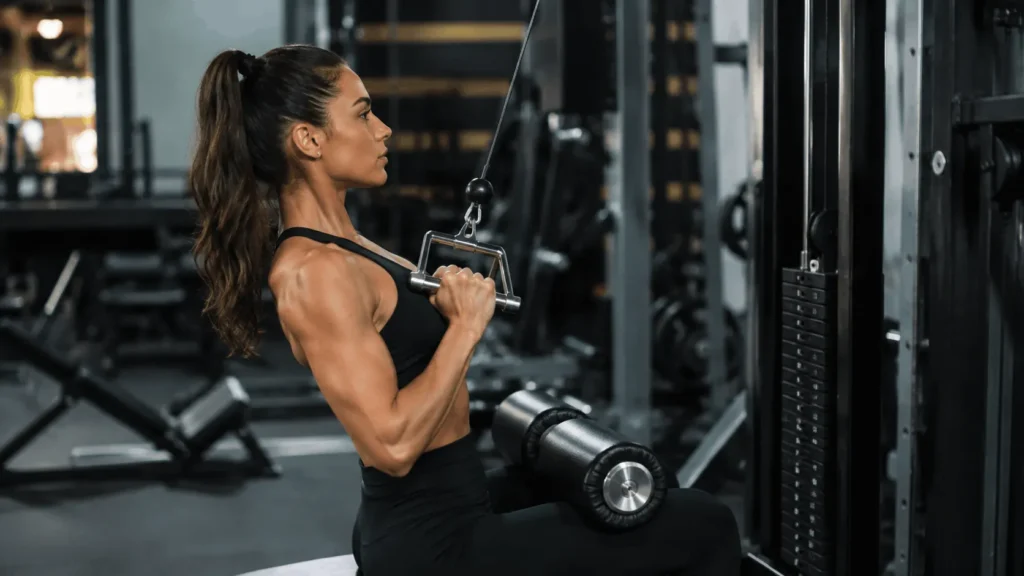
- Grip the handle with your palms facing each other, hands close together.
- Sit down with your arms fully extended and a slight lean back in your torso.
- Pull your shoulder blades down and back before you bend your elbows.
- Drive your elbows down toward your hips and pull the bar to your upper chest.
- Pause for a moment and squeeze your back at the bottom of the rep.
- Let the bar rise under control until your arms are straight again.
Keep your ribcage down and your core braced throughout the set. Avoid using your body weight to yank the bar down, since that shifts tension away from your lats and onto your lower back.
Close Grip vs Wide Grip vs Underhand Grip
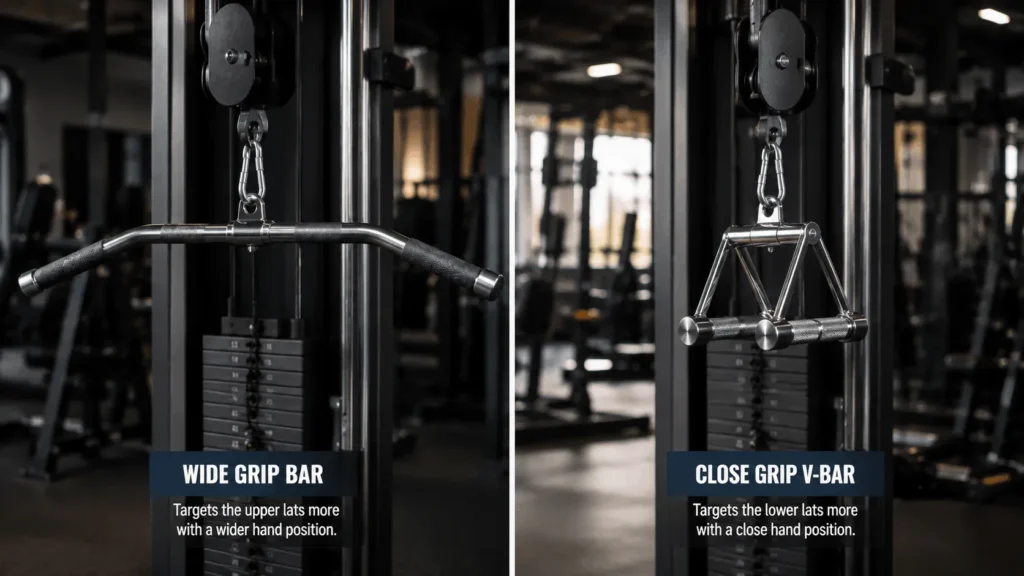
Lifters often ask which pulldown grip is best, but each one shifts the emphasis rather than making the exercise better or worse. A wide grip shortens your range of motion and puts more demand on the upper lats, rear delts, and upper back. It tends to feel more shoulder dominant and less bicep intensive. A close grip with a neutral or narrow overhand hold increases your range of motion and shifts more work onto the lower lats and biceps. It is often the more comfortable option for lifters with shoulder discomfort on wider bars. An underhand close grip goes a step further in the same direction. The supinated hand position recruits the biceps even more directly and closely resembles a chin up pattern. None of these grips replaces the others completely. Rotating between them across a training week or a training block trains your back from more than one angle and avoids the plateau that comes from repeating a single pattern indefinitely.
Common Form Mistakes That Take Tension Off Your Back
A few habits quietly shift the work away from the muscles you are trying to train.
Leaning back too far turns the pull into a rowing motion and lets your body weight do work your lats should be doing. A slight lean is fine, but an exaggerated one is a red flag. Pulling the bar too low, past your chest, forces your shoulders into a poor position and adds little benefit. Letting the bar rise too fast wastes the eccentric portion of the rep, where a lot of muscle growth happens.
How to Program the Close Grip Lat Pulldown in Your Back Workout
The close grip lat pulldown fits well in a back, pull, or upper body workout, and it pairs naturally with horizontal pulling movements like rows. For hypertrophy, most lifters do well with three to four sets of eight to twelve reps, resting around ninety seconds between sets. If your goal leans more toward strength and control, sets of five to eight reps with slightly heavier loads and longer rest work well too. Placing this exercise early in your workout, after a compound row or pull up, lets you use more weight while your grip and lats are still fresh. Later in a session, it also works well as a finishing movement with lighter loads and a stricter squeeze at the bottom of each rep.
Alternatives If You Don’t Have a Lat Pulldown Machine
If a cable machine is not available, a few exercises train similar muscles with a similar pulling pattern. Neutral grip pull ups closely mirror the close grip pulldown, since both use a narrow hand position and a vertical pull. Chin ups work in much the same way and add even more bicep involvement. Close grip seated cable rows target the same lower lat and mid back fibers, though the pulling angle is horizontal instead of vertical. Resistance band pulldowns anchored to a high point can also recreate the movement pattern for home training when no machine is available.