


Most people who start lifting weights pick a workout split by copying whatever routine a friend or an influencer is running, not because it fits their schedule or their recovery. That mismatch is the real reason so many lifters plateau within a few months. A workout split decides which muscle groups you train on which days, and getting that decision right has more impact on your results than almost any other training variable except consistency itself.
This guide breaks down the main workout split options, who each one suits, and how to pick the right structure based on your training age, weekly schedule, and how well your body recovers between sessions.
What a Workout Split Actually Controls
A workout split is not just a calendar. It controls how often each muscle group gets trained per week, how much volume you can fit into a single session without junk sets, and how much recovery time sits between hitting the same muscles again. Two lifters doing the same exercises can get very different results if one trains each muscle once a week and the other trains it twice, simply because muscle protein synthesis stays elevated for roughly 24 to 48 hours after a hard session, not seven days.
That single fact is why most modern strength coaches favor splits that hit each muscle group at least twice weekly over the old once-a-week bodybuilder routines, though there are still situations where a once-weekly approach makes sense.
Full Body Split
A full body split trains most of the major muscle groups in every session, usually three or four times per week with a rest day between sessions.
1. Who Should Use a Full Body Split
This is the strongest option for beginners in their first year of lifting, for anyone who can only commit to two or three days a week, and for lifters returning after a long break. Full body training lets you practice the main compound lifts- squat, hinge, push, and pull- with high frequency, which speeds up technique gains far faster than splitting those movements across separate days.
2. Sample Full Body Schedule
Monday: squat variation, bench press, barbell row, plank; Wednesday: deadlift variation, overhead press, pull-up or lat pulldown, side plank; Friday: front squat or leg press, incline press, cable row, farmer carry
Each session runs 45 to 60 minutes and covers legs, chest, back, and shoulders without leaving any muscle group untouched for more than 48 hours.
Upper Lower Split
An upper-lower split divides the week into upper body days and lower body days, typically run four times a week.
1. Who Should Use an Upper-Lower Split
This split suits intermediate lifters who have outgrown full body training but cannot commit to five or six gym days. It allows more total sets per muscle group than full body training while still hitting everything twice weekly, which keeps hypertrophy stimulus high without demanding daily gym visits.
2. Sample Upper Lower Schedule
Monday: upper body, bench press, row, overhead press, curl, triceps extension. Tuesday: lower body, squat, Romanian deadlift, leg press, calf raise. Thursday: upper body, incline press, pull-up, lateral raise, face pull. Friday: lower body, deadlift, split squat, leg curl, hip thrust
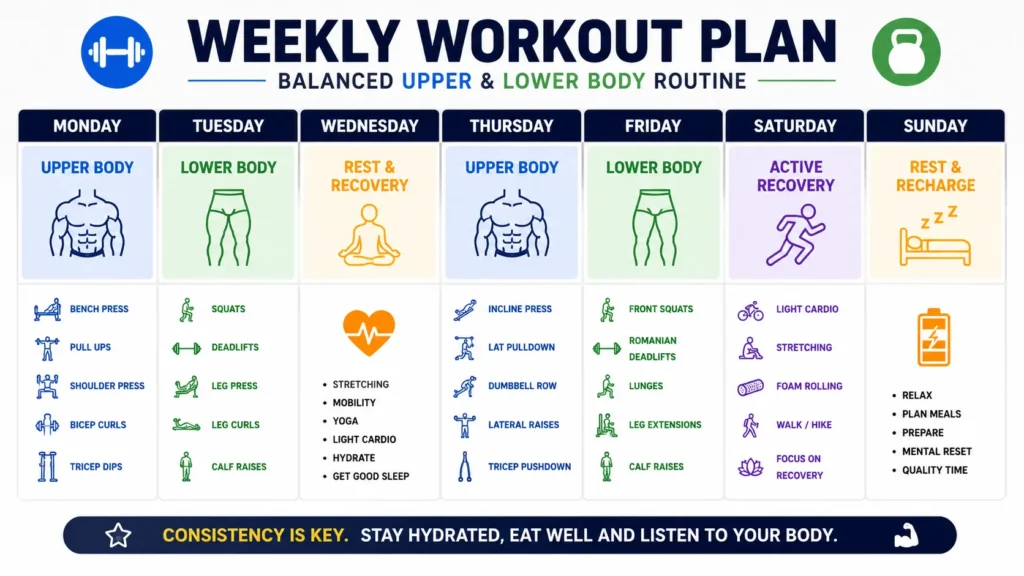
This four-day structure gives each muscle group roughly 72 hours of recovery, which is close to the sweet spot most research points to for hypertrophy.
Push Pull Legs Split
The push pull legs split, often shortened to PPL, groups exercises by movement pattern instead of body region. Push days cover chest, shoulders, and triceps. Pull days cover back and biceps. Leg days cover quads, hamstrings, glutes, and calves.
1. Who Should Use a Push-Pull-Legs Split
PPL is built for lifters training five or six days a week who want higher training volume per muscle group than upper-lower splits allow. Running the rotation twice in a week, PPL, PPL, rest, gives every muscle group two full sessions while grouping synergist muscles so nothing gets overworked in back-to-back sessions.
2. Sample Push Pull Legs Schedule
Day 1 Push: bench press, overhead press, incline dumbbell press, tricep pushdown Day 2 Pull: deadlift, pull-up, barbell row, face pull, bicep curl Day 3 Legs: squat, Romanian deadlift, leg press, calf raise Day 4 Push: incline barbell press, dumbbell shoulder press, cable fly, overhead tricep extension Day 5 Pull: lat pulldown, seated row, rear delt fly, hammer curl Day 6 Legs: front squat, hip thrust, leg curl, walking lunge
Lifters new to six-day training often underestimate recovery demands. Sleep and protein intake matter more on a PPL split than on any lower frequency program, because the margin for error shrinks once you are training almost every day.
Bro Split, Also Called a Body Part Split
A bro split trains one or two muscle groups per session across five or six days, such as chest on Monday, back on Tuesday, and legs on Wednesday.
1. Where a Bro Split Still Makes Sense
Research generally favors training each muscle group at least twice a week for hypertrophy, which puts the classic bro split at a disadvantage for most natural lifters. That said, advanced bodybuilders with years of training experience sometimes use body part splits because they can generate enough volume and intensity in a single session to justify the longer recovery window before hitting that muscle again. For anyone under three years of training experience, an upper-lower or push-pull legs split will almost always produce faster results.
PHUL and PHAT Hybrid Splits
PHUL, power hypertrophy upper lower, and PHAT, power hypertrophy adaptive training, blend heavy strength work with higher rep hypertrophy work across the same muscle groups. A PHUL week typically includes two upper body power days, two lower body power days, and matching hypertrophy-focused days later in the week. These hybrid approaches work well for intermediate to advanced lifters chasing both strength and size at the same time, though the extra structure makes them harder for beginners to manage.

How to Choose the Right Workout Split for Your Goals
1. Training Experience
Beginners get the most out of full body training because frequent practice on the main lifts builds skill faster than any other variable. Intermediate lifters, generally one to three years in, tend to progress fastest on upper-lower or PPL splits. Advanced lifters have more flexibility since their technique is already dialed in, though most still do best avoiding true once-a-week bro splits.
2. Weekly Time Available
Match the split to the days you can realistically show up, not the days you wish you had. A PPL split run on three days a week instead of six will leave each muscle group undertrained, so if you only have three or four days, an upper-lower or full-body split will deliver better results than a poorly executed PPL.
3. Recovery Capacity
Sleep quality, stress levels, age, and total training experience all affect how much volume you can recover from. Someone sleeping six hours a night under high work stress will not recover as well from six weekly sessions as someone sleeping eight hours with a low-stress job, even if both are the same age and experience level. Scale training frequency down if soreness lingers past 72 hours or if strength stalls for more than two weeks in a row.
How a Workout Split Affects Weekly Training Volume
Total weekly volume, the number of hard sets performed per muscle group, is the variable most directly tied to hypertrophy, and the split you choose decides how easily you can hit an effective volume range. Research generally supports somewhere between 10 and 20 hard sets per muscle group each week for most intermediate lifters, though beginners can grow with less and advanced lifters sometimes need more.
A full body split spreads that volume across three sessions, which limits how many sets you can add per muscle group before a workout runs too long. An upper-lower or PPL split concentrates volume into fewer, more focused sessions, making it easier to reach the higher end of that range without every workout stretching past 90 minutes. This is one reason lifters chasing serious muscle growth eventually move away from full-body training even if it served them well as beginners.
Common Mistakes When Choosing a Workout Split
Picking a six-day split without the schedule to support it is the most common error, since inconsistent training beats out any split’s theoretical advantage. Another frequent mistake is chasing a new split every few weeks instead of giving one program eight to twelve weeks to actually work. Progressive overload, gradually adding weight, reps, or sets over time, matters more than the specific split you choose, so switching too often makes it impossible to track meaningful progress.

Ignoring weak points is another issue. If your chest lags behind your back, a split that gives chest more weekly frequency will fix that faster than a generic template built for average proportions.
How Often Should You Change Your Split
Stick with a split for at least two full training blocks, roughly eight to twelve weeks, before deciding whether to switch. Change your split when your schedule changes, when progress genuinely stalls despite consistent effort and eating enough, or when a specific weak point needs more targeted frequency. Switching purely for variety rarely improves results and often resets progress on the lifts that matter most.