
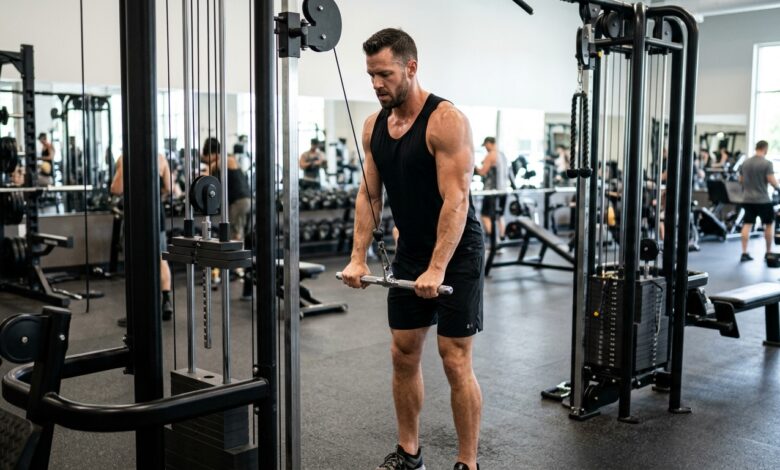
The triceps pushdown is a cable exercise that strengthens the muscles on the back of your upper arms. It involves pushing a cable attachment toward the floor while keeping your upper arms close to your body. With proper form, this exercise helps build triceps strength, improve arm development, and support other upper-body movements.
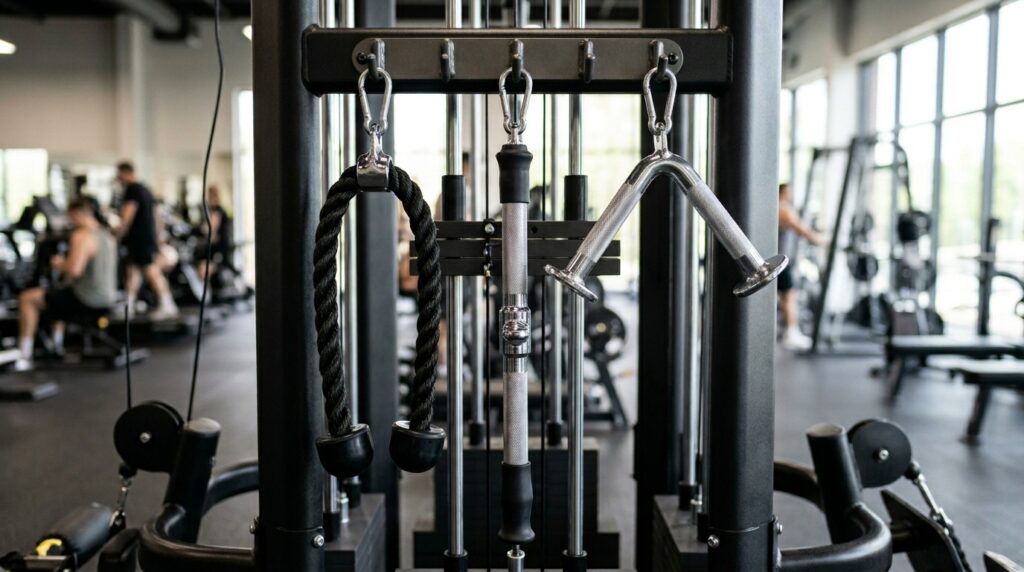
You can perform this exercise with a rope, straight bar, or V-bar attachment. Each option offers a slightly different grip and range of hand movement, so choosing one that feels comfortable is a good starting point.
What Is a Triceps Pushdown?
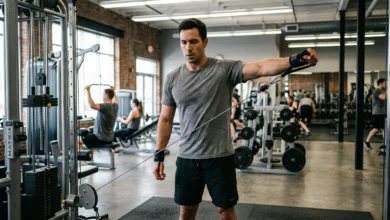
A triceps pushdown is an isolation exercise performed using a cable machine with a high pulley. You stand facing the machine, hold an attachment with both hands, and straighten your elbows to push the weight downward.
The main job of your triceps is to extend your elbows. This movement makes the pushdown useful for training the back of your upper arms without requiring a complicated lifting technique.
Unlike pressing exercises that involve your chest and shoulders, a pushdown allows you to focus more directly on elbow extension. It is suitable for beginners and experienced lifters who want an additional triceps exercise in their workout.
Muscles Worked During Triceps Pushdowns
The primary muscle involved is the triceps brachii, which has three heads.
1. Lateral Head
The lateral head is located on the outer portion of the upper arm. It contributes to the visible shape of your triceps and helps extend your elbow during every pushdown repetition.
2. Medial Head
The medial head sits underneath the other portions of the triceps. It contributes to elbow extension and remains active during different arm movements, including cable pushdowns.
3. Long Head
The long head runs along the back of your upper arm and crosses the shoulder joint. It also assists with elbow extension, but its length and loading conditions differ when your arms stay beside your body.
Overhead triceps extensions place the long head in a more stretched position because your arms are raised. Combining both exercises can provide a useful range of training positions.
Your forearms and core also assist by maintaining your grip and keeping your body stable.
How to Do a Triceps Pushdown Correctly
Correct technique helps you keep the movement focused on your triceps instead of using your body weight to move the cable.
Step 1: Set Up the Cable Machine
Attach a rope or bar to the machine’s highest pulley setting. Select a light weight initially so you can learn the movement without struggling to control the cable.
Stand facing the machine with your feet approximately hip-width apart. Keep your knees slightly bent and your torso stable.
Step 2: Hold the Attachment
Grab the attachment with both hands. For a straight bar, use an overhand grip with your hands around shoulder-width apart or slightly closer.
If you are using a rope, hold one end in each hand with your palms facing inward. Keep your wrists straight and avoid gripping so tightly that your forearms become unnecessarily tense.
Step 3: Position Your Elbows
Bring your elbows close to your sides and bend them to approximately a right angle. Your forearms should point forward, with the attachment around your upper abdomen or chest area.
Keep your shoulders relaxed and avoid allowing your upper arms to move forward and backward during repetitions.
Step 4: Push the Attachment Down
Straighten your elbows and push the attachment toward your thighs. Keep your upper arms relatively stationary throughout the movement.
At the bottom, straighten your arms without aggressively forcing your elbows into a painful lockout. If you use a rope, you can allow your hands to separate slightly when it feels natural.
Step 5: Return Slowly
Bend your elbows and allow the attachment to rise under control. Stop when your forearms return to the starting position without allowing your elbows to drift far forward.
Repeat the movement while maintaining the same posture and controlled range of motion.
Rope vs. Bar Triceps Pushdown: Which Is Better?
Both attachments train the triceps through elbow extension. The main differences involve hand position, grip comfort, and how the movement feels.
1. Rope Triceps Pushdown
A rope attachment allows your hands to move independently. You can separate the ends slightly at the bottom of each repetition, which some lifters find comfortable.
It is a useful option if a fixed bar position feels uncomfortable on your wrists. However, you may need to use a lighter weight than with a straight bar.
2. Straight Bar Triceps Pushdown
A straight bar keeps both hands in a fixed position and uses an overhand grip. It provides a stable attachment that many lifters find easy to control.
It can be a good choice for consistent training and tracking your progress over time.
3. V-Bar Triceps Pushdown
A V-bar has an angled grip that places your hands in a slightly different position from a straight bar. Some people prefer this attachment because it feels more natural on their wrists.
There is no single attachment that everyone must use. Choose the option that allows you to perform controlled repetitions without discomfort.
Common Triceps Pushdown Mistakes
Even though this is a beginner-friendly exercise, several mistakes can make your repetitions less effective.
1. Using Too Much Weight
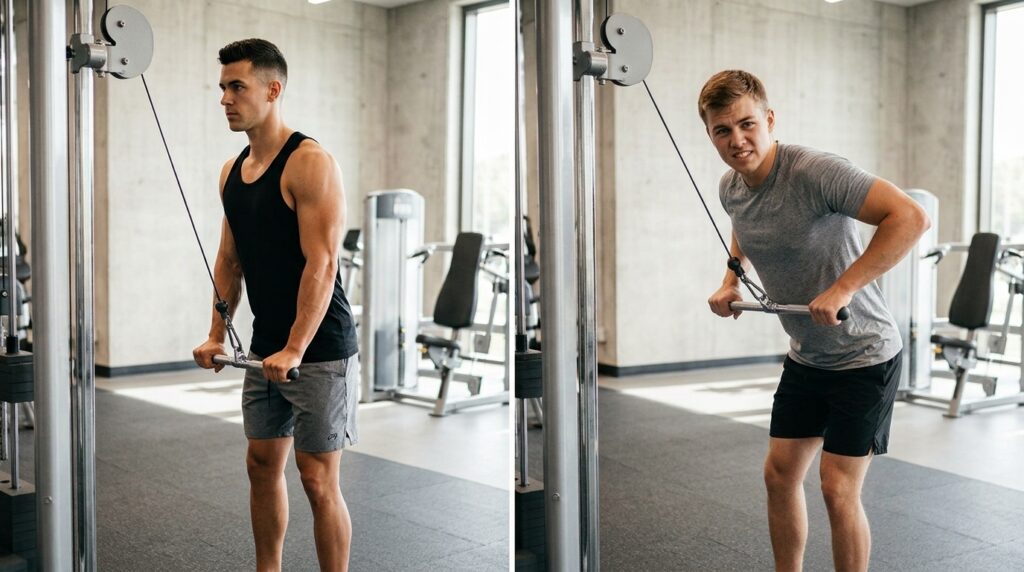
A weight that is too heavy can cause you to lean forward, swing your body, or use momentum to push the attachment down. Reduce the load until you can control the entire repetition.
2. Moving Your Elbows Too Much
Your upper arms should remain close to your sides. If your elbows move forward and backward with every repetition, you may be using more shoulder movement than necessary.
3. Bending Your Wrists
Keep your wrists in a comfortable, neutral position. Excessive wrist bending can make the movement uncomfortable and interfere with a consistent grip.
4. Rushing the Repetitions
Dropping the attachment quickly on the return portion removes some of the control you need during training. Allow the cable to rise slowly instead of letting the weight pull your arms upward.
5. Using Your Body to Push the Weight
Avoid bending your knees repeatedly or swinging your torso to complete each repetition. A stable body position helps you focus on extending your elbows.
Best Sets and Reps for Triceps Pushdowns
The right number of sets and repetitions depends on your experience, training goals, and overall workout volume.
For general muscle-building training, a practical starting point is:
- Beginners: 2 to 3 sets of 10 to 15 repetitions.
- Intermediate lifters: 3 to 4 sets of 8 to 15 repetitions.
- Strength-focused training: 3 to 4 sets of 6 to 10 controlled repetitions.
Rest for approximately 60 to 120 seconds between sets, adjusting the time according to your recovery and training intensity.
Choose a weight that lets you finish your repetitions with good technique while keeping a little energy in reserve. You do not need to reach complete muscular failure on every set.
How to Progress With Triceps Pushdowns
Progressive overload means gradually increasing the challenge placed on your muscles over time. You can apply this principle to cable pushdowns without immediately adding more weight.
Start by recording your attachment, weight, sets, and repetitions. Try to improve your performance gradually while keeping your technique consistent.
For example, if you complete 3 sets of 10 repetitions comfortably, work toward 12 or 15 repetitions before increasing the weight slightly.
Once you increase the resistance, return to the lower end of your repetition range and build up again. Small improvements are easier to maintain than sudden jumps in weight.
How to Add Triceps Pushdowns to Your Workout
Pushdowns work well during an upper-body or dedicated arm workout. You can perform them after compound exercises such as bench presses, close-grip presses, or shoulder presses.
For a simple triceps session, consider:
- Close-grip bench press: 3 sets of 8 to 10 reps.
- Rope triceps pushdown: 3 sets of 10 to 15 reps.
- Overhead cable triceps extension: 2 sets of 12 to 15 reps.
Adjust the number of sets according to your experience and recovery. You do not need to perform every exercise in the same session if your existing program already includes enough triceps work.
Safety Tips Before Performing the Exercise
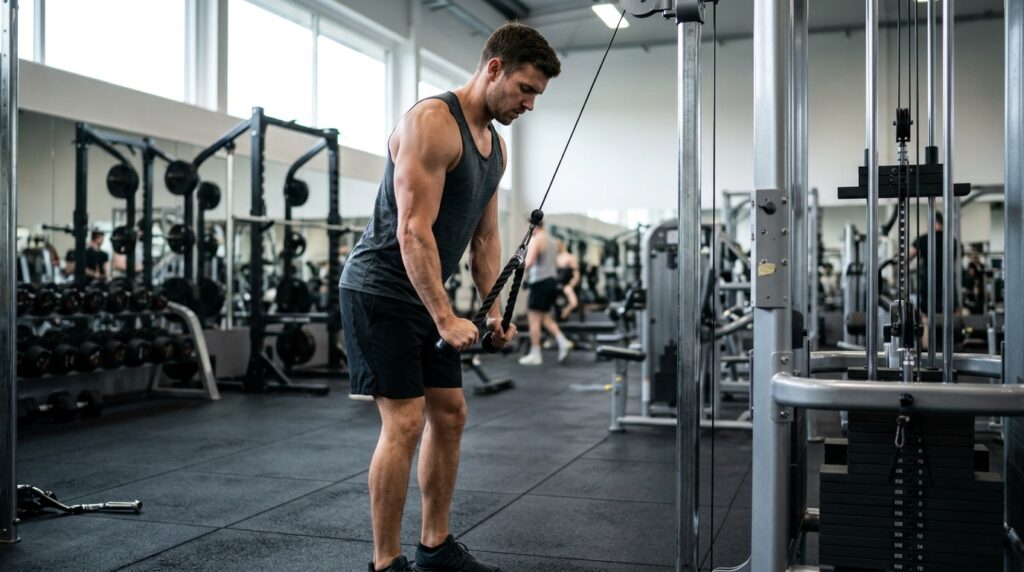
Start with a manageable weight and check that the cable attachment is properly secured before beginning. Keep your movements controlled and avoid forcing your elbows into an uncomfortable position.
If you experience sharp pain in your elbows, wrists, or shoulders, stop the exercise. Reduce the resistance or try another attachment if the issue is related to grip comfort. Persistent pain should be assessed by a qualified healthcare professional.
Consistency, suitable resistance, and proper technique will help you get more from your triceps pushdown training.