

If you sit most of the day, stand at a register, or hunch over a laptop, your lower back is probably tight, weak, or both. The best yoga poses for back pain target that exact combination. They loosen stiff hip flexors and hamstrings while waking up the deep muscles that are supposed to hold your spine steady. Done consistently, a short sequence can ease everyday stiffness and cut down how often flare-ups happen. This guide covers which poses to start with, how to sequence them, and which ones to skip if you have a herniated disc, sciatica, or a recent injury.
How Yoga Actually Helps Back Pain
Yoga does more than stretch tight muscles. It also strengthens the ones that are too weak to support your spine properly, which is often the real source of chronic tension. Three muscle groups matter most here: the paraspinal muscles that run along your spine, the multifidus muscles that stabilize each vertebra, and the transverse abdominis, the deep core muscle that wraps around your midsection like a belt. Weakness or poor coordination in any of these can leave your lower back doing work it wasn’t built to handle alone.
The slow, controlled breathing in yoga also plays a role. Shallow breathing and constant muscle guarding around an injury can make pain feel sharper and last longer. Long exhales signal your nervous system to release that guarding, which is part of why a slow yoga session often leaves people feeling looser than a quick static stretch does.
Who Should Be Cautious Before Starting
Yoga is generally safe for ordinary muscular back pain, but it isn’t right for every situation. Talk to a doctor or physical therapist first if you have a spinal fracture, a recent disc herniation with nerve symptoms, osteoporosis, or you’ve had recent back surgery. The same goes if your pain came from a fall, a car accident, or another clear injury rather than everyday stiffness.
Once you have the go-ahead, treat mild discomfort as your ceiling. A gentle pull in the muscle is normal. Sharp, shooting, or radiating pain is not, and it means you should back off the pose or skip it entirely that day
The Best Yoga Poses for Back Pain
These poses move from gentle mobility work into light strengthening, which mirrors how a safe back pain routine should progress.
Cat-Cow Pose
Start on your hands and knees, wrists under your shoulders and knees under your hips. Inhale as you drop your belly and lift your chest and tailbone, then exhale as you round your spine toward the ceiling and tuck your chin. Move slowly between the two positions for eight to ten breaths.
This pose warms up the entire spine and is often the safest place to begin, since it never asks the back to bear weight in a fixed position. It’s a good choice even on days when your back feels too irritated for anything more demanding.
Child’s Pose
Kneel with your big toes touching and knees spread wider than your hips. Sit back onto your heels and walk your hands forward until your forehead rests on the mat. Let your arms extend in front of you or rest alongside your body, palms up.
Child’s pose gently decompresses the lower back and stretches the hips at the same time. Use it as a reset between other poses, or hold it for a minute or two whenever your back needs a break.
Sphinx Pose
Lie on your stomach with your forearms on the mat, elbows stacked under your shoulders. Press your forearms down and lift your chest slightly, keeping your hips and legs relaxed on the floor. Hold for thirty seconds to one minute.
Sphinx pose builds gentle strength in the lower back without the intensity of a full backbend, which makes it a better starting point than cobra pose for anyone new to back-focused yoga.
Downward-Facing Dog
From hands and knees, tuck your toes and lift your hips up and back, forming an inverted V shape. Keep a soft bend in your knees if your hamstrings are tight, and press your chest toward your thighs.
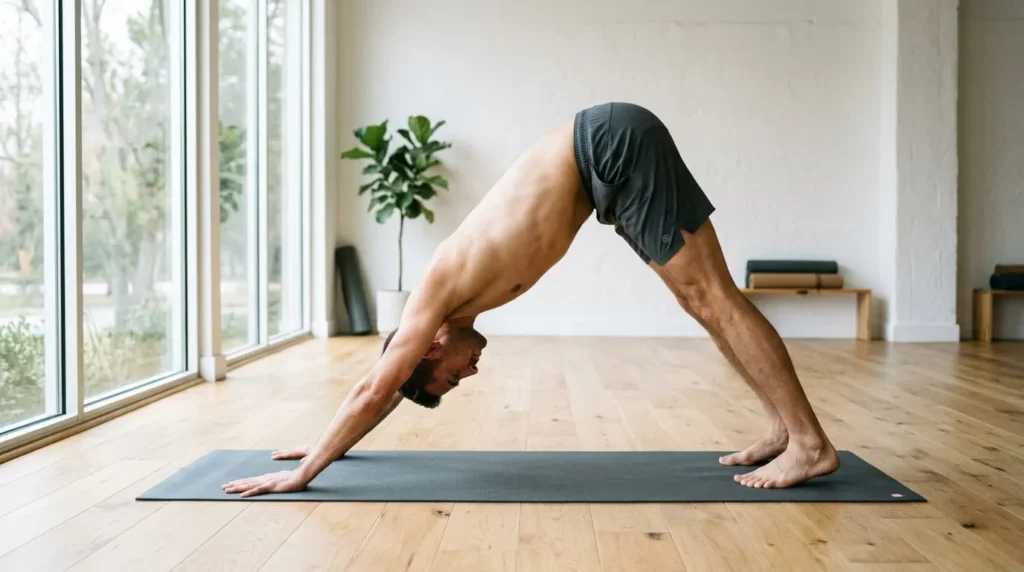
This pose lengthens the entire back of the body, including the hamstrings that often pull on the pelvis and contribute to lower back tightness. Skip it on days when wrist pain or acute sciatica makes weight-bearing on your hands uncomfortable.
Supine Twist
Lie on your back with your knees bent and feet flat on the floor. Let both knees fall gently to one side while keeping your shoulders pressed into the mat, and turn your head the opposite direction. Hold for thirty to sixty seconds, then switch sides.
A supine twist releases tension along the sides of the spine and in the outer hips without loading the back in a standing position. Keep the twist small and controlled rather than forcing your knees all the way to the floor.
Knees-to-Chest Pose
Lying on your back, pull both knees toward your chest and wrap your arms around your shins. Rock gently side to side if it feels good, and breathe into your lower back.
This pose gives the lower spine a light stretch in the opposite direction of most daily postures, which tend to compress it. It’s a comfortable finishing pose or a quick reset after sitting for long stretches.
Locust Pose
Lie face down with your arms alongside your body, palms facing down. On an inhale, lift your chest, arms, and legs a few inches off the mat, squeezing your glutes and lower back muscles. Hold for a few breaths, then release.
Locust pose is the most active strengthening move in this list, and it’s the one that most directly builds the endurance your lower back needs for daily activities like lifting and carrying. Keep the lift small at first rather than straining for height.
Legs-Up-the-Wall Pose
Sit sideways next to a wall, then swing your legs up and lie back so your legs rest vertically against it. Keep your arms relaxed by your sides and stay for three to five minutes.
This restorative pose takes all load off the spine and encourages blood flow back toward the heart, which many people find calms both back tension and general stress. It works well as a closing pose after any of the more active stretches above.
How to Build a Short Sequence
A simple routine works better than a long one you won’t repeat. Start with cat-cow for a minute to warm up, move into child’s pose, then sphinx and downward-facing dog to lengthen the spine and hamstrings. Add locust pose for strength, then finish with a supine twist, knees-to-chest, and legs-up-the-wall to release everything you just worked.

Ten to fifteen minutes daily, or every other day, is enough to notice a difference within a few weeks. Morning practice helps work out overnight stiffness, while an evening session can ease tension built up from a day of sitting or standing.
Poses to Avoid or Modify
Some common yoga poses can aggravate rather than relieve back pain, especially with an active injury. Deep forward folds that round the lower spine, such as a standing forward bend with locked knees, put unnecessary pressure on the discs. Full wheel pose and other deep backbends can strain the small facet joints in the spine if your core isn’t strong enough to support the position yet.
Plow pose and shoulder stand load significant weight onto the neck and upper back, which can pull on the lower spine indirectly if your form breaks down. Fast-paced vinyasa flows with repeated jump-backs are also worth skipping until your back pain has settled, since the impact and momentum leave little room for control.
When Yoga Isn’t Enough
Yoga helps most cases of ordinary muscular or postural back pain, but it isn’t a substitute for medical care when something more serious is going on. See a doctor if pain radiates down one leg past the knee, if you notice numbness or tingling, or if you have any change in bladder or bowel control. The same applies if pain follows a fall or accident, comes with fever, or hasn’t improved after several weeks of consistent, gentle practice.
For everyday tightness and mild chronic pain, though, a short, consistent yoga routine is one of the most practical tools available. Start with the gentler poses, pay attention to how your back responds, and build from there rather than chasing a full routine on day one.