


Fast twitch muscle fibers are the type II fibers in your skeletal muscles that contract quickly and forcefully. They do most of the work in sprints, jumps, and heavy lifts, and they tire out sooner than slow-twitch fibers do. Humans have two kinds, called type IIa and type IIx, and both respond to the right training.
This guide explains how these fibers work, how they differ from slow-twitch fibers, what training can and cannot change, and how to build a week of workouts around them.
What Are Fast Twitch Muscle Fibers?
Every skeletal muscle is a bundle of individual fibers, and those fibers come in different speeds. Researchers sort them mainly by the type of myosin heavy chain protein they contain, because that protein largely sets how fast a fiber shortens. Human muscle fibers fall into type I, type IIa, and type IIx, according to a review of myosin heavy chain isoforms in PubMed Central.
Type I fibers are slow twitch. Types IIa and IIx are fast twitch. They break down ATP quickly, produce high force, and have a short twitch. The cost is stamina: they have fewer mitochondria and blood vessels than slow-twitch fibers, so they fatigue sooner. Healthline’s medically reviewed overview calls them anaerobic, meaning they lean on stored glucose instead of a steady oxygen supply.
Type IIa vs. Type IIx Fibers
1. Type IIa: Fast and Fairly Durable
Type IIa fibers sit between the other two types. They contract fast, but they carry more mitochondria, myoglobin, and capillaries than IIx fibers, so they can keep working longer. That makes them the fast fibers that carry repeated hard efforts, such as a set of ten squats or a round of boxing. Research summarized by Healthline links type IIa fibers to overall muscle size.
2. Type IIx: Fastest and Quickest to Tire
Type IIx fibers contract and relax slightly faster than IIa fibers and produce the most power, but they burn out fast. In a comparison by Malisoux and colleagues (2006), summarized by the performance site Vitruve, IIx fibers contracted about 4.4 times faster than type I fibers, while IIa fibers were about 3 times faster. Peak power ran roughly ten times higher in IIx fibers and six times higher in IIa fibers.
Your nervous system saves IIx fibers for the hardest moments, like the last rep of a heavy set or the first strides of a sprint.
3. Why Older Articles Mention Type IIb
Rodents have a third fast type called IIb. Human muscle, like muscle from other large mammals, contains only type 1, 2A, and 2X fibers, according to a Cold Spring Harbor Perspectives in Medicine review. Many popular articles still label the fastest human fiber as IIb. In people, IIx is the accurate name, though some textbooks list the two together as IIB or IIX.
Fast Twitch vs. Slow Twitch Muscle Fibers
The short version: slow twitch fibers favor endurance, and fast twitch fibers favor power. Here is how they compare.
| Trait | Slow Twitch (Type I) | Fast Twitch (Type IIa and IIx) |
| Contraction speed | Slowest | Fast, with IIx the fastest |
| Force output | Low | High |
| Fatigue | Resists it well | Tires quickly, IIx fastest |
| Energy use | Mostly oxygen-based | Mostly glucose-based |
| Mitochondria and capillaries | Many | Fewer |
| Typical use | Posture, jogging, cycling, swimming | Sprints, jumps, heavy lifts |
Most muscles contain a mix, and the ratio varies from muscle to muscle, according to BYU-Idaho’s online physiology text. Postural muscles such as the soleus in your calf lean slow. Muscles used for powerful movements usually carry a larger share of fast fibers.
How Your Body Decides When to Use Fast Twitch Fibers
Your nervous system recruits fibers in order of size. Slow twitch fibers switch on first, type IIa fibers join as force demand rises, and IIx fibers come in last, as Kenhub’s anatomy guide explains. An easy walk or jog barely touches your fastest fibers. A heavy squat, a max-effort jump, or an all-out sprint calls them in.
Light weights lifted close to failure can recruit them late in the set as fatigue builds. Heavy loads and explosive movement are still the most direct route to these fibers, so the training plan below leans on both.
Activities That Depend on Fast Twitch Fibers
Healthline lists sprinting, powerlifting, jumping, agility drills, high-intensity cycling, and HIIT as the activities these fibers favor. Fiber mix tracks sport choice too. Costill’s 1976 work, as summarized by Vitruve, found trained sprinters had roughly 80 percent fast fibers, while long-distance runners tipped toward slow fibers. Genetics likely plays a large part in who ends up in which sport.
Everyday life draws on them as well. Taking stairs two at a time, catching yourself after a stumble, and hoisting a suitcase into an overhead bin all need a quick burst of force. That is the practical reason power matters at every age.
Can You Change Your Fiber Type?
Partly. Genetics sets much of the starting point. A BYU-Idaho physiology text notes that fewer than 5 percent of fibers have dual innervation, so genetics plays a far larger role than training.
Training can still shift fibers within the fast family. A review of the structure and function of human muscle fibers states that both endurance and resistance training move fibers from type 2X toward 2A, while the reverse shift has not been documented in any exercise program. An IDEA Health & Fitness summary of a 2021 review in Sports adds that programs lasting 6 to 16 weeks moved athletes with mostly IIx fibers toward IIa.
That shift is a good outcome. Type IIa fibers are fast and powerful but resist fatigue better, so a muscle with more IIa fibers can repeat hard efforts. Healthline cites a 1990 sprint-training study by Jansson and colleagues in which the share of type IIa fibers rose from 32 to 38 percent.
Moving slow fibers into the fast category has far weaker support. Endurance training pushes fibers the other way, toward type I, according to IDEA’s summary. Be skeptical of any product or program that promises to turn slow fibers into fast ones.
Size is a second lever. Strength-trained athletes carry larger IIa and IIx fiber areas than their endurance-trained peers, according to The Speed Project’s review of lifelong training research. Growing the fibers you have raises force potential even when the type stays the same.
How to Train Fast Twitch Muscle Fibers
Three inputs work: heavy loads, maximum speed, and full rest between efforts. Build the week around those and keep the rest simple.
1. Heavy Strength Training
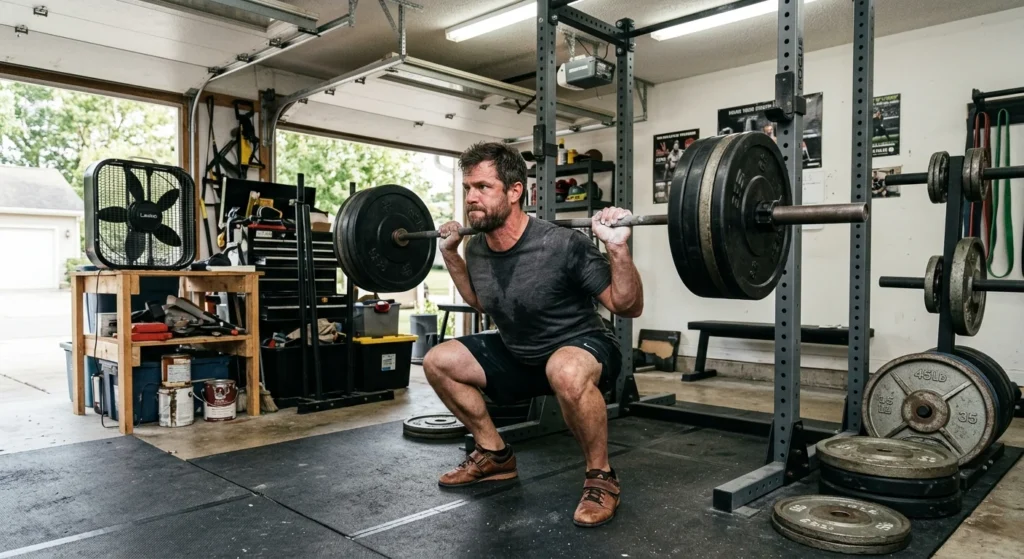
Heavy resistance training above about 70 percent of one-rep max shifts IIx and hybrid fibers toward a purer IIa profile and grows type II fibers, according to The Speed Project’s fiber-type review. A common template is squats, deadlifts, presses, or rows for 3 to 5 sets of 3 to 6 reps, with 2 to 4 minutes of rest between sets. Stop each set with a rep or two left, because form breakdown makes heavy work risky.
2. Sprints and Short Intervals
All-out efforts recruit fast fibers directly. The Jansson study, as Healthline describes it, used 30-second all-out bike sprints separated by 20-minute breaks. You can try shorter versions: 4 to 6 sprints of 6 to 10 seconds on a bike, hill, or flat ground, walking back for full recovery. Quality matters more than quantity, so end the session when your speed drops.
3. Jumps and Plyometrics
Box jumps, broad jumps, and medicine ball throws train speed of force production. Keep the volume low, around 3 sets of 3 to 5 reps, and rest until each rep feels sharp. Land softly with bent knees, and pick a box height you can jump onto without strain. Anyone with knee, ankle, or back problems should get clearance from a doctor or physical therapist first.
4. A Simple Weekly Template
The Physical Activity Guidelines for Americans, published by the U.S. Department of Health and Human Services, call for muscle-strengthening work on at least 2 days a week for adults. A fast-twitch week can fit inside that.
Day one is heavy lower body work, such as squats and deadlifts. Day two is a short sprint session followed by a few jumps. Day three is heavy upper body work, such as presses and rows, finished with medicine ball throws. Leave at least 48 hours before repeating a max-effort session for the same muscles, and add weight in small steps.
5. Recovery for Fibers That Tire Fast
Fast-twitch fibers fatigue quickly, so rest is part of the work. Long breaks between sets let you keep every rep fast, and sleep and enough protein support the repair that follows. The Speed Project also advises against junk volume, meaning extra tired reps that add soreness but little speed or strength.
What Happens to Fast Twitch Fibers With Age
Fast fibers shrink faster than slow ones as you get older. A review of human muscle fibers reports preferential atrophy of type 2A and 2X fibers in aging, consistent with greater age-related loss of nerve supply to fast motor units. A 2022 paper in the journal Aging reaches a similar conclusion, noting that fast twitch fibers tend to atrophy more with age than slow twitch fibers.

Strength and power work may help offset that loss. Adults over 50 can start with machines, bodyweight squats to a chair, and fast but controlled stand-ups, then add load gradually. Get a doctor’s approval first if you have heart disease, osteoporosis, or have not exercised in a long time.
How to Find Out Your Fiber Mix
The reference method is a muscle biopsy, where a small tissue sample is classified by its myosin heavy chain content. That is a lab procedure, and most people never need one.
Online fiber-type quizzes and rep-max tests give a rough guess at best. Your mix also varies from muscle to muscle, so no single number describes your whole body. The Speed Project makes the practical point that fiber type should not change your training approach, because fast- and slow-leaning athletes benefit from the same principles: quality sprints, full recoveries, heavy lifting, and power work.
Common Mistakes When Training for Power
The first mistake is treating every workout like a sprint. Fast fibers need rest, and a session that pushes every set to exhaustion trains stamina more than power. Keep power sessions short and crisp.
The second mistake is skipping the warm-up. Explosive movement loads tendons and joints quickly, and cold muscles strain more easily. Spend 5 to 10 minutes on easy movement and lighter practice reps first.
The third is adding too much, too soon. Sprinting and plyometrics put high stress on hamstrings, calves, and Achilles tendons. Start with a few reps at moderate effort for the first week or two, then build toward full speed.
The fourth is piling high-volume endurance work next to power work. Endurance training pushes fibers toward type I, so heavy weekly mileage can work against your speed goals. Keep cardio in the plan, but schedule it so it does not crowd out your heavy and fast sessions.

Fast-twitch muscle fibers respond to heavy loads, maximum-speed movement, and generous rest, and you do not need a biopsy or a special program to begin. Pick one heavy lift and one sprint or jump drill this week, track your weights and speeds over the next 6 to 8 weeks, and adjust from there. Anyone with a medical condition, an injury, or a long break from exercise should check with a doctor before starting.