
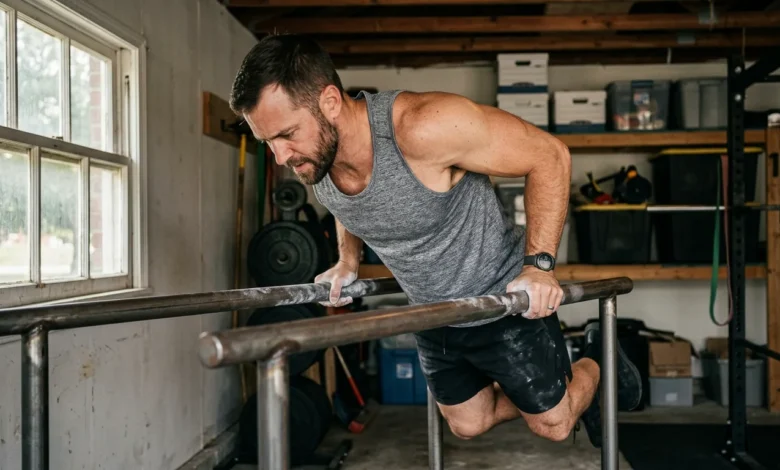
Dips work your chest, triceps, and front shoulders as the primary movers, with your core, lats, and shoulder blade muscles kicking in to keep your body stable through the full range of motion. Which muscle does the most work depends on your torso angle and hand position, and small form changes can shift the emphasis from chest to triceps or back again.
Quick Answer: The Muscles Dips Work
The pectoralis major, especially its lower fibers, drives the pushing motion when your torso leans forward. The triceps brachii extends your elbows through the entire rep and takes over almost completely when you stay upright. The anterior deltoid helps stabilize and assist the shoulder joint throughout the movement.
Behind those three, the serratus anterior and rhomboids control your shoulder blades, the lats add a small pulling assist near the bottom of the dip, and your abs and obliques keep your torso from swinging. None of these secondary muscles move much weight on their own, but they’re the reason a dip feels like a full upper-body exercise instead of just an arm move.
Chest: The Primary Mover on Bar Dips
Your pectoralis major is the biggest muscle recruited on a standard dip, and it does most of the pushing work when you lean your torso forward and let your elbows flare out slightly. This is the same reason a dip is sometimes called a “bodyweight decline press.” The angle mimics a decline bench press more than a flat one, so the lower chest fibers take on more load than the upper chest.
1. Lower Pectoralis Major vs Upper Chest
The lower and outer portions of the pec major do the heaviest lifting on a leaned-forward dip. The upper chest, called the clavicular head, gets far less involvement here than it would on an incline press or overhead press. If your goal is upper chest development, dips are not the right tool. They’re built for lower and mid chest thickness.
Triceps: The Workhorse Behind Every Rep
Every dip rep requires elbow extension, and that motion belongs almost entirely to the triceps brachii. Keep your torso upright and elbows tucked close to your sides, and the triceps take over as the main mover instead of the chest. This is why bodybuilders often call the upright version a “triceps dip.”
The triceps have three heads: long, lateral, and medial. Dips recruit all three, but the long head, which also crosses the shoulder joint, gets extra work because of the shoulder extension happening at the bottom of the movement. That combination is part of why dips are a staple in most serious arm-training programs.
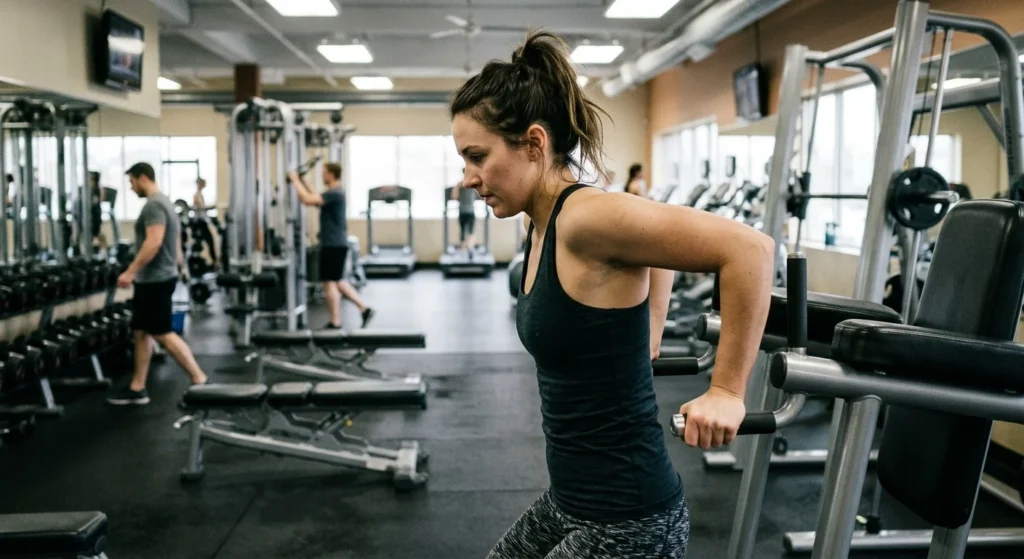
The American Council on Exercise has run EMG-based comparisons of common triceps exercises, and bodyweight dips consistently rank near the top for triceps muscle activation, often ahead of pushdowns and kickbacks. That’s a big part of why coaches keep recommending dips even when someone could just do a machine triceps exercise instead.
Shoulders: Anterior Deltoid Involvement
The front of your shoulder, the anterior deltoid, works throughout a dip to help extend and stabilize the shoulder joint as your arms straighten. It’s a secondary mover rather than the main driver, but it’s active on every single rep, which is why sore front delts after a heavy dip session are common.
The posterior and lateral deltoid heads barely participate. If your shoulders feel fatigued after dips, it’s almost always the front delt, not the side or rear delt, doing the extra work.
Supporting Muscles That Stabilize the Movement
A dip only looks like a simple push exercise from the outside. Underneath, several smaller muscles are firing constantly just to keep your shoulder blades and torso in the right position so the chest and triceps can actually do their job without your body swinging or your shoulders rounding forward.
1. Serratus Anterior and Rhomboids
The serratus anterior wraps around your ribcage and controls how your shoulder blade rotates as your arm moves overhead and back down. The rhomboids, sitting between your shoulder blades, work in the opposite direction, pulling your scapula back and down to keep your shoulders from creeping up toward your ears.
Weak serratus anterior function is one of the most common reasons people feel shoulder pinching on dips. Strengthening it through controlled dip reps, rather than fast, bouncy ones, often clears up that discomfort over a few weeks.
2. Core and Lats
Your rectus abdominis and obliques contract isometrically to stop your legs and hips from swaying while you’re suspended between the bars. This is the same kind of core bracing you’d use holding a plank, just applied while your upper body is doing separate work.
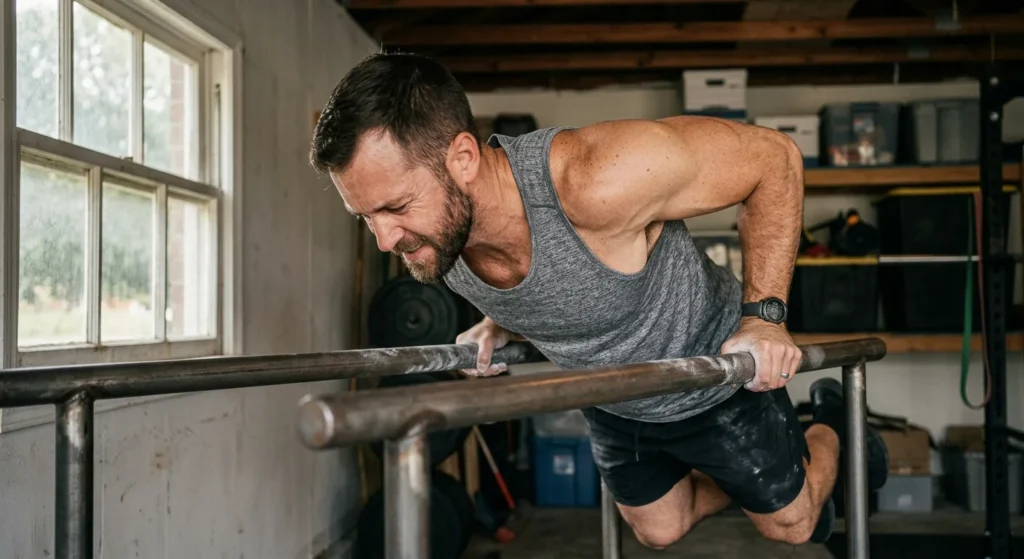
The latissimus dorsi gets a small assist role too, mainly during the bottom portion of the rep where your arm briefly extends behind your torso line. It’s not a major contributor compared to a pulldown or row, but it’s enough that some lifters count dips as light “pull” volume on high-frequency training weeks.
Chest Dips vs Triceps Dips: How Body Position Changes Muscle Emphasis
The single biggest factor in which muscle a dip trains is torso angle. Lean forward with elbows flared and you shift load onto the chest. Stay upright with elbows tucked, and you shift it onto the triceps.
Hand and bar width matter too. Wider parallel bars increase chest involvement because your arms move through a bigger horizontal arc. Narrower bars, like those on a standard dip station or bench dip setup, keep the movement closer to pure elbow extension, which favors triceps.
Depth changes the picture as well. Going only to a 90-degree elbow bend limits shoulder strain and keeps tension on the chest and triceps. Dropping deeper, past parallel, increases the stretch on the pec major and front delt, but it also raises the risk of shoulder impingement for people with limited shoulder mobility.
How to Adjust Your Dip Form to Target Specific Muscles
For more chest activation, lean your torso forward from the start of the rep, let your elbows flare out a few inches instead of staying tucked, and use a wider set of parallel bars if your gym has them. Keep your legs bent behind you to make leaning easier without losing balance.
For more triceps activation, keep your torso as vertical as possible for the entire rep, pin your elbows close to your ribs, and use a narrower dip station rather than wide gymnastic rings or bars. Straightening your legs out in front of you can help counterbalance the upright position.
Either way, control the descent instead of dropping fast. A two- to three-second lowering phase keeps tension on the target muscle longer and reduces the jerky bottom-position stress that causes most dip-related shoulder complaints.
Common Mistakes That Take Tension Off the Target Muscles
Shrugging your shoulders up toward your ears at the top of the rep shifts effort away from the chest and triceps and onto the upper traps instead, which isn’t the point of the exercise. Locking out fast at the top and letting momentum carry you also reduces time under tension for the muscles you’re actually trying to train.
Going too deep without the shoulder mobility to support it is another common issue. If you feel a sharp pinch rather than a stretch at the bottom, that’s usually a sign to shorten your range of motion rather than push through it.
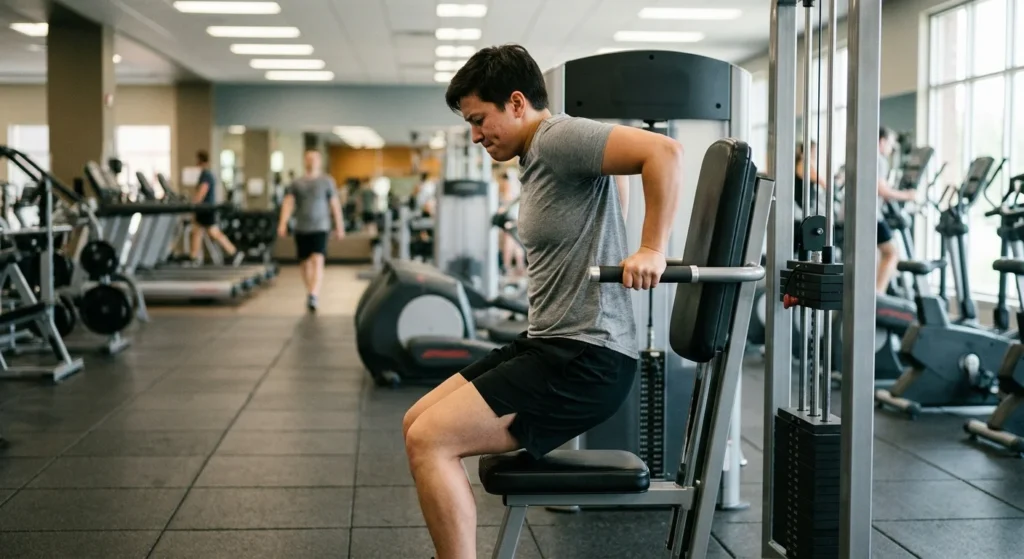
Flaring the elbows too wide during a triceps-focused set defeats the purpose, since it pulls the chest back into the movement. If your goal is triceps, elbow position matters more than almost anything else in your setup.
Sample Dip Variations to Try
Bar dips on parallel bars are the standard version and the best starting point for building general upper-body pushing strength. Bench dips, done with your hands on a bench and feet on the floor or another bench, isolate the triceps more heavily and need no equipment beyond furniture.
Ring dips add an instability challenge, forcing the stabilizer muscles, especially the rotator cuff and serratus anterior, to work harder than they would on fixed bars. Weighted dips, done with a dip belt or a weight vest, are the natural progression once bodyweight dips stop feeling challenging for 10 to 12 reps.
Assisted dip machines or resistance bands looped over the bars are the right entry point if you can’t yet do a full bodyweight dip. They let you train the same muscles through the same range of motion while you build up the strength to remove the assistance over time.