
Most step counters give you a number, but that number rarely tells you what it means for your body. Ten thousand steps burn a different number of calories for a 130-pound person than for a 220-pound person, and the terrain, pace, and even your stride length further complicate the math. Understanding how steps convert to calories burned lets you use your daily step count as a real fitness tool rather than just a number on a screen.
The Basic Formula for Steps to Calories Burned
The simplest way to estimate calories burned from steps starts with your weight and your average stride length. A rough industry standard puts the number at about 0.04-0.05 calories burned per step for an average-weight person walking at a normal pace. That means 10,000 steps land somewhere between 400 and 500 calories for most adults, though this range shifts quickly once you factor in body weight and speed.
A more accurate version of the formula uses your weight in pounds, distance walked in miles, and a MET value for walking. MET stands for metabolic equivalent of task, and it measures how much energy an activity requires compared to resting. Walking at a moderate pace has a MET value of about 3.5, while brisk walking pushes closer to 4.3, and walking uphill or with added weight can climb past 6.
The formula looks like this: Calories burned equals MET value multiplied by body weight in kilograms multiplied by the duration of activity in hours. This is why two people can take the same number of steps and burn noticeably different amounts of energy.
How Body Weight Changes the Numbers
Heavier bodies require more energy to move the same distance, so calories burned per step rises with body weight. A 150-pound person walking at a normal pace burns roughly 0.04 calories per step, while a 200-pound person burns closer to 0.05 calories per step at the same speed. Over 10,000 steps, that difference adds up to a gap of nearly 100 calories between the two people.
This is also why weight loss tends to slow the calorie burn from the same daily step count. As body weight drops, each step requires slightly less energy, so someone who started burning 500 calories from a 10,000-step walk may burn closer to 450 calories doing the identical walk after losing 20 pounds. This is not a reason to stop walking. It simply means step count alone stops being a reliable calorie tracker once your weight changes significantly, and pace or distance needs to increase to keep burn rates consistent.
Walking Pace and Terrain Matter More Than People Expect
Step count treats a stroll and a brisk power walk as identical, but your body does not. Walking speed changes the MET value substantially, and MET value drives the calorie calculation more than step count does on its own.
1. Casual Walking Pace
A relaxed pace, around 2 miles per hour, sits at a MET value close to 2.8. This is the pace most people fall into during errands or casual movement around the house, and it burns fewer calories per step than a deliberate walk.
2. Brisk Walking Pace
Brisk walking, typically 3.5 to 4 miles per hour, raises the MET value to around 4.3. At this pace, the same 10,000 steps that burned 400 calories at a casual pace can burn closer to 500 to 550 calories.
3. Incline and Terrain
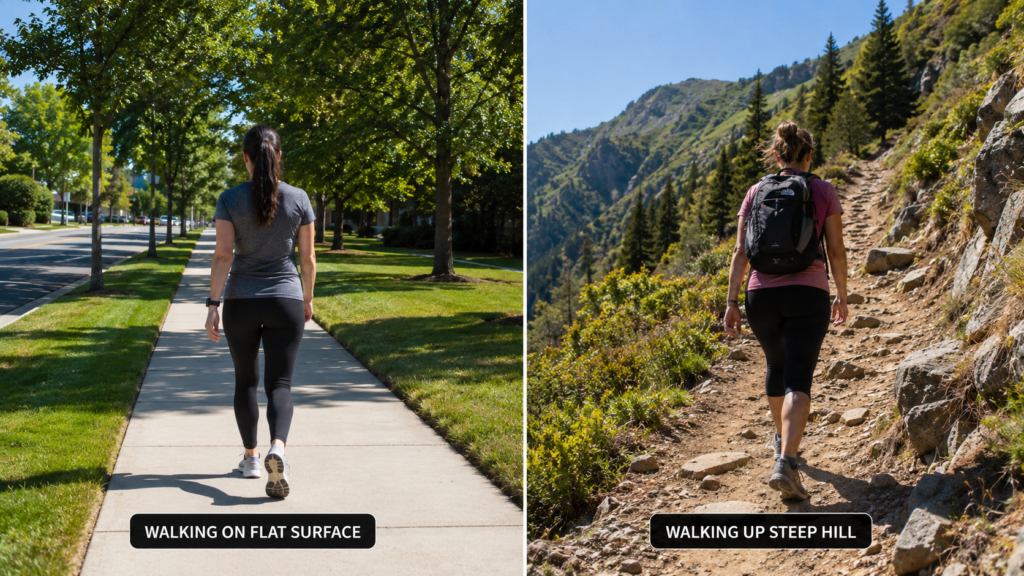
Walking uphill, on sand, or on uneven trails increases the energy cost of each step without necessarily increasing step count. A 5 percent incline can raise calorie burn by 20 to 30 percent compared to flat ground at the same pace, which is why hiking apps rarely rely on step count alone.
Steps to Calories Burned by Common Step Counts
Below is a general estimate for an average adult weighing around 170 pounds, walking at a moderate pace. These numbers shift with weight, speed, and stride length, but they give a useful baseline.
At 1,000 steps, most people burn around 40 to 50 calories, which roughly matches a five to ten-minute walk. At 5,000 steps, the burn rises to about 200 to 250 calories, a distance most adults cover in 40 to 50 minutes at a normal pace. At 10,000 steps, the widely cited daily target, calorie burn lands between 400 and 500 calories for most body types.
At 15,000 steps, burn typically reaches 600 to 750 calories, and at 20,000 steps, many people burn 800 to 1,000 calories depending on pace and body weight. These ranges assume steady walking rather than a mix of walking and standing still, since idle time logged by a step counter does not add to the total.
Does Stride Length Change the Calorie Count?
Yes, and this is one of the most overlooked variables in step-based calorie tracking. Someone with a longer stride covers more distance per step, which means they burn slightly more calories per step than someone with a shorter stride walking the same number of steps.
Average stride length runs about 2.1 to 2.5 feet for women and 2.2 to 2.7 feet for men, though height is the biggest factor. A taller person with a longer stride walking 10,000 steps may cover 5 miles, while a shorter person walking the same 10,000 steps might only cover 4 miles. Since calorie burn ties more closely to distance and effort than to raw step count, the taller walker typically burns more calories for the identical number of steps.
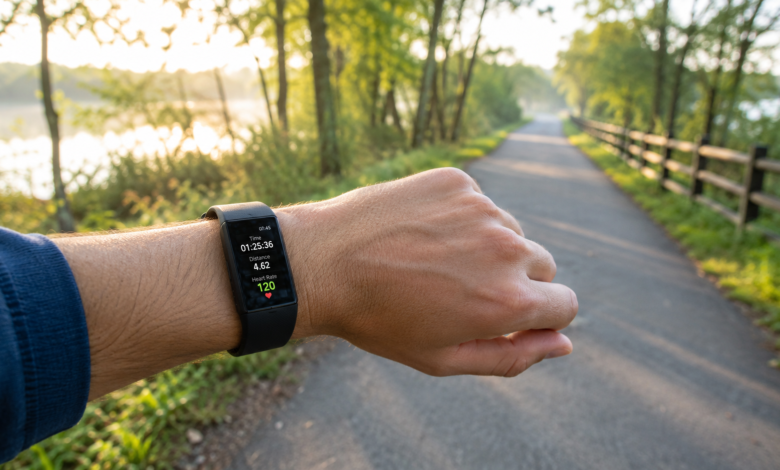
Most fitness trackers estimate stride length automatically based on height and weight entered during setup, but manually calibrating your device after measuring your actual stride improves accuracy considerably.
Steps vs Running for Calorie Burn
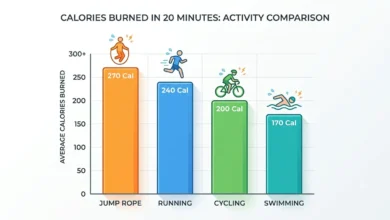
Steps taken while running burn significantly more calories than steps taken while walking, even when the step count looks identical on a tracker. Running has a MET value between 8 and 12 depending on pace, compared to 3 to 4.5 for walking, which roughly doubles or triples the calorie cost per step.
A person running 10,000 steps, which typically covers around 5 miles, might burn 500 to 700 calories depending on pace and body weight. The same 10,000 steps walked at a moderate pace burn closer to 400 to 500 calories. This gap is why step count comparisons between walkers and runners can be misleading, and why calorie estimates should always account for activity intensity, not just steps logged.
How to Use Steps to Calories Burned for Weight Goals
Step count becomes genuinely useful for weight management once you treat it as one input among several rather than the whole picture. A daily step goal paired with an awareness of pace, incline, and consistency gives a far more accurate calorie estimate than steps alone.
For weight loss, increasing daily steps from a sedentary baseline of 3,000 to 4,000 steps up to 8,000 to 10,000 steps typically adds 150 to 300 extra calories burned per day, without requiring dedicated workout time. Combining a higher step count with two or three brisk walking sessions per week, where pace intentionally increases, raises total weekly calorie burn further than step count increases alone.
For general health maintenance rather than weight loss, most research points to diminishing returns past 8,000 to 10,000 steps per day for many health markers, though calorie burn continues to increase linearly the more steps you take.

Common Mistakes That Throw Off Step-Based Calorie Estimates
Several habits quietly distort the accuracy of steps-to-calories-burned calculations, even when using a quality fitness tracker.
Wearing a tracker on the wrist while pushing a stroller or shopping cart often undercounts steps, since arm swing drives most wrist-based step detection. Carrying weight, such as a backpack or laptop bag, increases actual calorie burn without the tracker adjusting for the added load. Not updating your weight in the tracker app after gaining or losing weight causes the calorie estimate to drift further from accurate over time. Standing and shuffling in place, common during cooking or cleaning, can log steps without matching the calorie burn of purposeful walking.
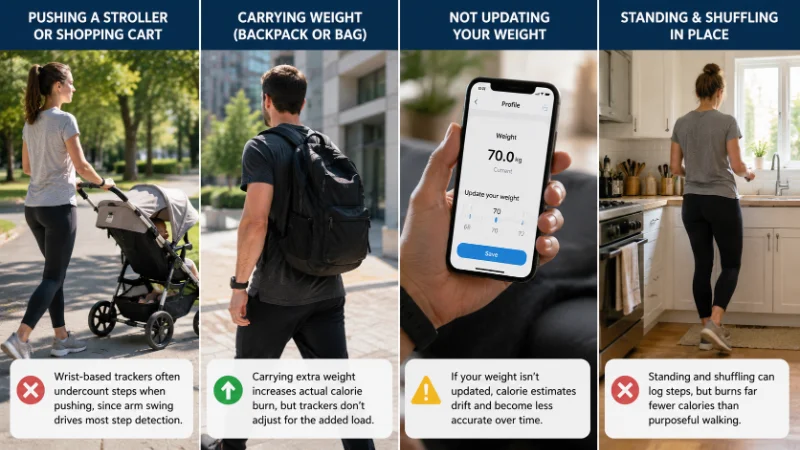
Correcting these factors, primarily by keeping tracker weight settings current and understanding that not all logged steps represent equal effort, improves the reliability of any calorie estimate based on steps.