

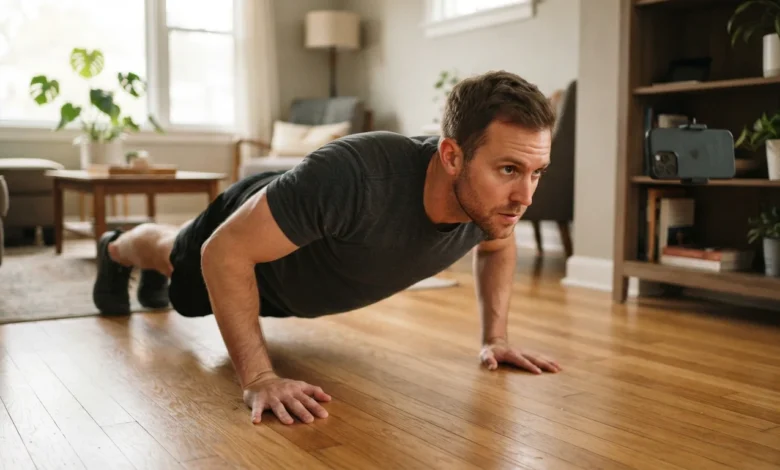
Most healthy men should be able to do about 22 to 28 clean pushups in their twenties and 17 to 21 in their thirties. After that, the number drops by roughly four to five reps per decade. If you land below your age band, treat it as a training gap you can close in a few weeks.
This is how many pushups a man should be able to do when the reps are counted honestly: full range, straight body, no resting at the top. The tables below come from published fitness norms, not from a gym poster.
Pushup Standards for Men by Age
The most widely used numbers come from the Canadian musculoskeletal fitness norms, published by Payne and colleagues in the Canadian Journal of Applied Physiology in 2000. They tested 571 healthy adults aged 15 to 69. Men were scored on standard push-ups from the toes, counting maximum reps in a row. Here is the average number of push-ups for men by age, split into rating bands.
| Age | Needs Improvement | Fair | Good | Very Good | Excellent |
| 20-29 | 16 or fewer | 17-21 | 22-28 | 29-35 | 36 or more |
| 30-39 | 11 or fewer | 12-16 | 17-21 | 22-29 | 30 or more |
| 40-49 | 9 or fewer | 10-12 | 13-16 | 17-24 | 25 or more |
| 50-59 | 6 or fewer | 7-9 | 10-12 | 13-20 | 21 or more |
| 60-69 | 4 or fewer | 5-7 | 8-10 | 11-17 | 18 or more |
Mayo Clinic guidance, reported by Fox News Digital in March 2025, lists nearly the same targets: 28 reps at age 25, 21 at 35, 16 at 45, 12 at 55 and 10 at 65. Those match the top of the Good band above, which is why two sources that look different usually agree.

So when a site says a 25-year-old man should do 28, it is quoting the ceiling of Good. When another says 36, it is quoting Excellent.
Is 20 Pushups Good for a Man?
It depends on your age. Twenty pushups are rated Fair for a man in his twenties, Good in his thirties, Very Good in his forties and fifties, and Excellent in his sixties, using the same Canadian norms.
Is 30 pushups good for a man? Yes. It is Very Good for a man in his twenties and Excellent for any man 30 or older. Outlift’s strength guide also puts a man in good shape at 30 to 40 reps.
How Many Pushups Should a Man Do in a Row Versus in a Day?
These are two different questions, and mixing them up is why advice online feels contradictory. The age tables measure one max set with no rest, which tests muscular endurance. A daily total is a training volume number, and it depends on your goal.
Ebenezer Samuel, fitness director at Men’s Health US, told Men’s Health Australia that most people should eventually reach 20 to 25 consecutive push-ups. The training research adds a useful detail. Kotarsky and colleagues (2018) had 23 moderately trained men do progressive pushup training three days a week for four weeks, and their pushup performance rose significantly more than a bench press group’s.
Why the Number Matters for Your Health
The strongest reason to care comes from a 2019 study in JAMA Network Open by Yang and colleagues. They followed 1,104 active male firefighters for 10 years. Men who could do more than 40 pushups at baseline had a 96 percent lower rate of cardiovascular events than men who managed fewer than 10.
Only 37 events occurred in total, and the group was active, working-age men, so the numbers will not transfer cleanly to everyone. The study also cannot show that doing pushups prevents heart disease. It shows that pushup count was a better marker of future risk than a submaximal treadmill test in that group.
Read 40 as a strong marker, not a requirement. A man who sits at 25 and trains regularly is in a good place.
Why Body Weight and Pushup Style Change Your Score
Two men of the same age can post very different counts for reasons that have nothing to do with effort. A heavier man lifts more bodyweight on every rep, and a taller man travels farther each time.
Style matters just as much. The Canadian norms use a standard pushup for men, with the chin touching the mat. Ebben and colleagues (2011), in the Journal of Strength and Conditioning Research, measured force across six pushup variations in 23 recreationally fit adults. Knee pushups and hands-elevated pushups produced lower forces than the rest, and feet-elevated pushups produced the highest.
That is why 30 knee reps and 30 floor reps are not the same score. Military pass marks are minimums for service members, so do not use them as a fitness norm either.
Which Number Should You Aim For?
Your target depends on what you want from the exercise. So how many push-ups should a man be able to do for a basic health marker? Reaching the Good band for your age is a sound first goal. For the heart-health link in the firefighter data, 40 is the number to chase once your form stays clean.
Pushups also tend to turn into an endurance check once you pass about 30 reps. Vaara and colleagues (2012) tested 846 young men and found pushup scores correlated with maximal bench press strength (r = 0.61), a moderate link, not a perfect one. If strength is your goal, move to feet-elevated or weighted pushups instead of adding more reps.
Pushup Goals for Men in Their 30s, 40s, and 50s
A 30-year-old man should aim for 17 to 21 reps to rate Good and 30 or more for Excellent. At 40, the Good band is 13 to 16 and Excellent starts at 25. At 50, a man should aim for 10 to 12 to rate Good and 21 or more for Excellent.
The drop reflects normal age-related muscle loss, and training pushes back against it hard. A trained 55-year-old can often beat an untrained 25-year-old on this test.
How to Test Your Pushup Max Properly
Self-counted numbers run high because depth and hip position drift when you are tired. Test the way the norms were collected.
- Warm up for five minutes, then do 8 to 10 slow reps at an easier angle.
- Place your hands under your shoulders, with your body in one line from heels to head and your glutes tight.
- Lower until your chest is about a fist from the floor. The lab protocol uses the chin touching the mat.
- Do continuous reps with no rest at the top. If you pause to shake out an arm, the set is over.
- Stop when your hips sag, or your depth shortens twice in a row, and do not count those two reps.
Film one set from the side. Most men find their depth is shallower than it felt. Retest every three to four weeks, not every few days.
What If You Cannot Hit Your Age Band Yet?
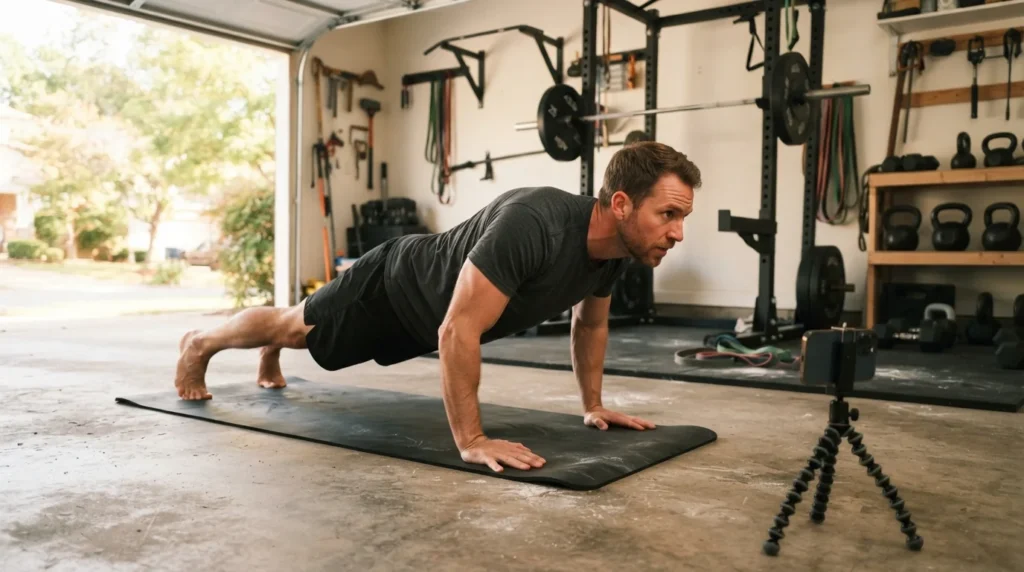
Start below the floor and climb. For a beginner man, 10 strict pushups is a sensible first target, according to Livestrong.
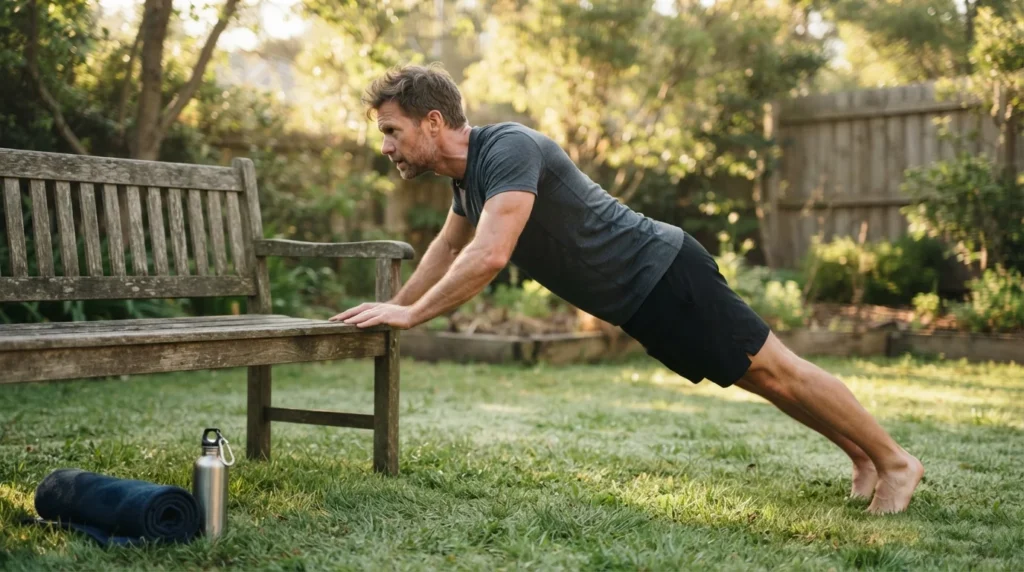
The ladder runs from wall pushups to countertop pushups, then a sturdy bench or bottom stair, then knees, then slow four-second negatives on the floor, then the full pushup from your toes. Work at the step where 8 to 12 clean reps feel hard by the last two, and add a rep or two each session. Move up when you reach 3 sets of 15, and expect your count to drop by about half at first.
How to Add Reps Fast
Pushup numbers respond quickly because the movement is simple and your nervous system learns it fast.
- Train three days a week with at least one rest day between sessions.
- Do 3 to 5 sets and stop two or three reps short of failure on most of them.
- Add one rep per set each week, so 4 sets of 8 becomes 4 sets of 9.
- On off days, add a few easy sets of about half your max, spread through the day.
- Row or do band pull-aparts too, so the front of the shoulder does not take all the load.
Here is a simple 8-week template. Test your max. On day one, do 3 sets at 50 percent of that max. On day two, do 4 sets at 50 percent. On day three, do one all-out set plus 2 sets at 50 percent. Add a rep to every working set each week, retest at weeks 4 and 8, and reset your percentages.
This structure is a common bodyweight progression, not a clinical protocol, so treat it as a starting point and adjust it to how you recover.
When to Skip the Max Test
A max pushup test is an all-out effort that raises heart rate and blood pressure and loads the shoulders, elbows, wrists, and lower back. Check with a doctor first if you have heart disease, uncontrolled high blood pressure, recent chest symptoms, or a shoulder, wrist, or back injury, or if you have been inactive for a long time. This article is general information, not medical advice.