

Static stretching and passive stretching get confused constantly, even by people who train regularly. Both involve holding a muscle in a lengthened position, and both look nearly identical from the outside. The real difference comes down to one question: who or what is doing the work to create that stretch?
What Is Static Stretching
Static stretching means you actively move a muscle into a lengthened position yourself and hold it there without movement, usually for 15 to 60 seconds. You reach forward to touch your toes and stay there. Your own muscles create and maintain the stretch.
What Is Passive Stretching
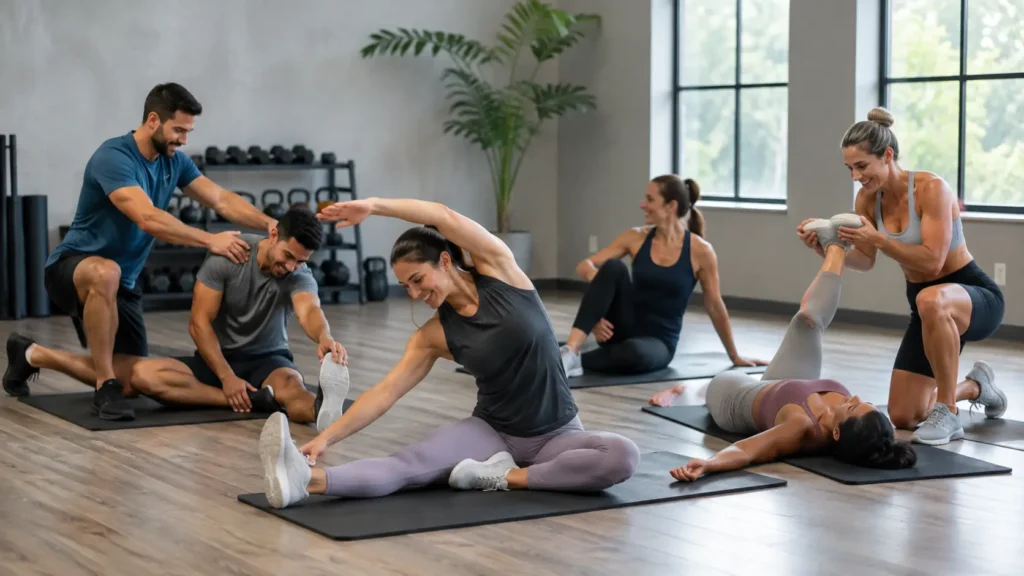
Passive stretching means an external force does the work instead of your own muscles. A partner pushes your leg toward your chest, a strap pulls your foot back, or gravity does the job while you relax completely. You are not actively engaging the muscle to create the position.
This distinction matters because it changes what is happening physiologically. In static stretching, you are still recruiting some muscular effort to hold the position, even though the target muscle itself is relaxed and lengthening. In passive stretching, you can achieve a deeper range of motion because there is no competing muscular tension working against the stretch.
Both methods fall under the broader category of static flexibility training, as opposed to dynamic stretching, which involves continuous movement rather than holding a fixed position.
Active Static vs Passive Static Stretching
Static stretching itself splits into two subtypes worth understanding, because “static stretching” as a general term actually covers both active and passive variations.
1. Active Static Stretching
Active static stretching is what most people picture when they hear “static stretching.” You use your own muscles, specifically the opposing muscle group, to move a joint into a stretched position and hold it there without outside help. Lifting your leg straight up in front of you and holding it with no hands is active static stretching.
2. Passive Static Stretching
Passive static stretching is the more precise term for what most people simply call “passive stretching.” You get into the stretched position using an external force such as a partner, a strap, a wall, or gravity, and you hold that position while relaxing the target muscle completely.
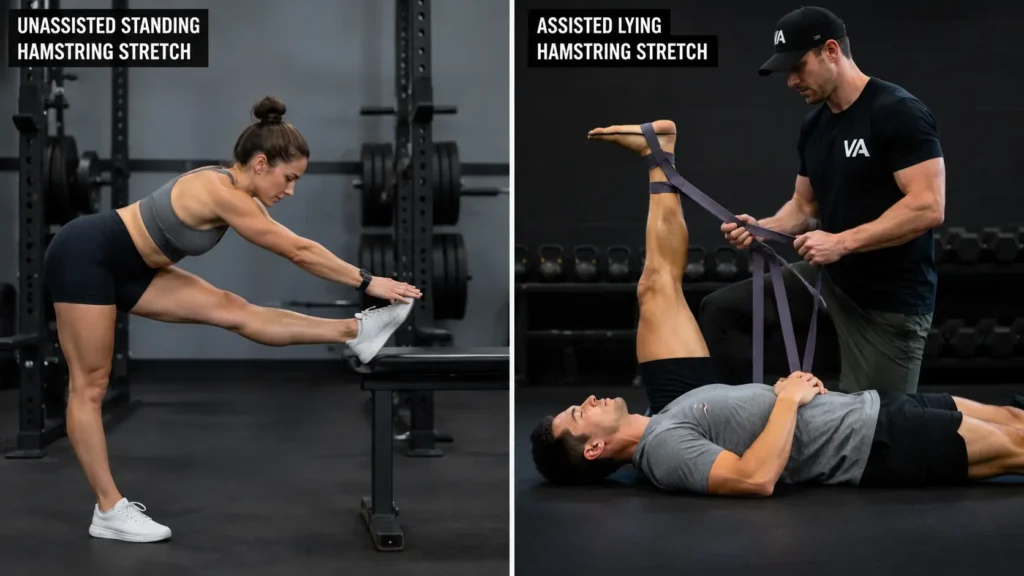
So technically, passive stretching is a subcategory of static stretching, not a separate category entirely. When people ask how static and passive stretching differ, they are usually asking how active static stretching compares to passive static stretching.
Comparing the Two Methods
Active static stretching tends to produce a smaller range of motion because the opposing muscle can only pull so hard on its own. It builds a small amount of strength in the muscles doing the holding, since they work against resistance the whole time. It requires no equipment or partner, which makes it practical for solo training sessions.
Passive static stretching allows a much deeper stretch because the target muscle stays fully relaxed while an outside force does the lengthening. This makes it more effective for improving flexibility over time, particularly for tight areas like hamstrings, hip flexors, and shoulders. The main risk is that without feedback from your own muscular effort, it is easier to push too far and strain a muscle or joint.
When to Use Static Stretching
Static stretching, in either form, works best after a workout rather than before one. Research on pre-exercise stretching has shown that holding static stretches immediately before strength or power-based activity can temporarily reduce muscular force output and jump height. Save static holds for your cool-down, when muscles are already warm.
It also works well as standalone flexibility training on rest days. Ten to fifteen minutes of active static holds targeting major muscle groups, done two to three times per week, is enough to produce measurable improvements in range of motion within four to six weeks for most people.
When to Use Passive Stretching
Passive stretching earns its place in a few specific situations where active stretching falls short. Athletes recovering from injury often use passive stretching under the guidance of a physical therapist, because the therapist can control the exact angle and force applied while monitoring for pain or resistance.
Passive stretching is also the standard approach in partner-assisted flexibility work, common in gymnastics, dance, and martial arts, where athletes need extreme ranges of motion that active stretching alone cannot produce efficiently.

For general fitness and everyday mobility, passive stretching using a strap or towel is a practical middle ground. Looping a strap around your foot to pull your leg into a hamstring stretch gives you some of the depth benefits of passive stretching while keeping full control over how hard you pull.
Benefits and Drawbacks of Each
1. Benefits of Active Static Stretching
Active static stretching builds a small amount of strength in the antagonist muscle group with every hold. It requires no equipment, no partner, and no special setup, which makes it the most practical option for daily use.
2. Benefits of Passive Stretching
Passive stretching’s main benefit is depth. Full muscular relaxation combined with external force consistently produces a greater range of motion than active stretching can achieve on its own, making it the better choice when the goal is maximizing flexibility.
3. Drawbacks to Consider
Active static stretching has a ceiling on range of motion, since the opposing muscle can only generate so much pulling force. Passive stretching carries more risk, since you lose the direct proprioceptive feedback that normally tells you when to stop. Clear verbal cues about pain versus tension are essential when working with a partner.
Which Should You Choose
Neither method is universally better. The right choice depends on your goal, your access to a partner or props, and your experience level.
If you train alone and want a simple, low-risk way to maintain flexibility and support recovery after workouts, active static stretching covers most of what you need.
If your goal is to significantly increase range of motion beyond what your own muscles can pull you into, whether for a sport, dance, gymnastics, or a specific mobility goal, incorporating passive stretching with a strap, prop, or trained partner will get you there faster.
Many effective flexibility programs use both. A typical approach starts with active static holds to warm the muscle and establish a baseline range, then progresses into passive stretching with a strap or partner to push slightly beyond that baseline.
Whichever method you choose, consistency matters more than intensity. Stretching two to three times per week for several weeks produces far better long-term results than a single aggressive session that leaves you sore or risks injury.
A few mistakes recur in both methods and explain why some people stretch consistently without seeing much progress. Bouncing during a hold, sometimes called ballistic movement, defeats the purpose of static and passive stretching entirely. The muscle needs a sustained, unmoving hold to trigger the relaxation response that allows it to lengthen.
Holding a stretch for too short a time is another common issue. Anything under 15 seconds mostly just warms the tissue without producing lasting change. Most research supports holds between 30 and 60 seconds per muscle group, repeated two to four times per session.
Skipping the warm-up before static stretching, even though it is typically a cool-down activity, can still limit results. Stretching cold muscle tissue yields less range of motion and carries a higher risk of injury than stretching tissue that has already been through movement.