

Cardio does not kill gains for most people. Research shows a small interference effect between cardio and strength training, but it mainly shows up with high volumes of both, done in the same session, without enough food to support recovery. Moderate cardio, spaced apart from lifting, has little to no measurable effect on muscle growth.
Where the “Cardio Kills Gains” idea comes from
The theory traces back to a 1980 study by exercise scientist Robert Hickson, who coined the term “adaptation interference.” Hickson compared a group doing resistance training alone against a group doing resistance training plus daily cardio, and found the cardio group made smaller strength gains after ten weeks. The study shaped gym culture for decades, and it’s part of why so many lifters still avoid the treadmill on leg day.What often gets left out is the training volume in that original study. Participants doing concurrent training were cycling or running up to six days a week on top of lifting, a load far higher than what most recreational lifters attempt. A newer, more accurate reading of the research separates “some cardio” from “a lot of cardio,” and the two produce very different outcomes.
What the Science Actually Says
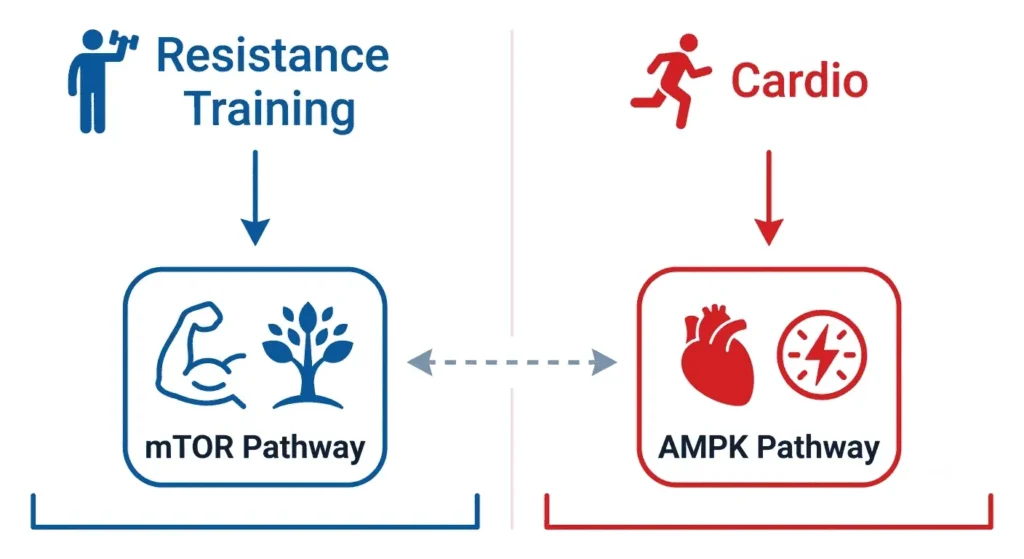
At the cellular level, resistance training and endurance training send different signals. Lifting weights activates the mTOR pathway, which drives muscle protein synthesis and hypertrophy. Cardio activates AMPK, a pathway tied to energy production and fat oxidation. In theory, AMPK activation can blunt mTOR signaling, which is the biological basis for the interference effect.
In practice, that signaling conflict rarely translates into meaningful muscle loss for someone training a few times a week. A widely cited 2012 meta-analysis by Wilson and colleagues found that concurrent training did reduce strength and hypertrophy gains compared to resistance training alone, but the effect size was small for most participants, and running produced more interference than cycling or rowing. More recent reviews have found even less of an effect once total volume and recovery time are accounted for.
When Cardio Really Can Slow Muscle Growth
1.Too much cardio volume
The interference effect scales with how much cardio you’re doing, not whether you’re doing any at all. Several hours of running or cycling stacked on top of a full lifting program will eventually eat into recovery capacity, since your body only has so much energy and repair bandwidth to spread across both. Someone training for a marathon while trying to build maximum muscle is working against their own recovery in a way a jogger doing three easy 5Ks a week is not.
2.Doing cardio and lifting back-to-back
Timing matters more than most people expect. A cardio session done right before lifting can leave you fatigued and unable to train as heavy, which limits the mechanical tension that actually drives hypertrophy. Some research also suggests that AMPK activation from a cardio session stays elevated for a few hours afterward, which is one reason coaches often recommend spacing the two sessions apart when possible.
3.Not eating enough to cover both
Cardio burns calories, and if you don’t adjust your intake, you can end up in a bigger deficit than you realize. Muscle growth requires a calorie surplus, or at minimum enough protein and total energy to support repair. Someone who adds three cardio sessions a week without eating more is far more likely to see stalled progress than someone doing the same cardio while tracking and adjusting their intake.
How to do Cardio without Losing Gains
1.Separate the sessions when you can
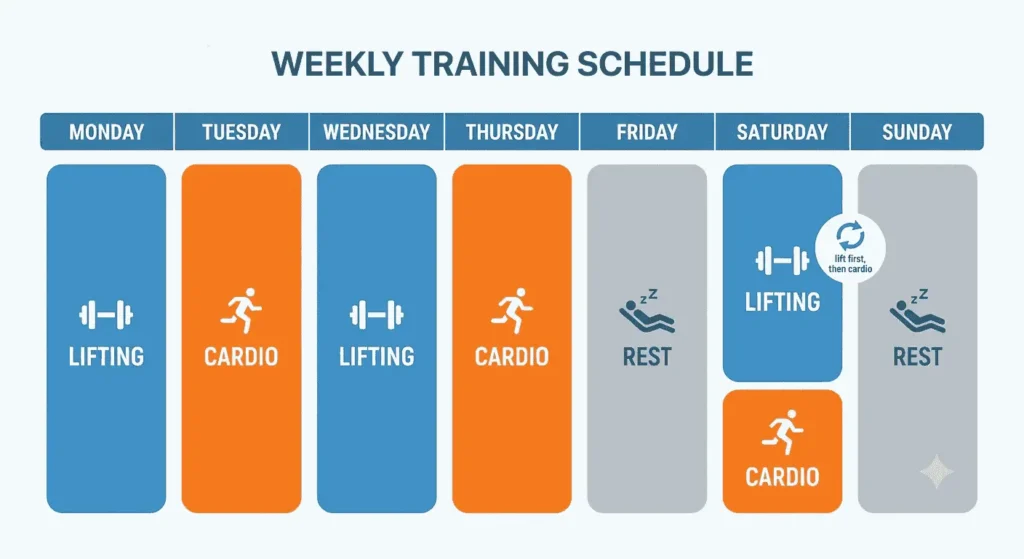
Spacing cardio and lifting by at least a few hours, or better, doing them on different days entirely, reduces the overlap in fatigue and signaling. If your schedule only allows one session a day, lifting first and doing cardio afterward generally protects your lifting performance better than the reverse order.
2.Pick lower-impact cardio
Running causes more muscle damage than cycling, rowing, or swimming, largely because of the eccentric loading involved in every stride. That damage adds to the recovery workload your body already carries from lifting. Swapping some running sessions for a bike, a rower, or an incline walk keeps your heart rate up without piling on extra soreness in the same muscle groups you’re trying to grow.
3.Eat to support both types of training
Aim for roughly 1.6 to 2.2 grams of protein per kilogram of body weight daily, a range commonly cited in sports nutrition research for people actively strength training. If you’re adding meaningful cardio volume, increase total calories to match, rather than letting the extra activity quietly erode the surplus you need for muscle growth.
Does the type of cardio matter
Yes, both the format and the intensity change how much interference you’ll feel. Steady, moderate-intensity cardio in the 30 to 45 minute range, sometimes called zone 2 training, tends to produce the least interference because it’s not intense enough to cause major systemic fatigue. HIIT sessions are more taxing per minute but shorter overall, and several studies have found they don’t meaningfully hurt muscle growth when kept to once or twice a week. The combination most likely to blunt gains is long-duration, high-intensity cardio done frequently, which is closer to endurance-athlete territory than a general fitness routine.
The bottom line
For almost anyone lifting a few times a week and doing a moderate amount of cardio, the “cardio kills gains” fear is overstated. The interference effect is real, but it mainly shows up at volumes and intensities most gym-goers never reach. Keep cardio and lifting reasonably separated, favor lower-impact cardio when you can, and eat enough to cover both, and there’s no real reason to skip the treadmill to protect your gains.
FAQ’S
1. Does cardio really kill muscle gains?
Not for most people. Research shows a measurable interference effect only at high volumes of concurrent training, especially when sessions are combined and nutrition doesn’t account for the extra calories burned.
2. Should I do cardio before or after lifting?
Lifting first is generally better if muscle growth is the priority, since it lets you train heavy while fresh. Save cardio for after your lifting session or for a separate day.
3. How much cardio is too much for building muscle?
There’s no universal cutoff, but several hours a week of high-intensity cardio, especially running, is where most research starts to show a meaningful drop in strength and hypertrophy gains.
4. Is running worse for gains than cycling?
Running tends to cause more muscle damage than cycling or rowing because of the impact and eccentric loading involved, which can add to your overall recovery demand.
5. Can cardio actually help muscle growth?
Yes, in moderate amounts. Better cardiovascular fitness improves recovery between sets and sessions, which can support higher training volume over time, one of the drivers of hypertrophy.